

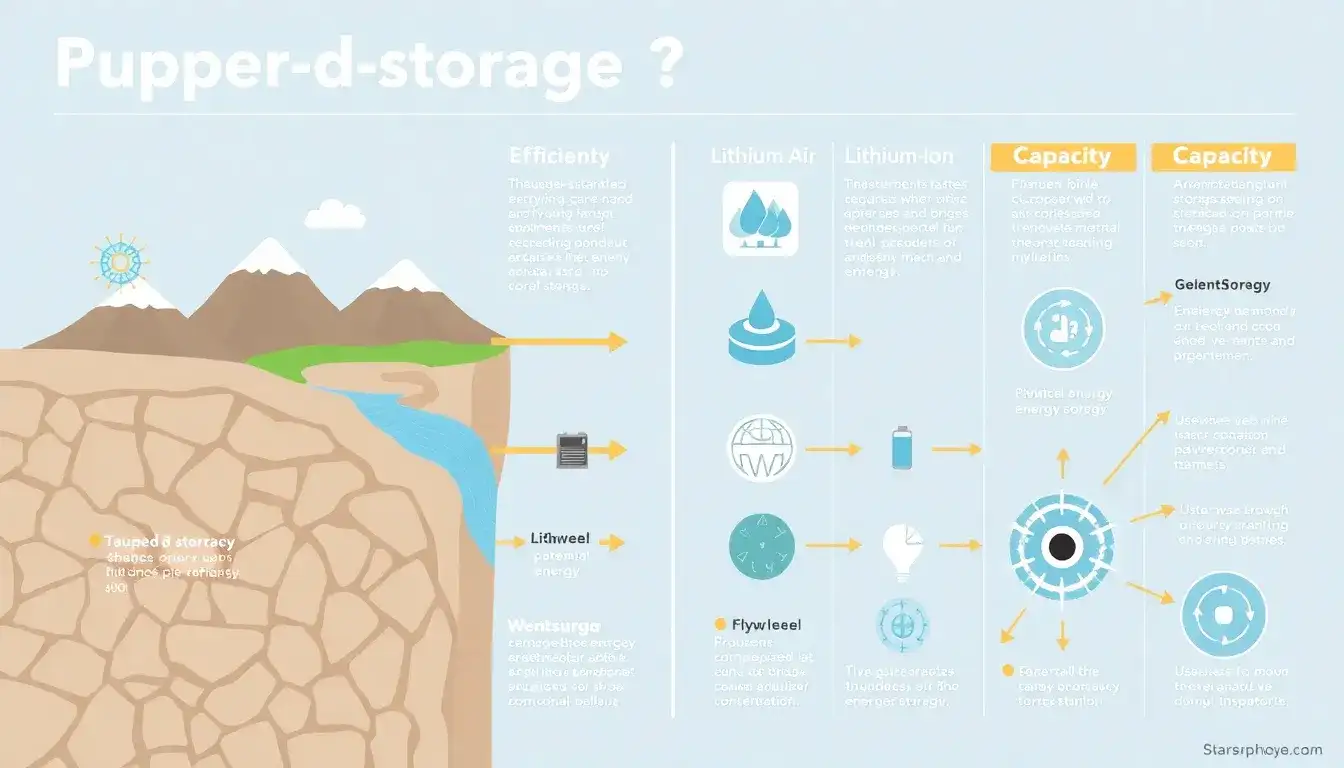
Pumped-storage hydroelectricity (PSH) is a large-scale energy storage method that offers several advantages and some limitations when compared to other energy storage technologies such as lithium-ion batteries.
Key Comparisons
1. Scale and Capacity
- PSH is the world’s largest battery technology by installed capacity, accounting for over 94% of global energy storage capacity, significantly exceeding other methods.
- It is especially cost-effective and well-suited for very large capacity storage applications (e.g., gigawatt-scale), making it ideal for grid-scale energy management.
2. Cost
- PSH tends to have lower costs per unit of energy stored compared to other storage methods, particularly at large scales. This cost advantage stems from the mature technology and long operational life of pumped storage plants.
- However, high upfront investment and long amortization periods can discourage new development, with battery storage sometimes favored for faster deployment despite potentially higher lifetime costs.
3. Efficiency
- The round-trip energy efficiency of pumped storage typically ranges between 70% and 80%, with some claims up to 87%. While this is somewhat lower than lithium-ion batteries (often around 85-95%), the difference is offset by PSH’s large capacity and longevity.
4. Environmental and Site Considerations
- PSH requires specific geographical conditions—significant elevation difference and water availability—making suitable sites limited. This can lead to ecological and social challenges in sensitive or scenic areas.
- Lithium-ion batteries and other chemical storage solutions have broader siting flexibility but entail different environmental impacts related to raw material extraction and disposal.
5. Resource Use and Environmental Impact
- PSH and battery systems differ substantially in raw material needs. PSH typically uses fewer critical raw materials during installation and operation over its lifetime compared to battery storage, which relies heavily on specific minerals.
- PSH has a comparatively lower carbon footprint over its lifetime when considering large-scale operations.
6. Application and Grid Integration
- PSH is best suited for bulk energy storage and shifting large amounts of energy over hours to days, stabilizing grids with large renewable inputs like wind and solar.
- Batteries offer advantages in rapid response and modular deployment, suitable for shorter-duration storage and distributed applications.
Summary Table
| Feature | Pumped-Storage Hydroelectricity | Lithium-Ion Battery Storage |
|---|---|---|
| Installed Capacity Share | ~94% of global energy storage | Much smaller share |
| Cost | Lower for large-scale, high upfront | Falling costs, faster deployment |
| Round-trip Efficiency | 70-80% (up to 87%) | Typically 85-95% |
| Site Requirements | Large elevation & water availability | Flexible |
| Environmental Impact | Lower lifetime raw material demand | Higher mineral extraction impact |
| Suitability | Bulk, long-duration storage | Fast response, modular, short-duration |
In conclusion, pumped-storage hydroelectricity remains the dominant technology for large-scale, long-duration energy storage due to cost-effectiveness and capacity, despite site limitations and longer development times. Other methods like lithium-ion batteries complement PSH by providing flexible, rapid-response storage for distributed and short-term grid needs.
Original article by NenPower, If reposted, please credit the source: https://nenpower.com/blog/how-does-pumped-storage-hydroelectricity-compare-to-other-energy-storage-methods/

