

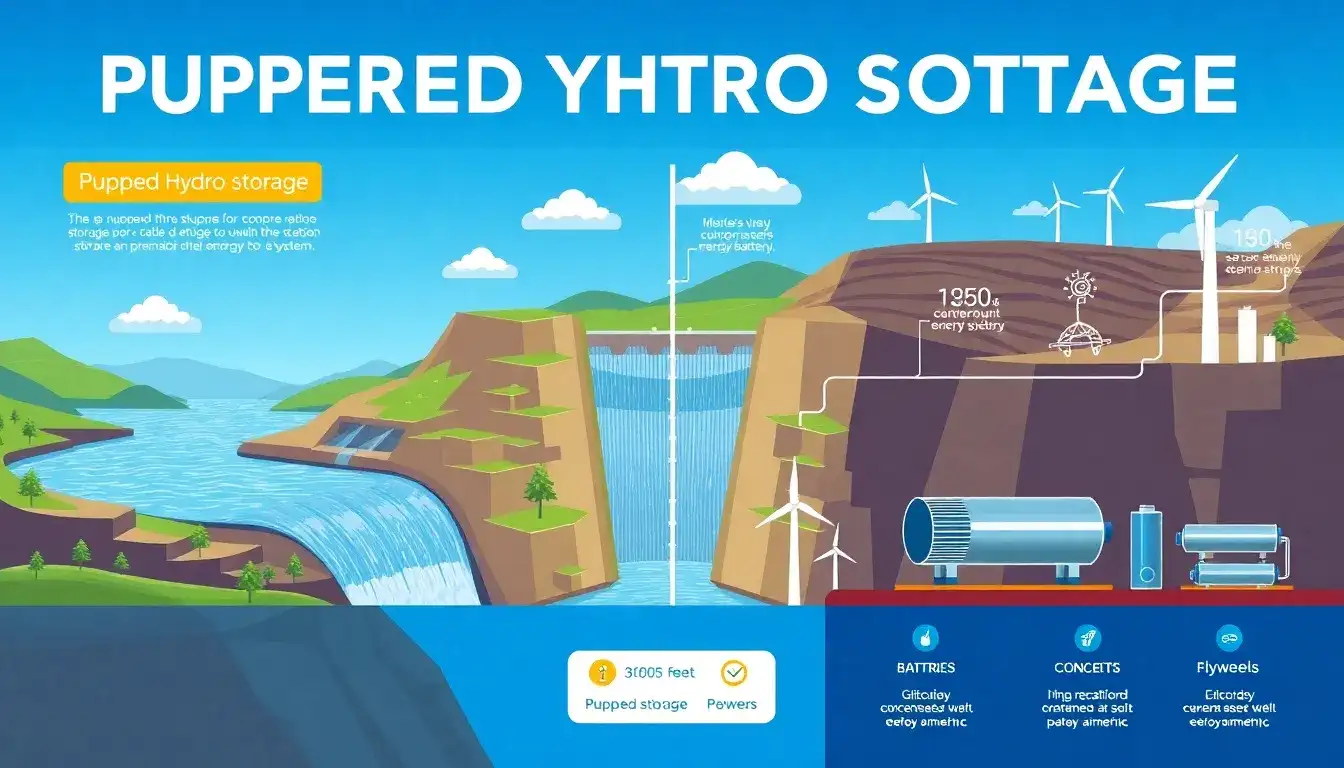
Pumped Hydroelectric Storage (PHS) Comparison
Pumped hydroelectric storage (PHS) compares to other forms of energy storage in several key aspects including cost, capacity, duration, environmental impact, and operational characteristics:
Cost and Scale
- PHS tends to be cheaper than many other energy storage technologies, particularly for very large capacity storage projects. This makes it a cost-effective option for grid-scale energy storage needs.
- While battery storage (such as lithium-ion) has become popular, studies show PHS often has lower overall costs when scaled up due to economies of scale and long operational lifespans.
Storage Capacity and Duration
- PHS is well-suited for long-duration storage and large-scale energy supply, typically allowing storage capacities in the hundreds of megawatts to gigawatt-hours range with the ability to store energy for hours to days.
- Other technologies like lithium-ion and lead-acid batteries mostly serve shorter-duration applications, typically providing storage for minutes to a few hours, making PHS more advantageous for sustained energy supply.
- Compressed-air energy storage (CAES) is another long-duration technology but compared to PHS, pumped storage emits fewer greenhouse gases and offers broader grid services.
Operational Flexibility and Grid Services
- PHS can respond rapidly to changes in electricity demand by either pumping water uphill when electricity is cheap or generating electricity by releasing water when demand is high, offering grid flexibility and resilience.
- It helps integrate variable renewable energy sources like wind and solar by storing excess production and dispatching power when renewables are not generating.
- Batteries provide fast response times and are good for short bursts of power but typically don’t match the long-duration capabilities of PHS.
Environmental and Site Considerations
- PHS infrastructure involves the use of two reservoirs at different elevations, and can be either open-loop (connected to natural water bodies) or closed-loop (reservoirs isolated from natural water).
- Potential environmental impacts from traditional open-loop systems have led to research and development into closed-loop systems which aim to reduce ecological disruption.
- While batteries have environmental concerns related to mining and disposal of materials, PHS projects require significant land and water resources which can impact local ecosystems, especially open-loop systems.
Summary Comparison Table
| Feature | Pumped Hydroelectric Storage | Lithium-ion Batteries | Compressed-Air Energy Storage (CAES) | Lead-acid and Flow Batteries |
|---|---|---|---|---|
| Cost per kWh (large scale) | Generally lower for large capacities | Higher, declining with tech advances | Moderate | Moderate to high |
| Storage duration | Long (hours to days) | Short (minutes to a few hours) | Long (hours to days) | Short to moderate |
| Power capacity | Very large (hundreds of MW to GW) | Moderate to large | Large | Moderate |
| Environmental impact | Depends on site, potential water/ecosystem effects | Material extraction/recycling issues | Moderate (GHG emissions lower than CAES) | Materials disposal issues |
| Response time | Fast | Very fast | Moderate | Fast |
| Grid services | Energy shifting, inertia, resilience | Energy shifting, frequency response | Energy shifting, inertia | Energy shifting |
In conclusion, pumped hydroelectric storage excels in providing cost-effective, large-scale, long-duration energy storage with grid stability benefits, making it essential for integrating high levels of renewable energy. However, it requires specific geographical conditions and has environmental concerns related to water and land use. Other technologies, like lithium-ion batteries, offer faster response times and siting flexibility but are better suited for shorter-duration storage and smaller scale applications.
Original article by NenPower, If reposted, please credit the source: https://nenpower.com/blog/how-does-pumped-hydroelectric-storage-compare-to-other-forms-of-energy-storage/

