

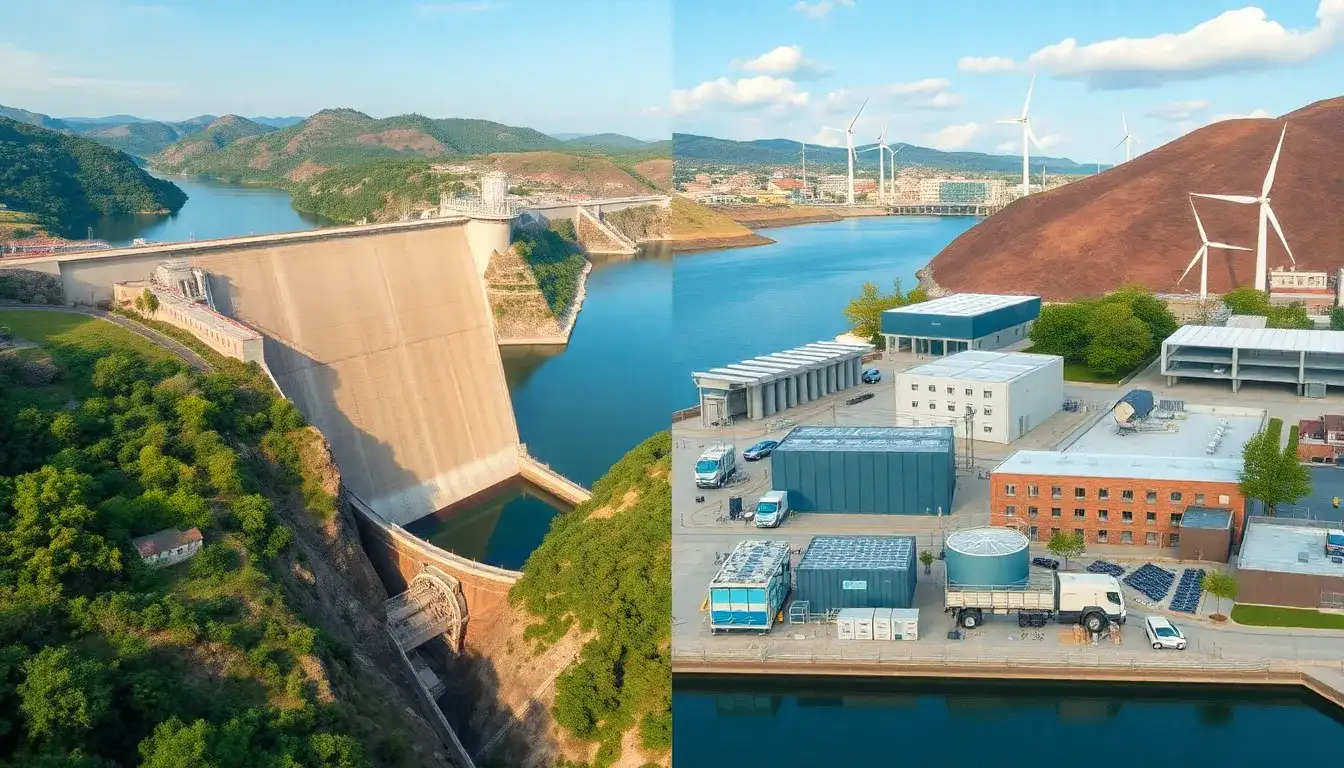
Pumped Hydroelectric Energy Storage (PHES)
Pumped hydroelectric energy storage (PHES) is the largest form of utility-scale energy storage, accounting for more than 94% of installed energy storage capacity globally. Here’s how it compares to other forms of utility-scale energy storage:
Key Features of Pumped Hydroelectric Energy Storage
- Efficiency: PHES is typically around 70% to 87% efficient in a full cycle, meaning that 70% to 87% of the energy used to pump water is recovered as electricity.
- Capacity and Duration: PHES facilities can provide electricity for extended periods, often up to 10 hours or more, making them suitable for long-duration storage.
- Suitability: Requires specific geographical conditions such as elevation differences and water availability, which can limit site selection.
- Role in Grid Management: Helps stabilize the grid by absorbing excess energy during low demand and releasing energy during high demand periods.
Comparison to Other Utility-Scale Energy Storage Technologies
Lithium-Ion Batteries (LIBs)
- Efficiency: Generally more efficient than PHES with efficiencies often near or above 90%.
- Capacity and Duration: Typically used for shorter durations of energy storage, often around 4-6 hours.
- Suitability: Can be deployed almost anywhere, providing flexibility in location choice.
Compressed Air Energy Storage (CAES)
- Efficiency: Similar to PHES but with higher greenhouse gas emissions due to heat loss during compression.
- Capacity and Duration: Designed for long-duration storage like PHES.
- Suitability: Requires underground caverns, limiting deployment locations.
Vanadium Redox Flow Batteries (VRFBs)
- Efficiency: Lower than LIBs but competitive with PHES, with long-duration capability.
- Capacity and Duration: Can store energy for several hours to days, useful for long-duration applications.
- Suitability: Offers flexibility in deployment but is less mature compared to PHES.
Lead-Acid Batteries (PbAc)
- Efficiency: Generally less efficient than other battery types, with a shorter lifespan.
- Capacity and Duration: Short-duration energy storage, used less commonly for utility-scale applications.
- Suitability: Less commonly used for large-scale storage due to environmental and efficiency concerns.
Conclusion
Pumped hydroelectric energy storage remains the dominant technology for large-scale energy storage due to its high capacity and long-duration storage capabilities. However, its geographical limitations and lower efficiency compared to some battery technologies mean that other forms of storage, like lithium-ion batteries and compressed air storage, are increasingly important for diverse energy storage needs.
Original article by NenPower, If reposted, please credit the source: https://nenpower.com/blog/how-does-pumped-hydroelectric-energy-storage-compare-to-other-forms-of-utility-scale-energy-storage/

