

Pumped Hydro Electric Energy Storage (PSH)
Pumped hydroelectric energy storage (PSH) remains a benchmark for large-scale, long-duration energy storage, though its cost-effectiveness depends on site-specific factors and competing technologies. Here’s a structured comparison:
Cost Structure
- Capital Costs: PSH requires high upfront investments (site-specific geotechnical work, dams, reservoirs), but NREL’s cost model enables precise estimation based on terrain and design. Closed-loop systems (two new reservoirs) and hybrid systems (one existing reservoir) show varying cost profiles.
- Longevity: With lifespans exceeding 50 years and low operational costs, PSH achieves cost-effectiveness over decades.
- Round-Trip Efficiency: ~70-85%, lower than batteries but comparable to compressed air energy storage (CAES).
Comparison to Other Technologies
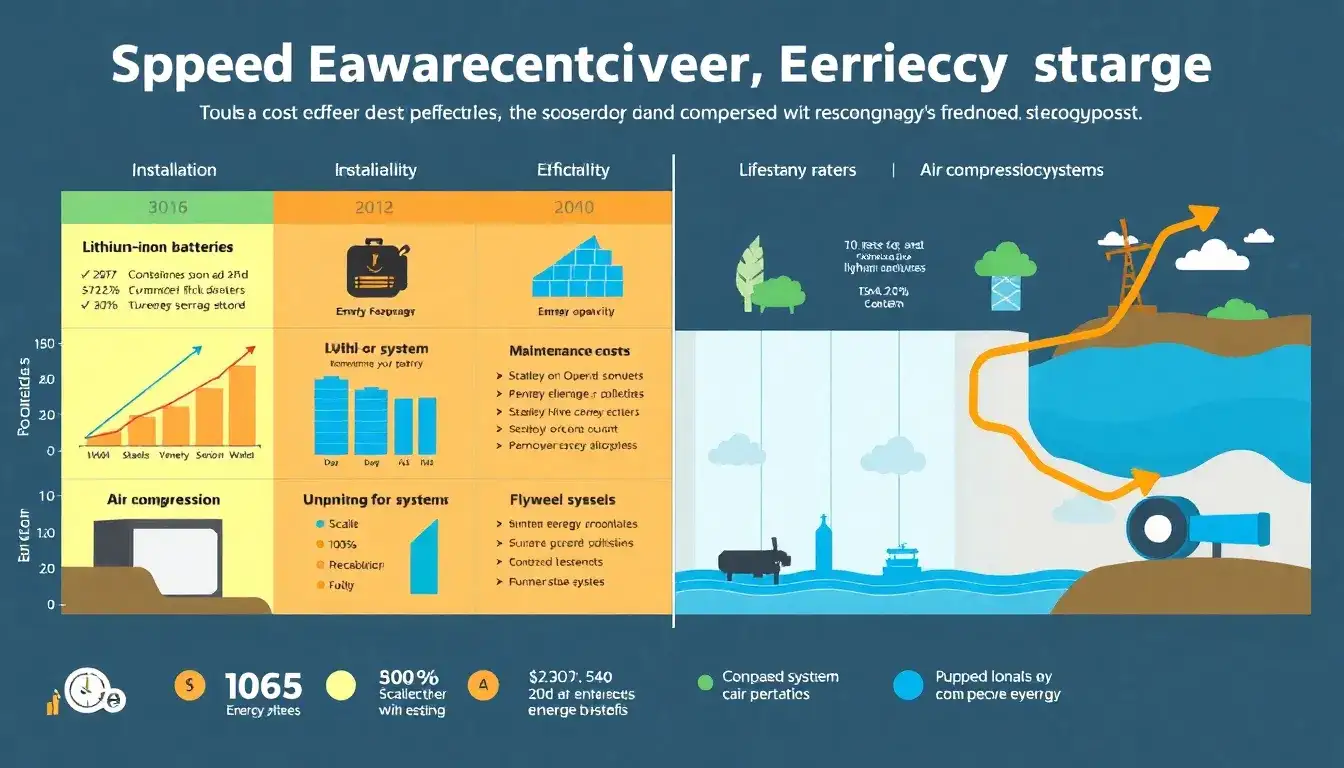
| Storage Type | Capital Cost Range | Lifespan | Efficiency | Scalability |
|---|---|---|---|---|
| Pumped Hydro | High ($1,500–$5,000/kW) | 50+ years | 70–85% | Excellent (GW-scale) |
| Battery (Li-ion) | Moderate ($800–$1,500/kWh) | 10–15 years | 85–95% | Modular (MW-scale) |
| Flow Batteries | High ($1,200–$2,500/kWh) | 20+ years | 60–75% | Moderate |
| CAES | Moderate ($500–$1,500/kW) | 30+ years | 40–70% | Large-scale |
| Hydrogen (Power-to-X) | Very high ($1,500–$3,000/kW) | 20–30 years | 25–50% | Emerging |
Key Advantages
- Grid Services: PSH provides rapid response (<5 minutes to full output) and critical inertia, outperforming most alternatives in grid stabilization.
- Sustainability: Uses water as the primary resource, avoiding rare minerals required for batteries.
- Benefit-Cost Ratio: Case studies show net benefits from avoided coal use ($1.9B) and CO₂ savings ($12B over 25 years).
Limitations
- Geographical Constraints: Requires specific elevation differences and water access, limiting universal deployment.
- Environmental Permitting: Closed-loop systems reduce ecological impact but face lengthy approval processes.
- Market Gaps: Current pricing models often fail to compensate PSH adequately for grid resilience services.
Conclusion
PSH is most cost-effective for multi-day storage in regions with suitable topography, while batteries dominate shorter durations. Hybrid systems combining PSH with faster-responding technologies may optimize cost-benefit ratios as grids decarbonize.
Original article by NenPower, If reposted, please credit the source: https://nenpower.com/blog/how-does-pumped-hydroelectric-energy-storage-compare-to-other-forms-of-energy-storage-in-terms-of-cost-effectiveness/

