

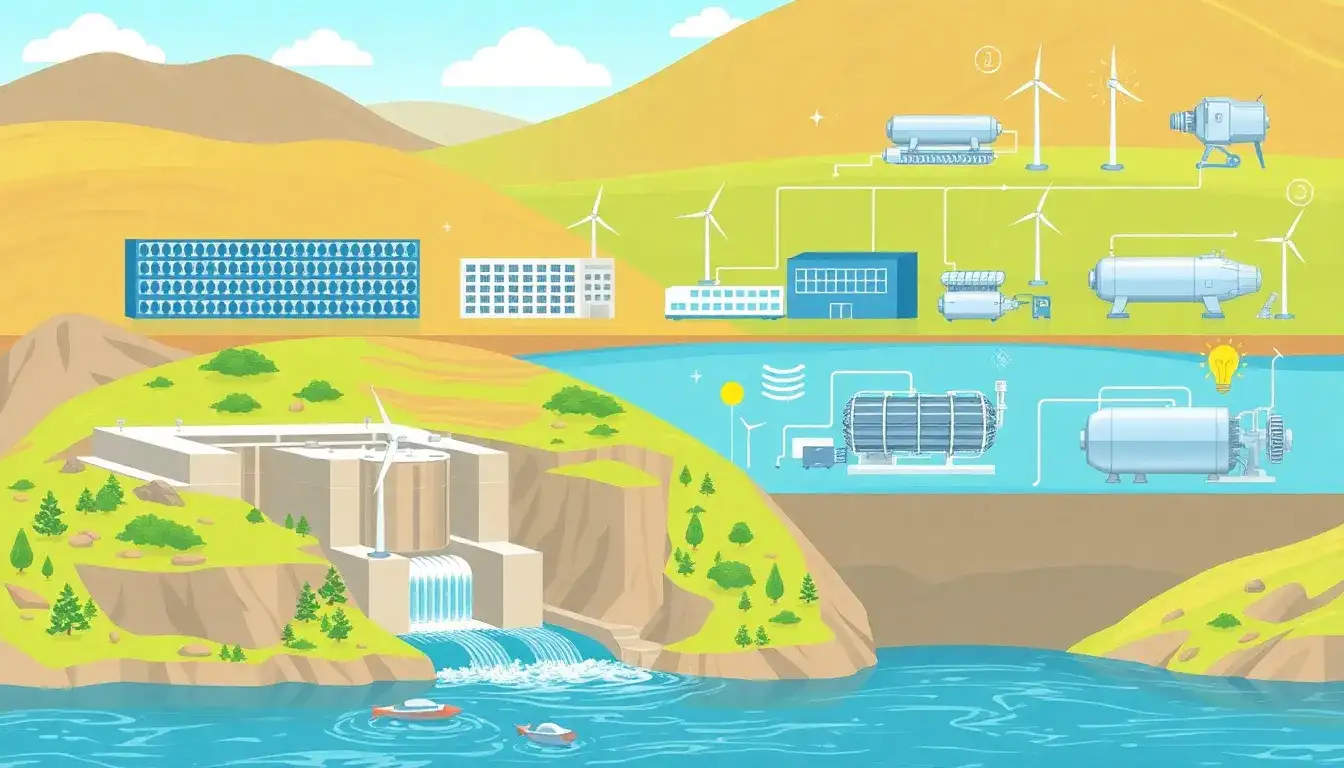
Pumped hydroelectric energy storage (PHES) is the most widely deployed and largest-capacity form of grid-scale energy storage globally, significantly ahead of other technologies like lithium-ion batteries, compressed-air energy storage (CAES), and flow batteries.
Energy Efficiency and Duration
PHES typically achieves a round-trip energy efficiency of about 70% to 80%, with some claims up to 87% and commonly more than 80% through a full cycle. In comparison, lithium-ion batteries have somewhat higher efficiency but shorter durations—PHES can provide about 10 hours of electricity storage, whereas lithium-ion batteries generally deliver around 6 hours. This makes pumped storage better suited to long-duration energy storage needs.
Storage Capacity and Scale
PHES dominates in capacity terms, accounting for over 94% of installed energy storage worldwide, with facilities often sized in the hundreds of megawatts to gigawatts range and storage capacities spanning thousands of megawatt-hours annually. Batteries, by contrast, often serve shorter-term and smaller-scale applications.
Environmental Impact and Services Provided
Pumped storage hydropower has about one-quarter of the greenhouse gas emissions compared to compressed-air energy storage systems while providing critical grid services such as grid inertia and resilience. Unlike batteries, PHES can also help stabilize the grid on a large scale.
Limitations
The main drawback of PHES lies in its site specificity: it requires suitable topography with significant elevation differences and sufficient water availability. This often limits its deployment to hilly or mountainous regions, sometimes raising social and ecological concerns.
Summary Comparison
| Feature | Pumped Hydroelectric Storage | Lithium-ion Batteries | Compressed-Air Energy Storage (CAES) | Vanadium Redox Flow Batteries (VRFBs) |
|---|---|---|---|---|
| Energy Efficiency | ~70-80% (up to 87%) | Typically high (~85-95%) | Lower than PHES | Moderate |
| Storage Duration | ~10 hours | ~6 hours | Long-duration | Typically shorter |
| Installed Capacity Share | >94% of global energy storage | Smaller scale, shorter projects | Less common, niche applications | Emerging technology |
| Environmental Impact | Low GHG emissions (low carbon) | Medium (dependent on battery chemistry) | Higher than PHES | Low |
| Grid Services Provided | Grid inertia, resilience | Primarily short-duration storage | Grid-scale storage and resilience | Flexible, but less grid inertia |
| Site Requirements | Needs elevation, water source | Flexible, can be deployed anywhere | Large underground caverns required | Flexible |
| Scale Suitability | Bulk energy storage | Distributed and smaller scale | Bulk storage | Medium-scale |
In conclusion, pumped hydroelectric energy storage stands out for large-scale, long-duration energy storage with proven reliability and low emissions but is constrained by geographic and environmental considerations. Other technologies like lithium-ion batteries are more flexible in siting and better for shorter-duration storage, while CAES and flow batteries offer additional options with different trade-offs.
Original article by NenPower, If reposted, please credit the source: https://nenpower.com/blog/how-does-pumped-hydroelectric-energy-storage-compare-to-other-forms-of-energy-storage/

