

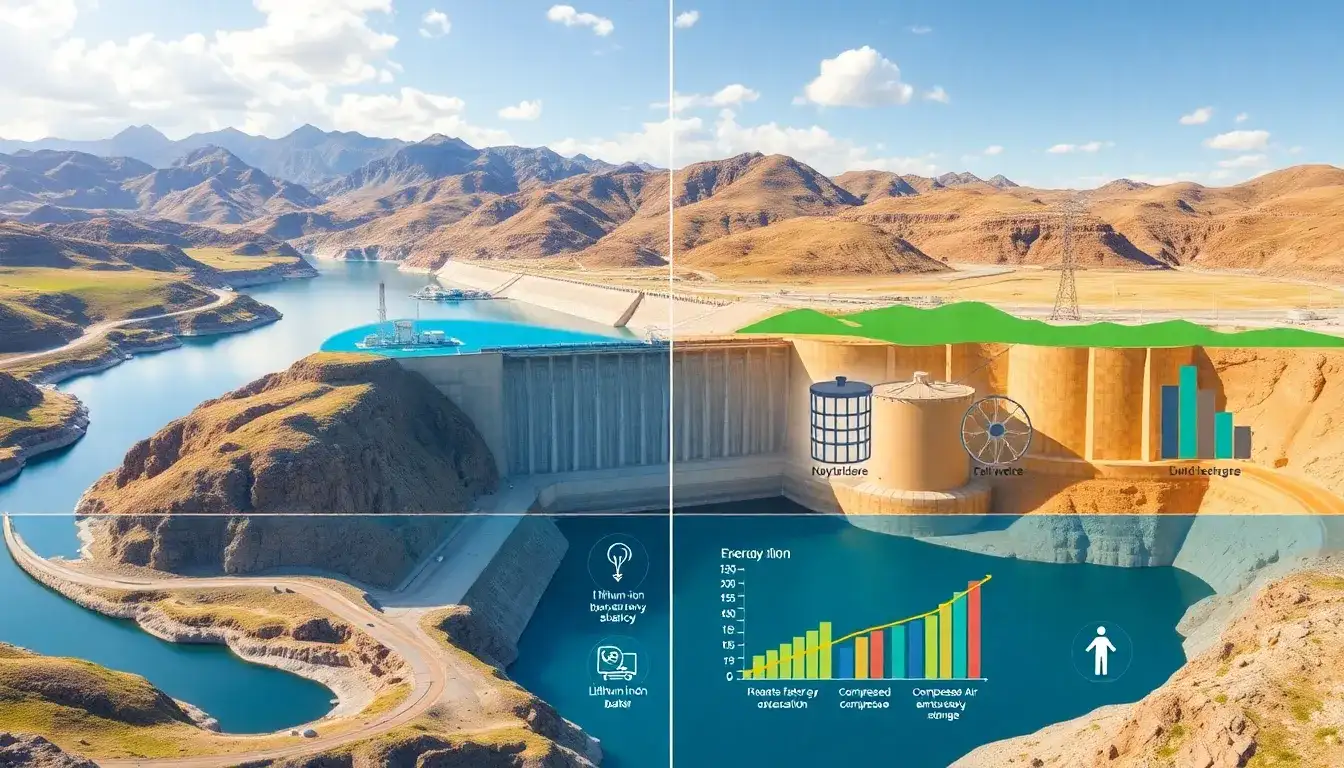
Pumped hydroelectric energy storage (PHES) compares to other energy storage technologies in several key dimensions: capacity scale, cost, efficiency, environmental impact, and practical constraints.
Capacity and Scale
- PHES is the largest form of grid energy storage worldwide, accounting for over 94% of installed energy storage capacity, far exceeding other technologies like batteries and compressed-air energy storage (CAES). It offers bulk energy storage on the order of gigawatts and gigawatt-hours, making it ideal for large-scale grid applications.
Cost and Economics
- For very large capacity storage, PHES tends to be cheaper than alternatives, especially lithium-ion batteries, when considering lifetime investment costs and specific raw material costs. However, the initial investment cost is high, with long amortization periods, which can discourage new developments.
Efficiency
- The round-trip energy efficiency of PHES varies between 70% and 80%, with some claims of up to 87%. This is competitive with battery technologies, which typically have high efficiencies but limited duration and capacity for grid-scale storage.
Environmental Impact
- Closed-loop pumped storage systems have among the lowest global warming potential compared to other large-scale storage technologies like CAES, lithium-ion, lead-acid, and vanadium redox flow batteries. PHES uses water cycling between reservoirs, minimizing ongoing emissions once built.
Practical Constraints
- PHES requires specific geographical features: sufficient height differences between two reservoirs and water availability, often limiting suitable sites to hilly or mountainous regions. This can lead to social and ecological challenges due to environmental sensitivity and land use concerns.
Comparison Summary
| Feature | Pumped Hydroelectric Storage | Lithium-Ion Batteries | Compressed Air Energy Storage (CAES) | Other Flow Batteries (e.g., Vanadium) |
|---|---|---|---|---|
| Capacity Scale | Very large (GW, GWh scale) | Smaller scale, modular | Large scale | Medium scale |
| Cost (Lifetime) | Lower for large capacity, high initial | Falling costs but higher raw material | Moderate cost but higher emissions | Higher cost, complex |
| Efficiency | 70-80% (some up to 87%) | ~85-95% | ~70% | ~75-85% |
| Environmental Impact | Lowest GHG emissions among large-scale | Moderate, depends on materials and recycling | Higher GHG emissions | Moderate |
| Site Requirements | Requires specific geography (height, water) | Flexible site, urban compatible | Requires specific geology | Flexible |
| Lifespan | Long (decades) | Shorter (5-15 years) | Long | Medium to long |
In summary, PHES remains the dominant and cost-effective technology for large-scale, long-duration energy storage, particularly suited for grid stability and integration of renewables like solar and wind. While lithium-ion batteries are rapidly dropping in cost and better for shorter duration and distributed applications, PHES is more efficient and sustainable for bulk energy storage where suitable sites exist. Other technologies like CAES and flow batteries fill intermediate niches but generally do not match PHES in scale or environmental performance.
Original article by NenPower, If reposted, please credit the source: https://nenpower.com/blog/how-does-pumped-hydroelectric-energy-storage-compare-to-other-energy-storage-technologies/

