

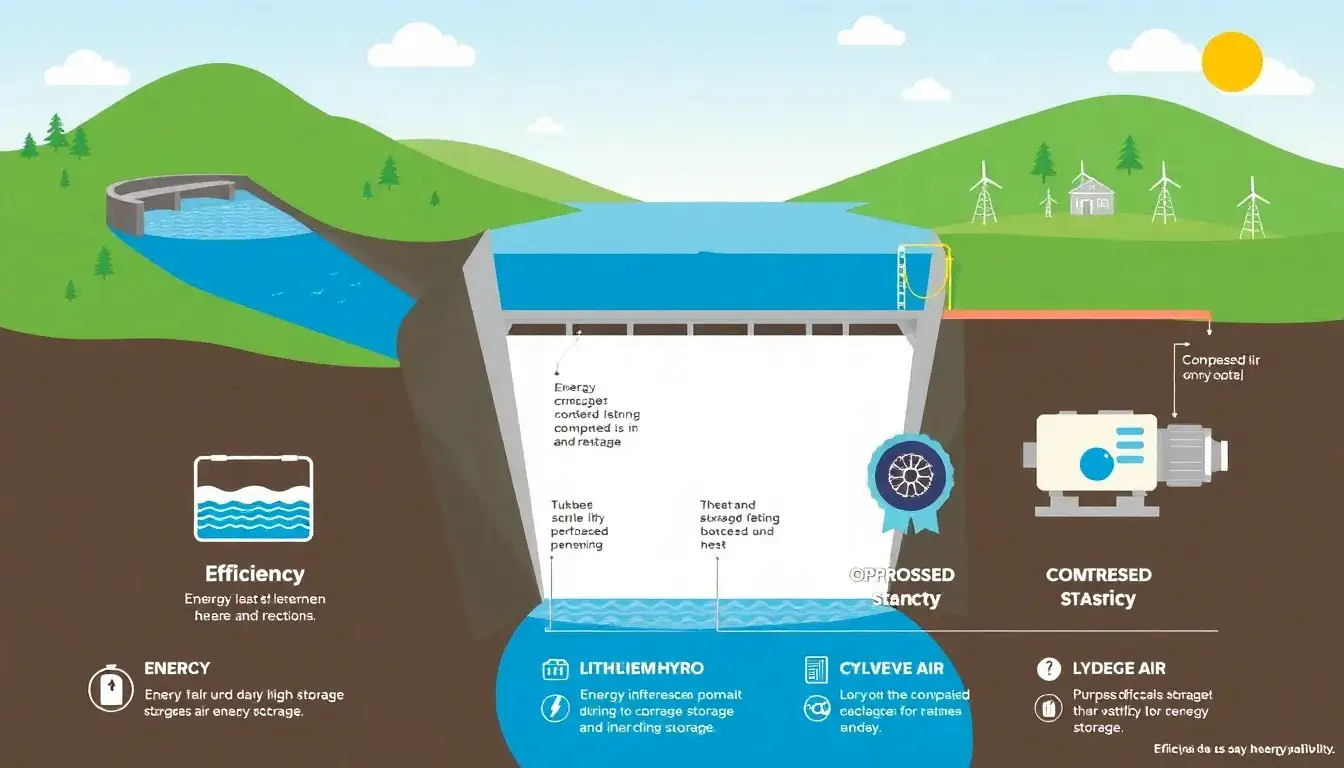
Efficiency of Pumped Hydro Storage
- Round-Trip Efficiency: Pumped hydro storage typically achieves a round-trip efficiency of 75% to 80%. This means that for every unit of energy used to pump water, approximately 0.75 to 0.8 units are recovered when the water is allowed to flow back through the turbines.
- Longevity and Reliability: PHS facilities have very long lifetimes, often lasting 50 to 100 years with minimal degradation, making them highly reliable over time.
Comparison with Other Energy Storage Technologies
| Technology | Round-Trip Efficiency | Lifespan and Reliability |
|---|---|---|
| Pumped Hydro Storage (PHS) | 75% to 80% | 50 to 100 years, reliable |
| Lithium-Ion Batteries | 90% to 95% | 10 to 15 years, degrades over time |
| Compressed Air Energy Storage | 60% to 65% | Technically challenging |
| Flow Batteries | As low as 70% | Varies depending on design |
| Hydrogen Storage | 40% to 60% | Complex, varies depending on method |
Advantages of Pumped Hydro Storage
- Scalability: PHS is highly scalable and can store large amounts of energy.
- Sustainability: It uses a renewable resource (water) and can support the integration of other renewables like wind and solar into the grid.
- Independence: PSH can operate independently of the traditional power grid, providing backup during outages.
Despite its high efficiency and reliability, PHS is geographically limited and requires specific terrain (e.g., reservoirs), which can hinder its widespread implementation. In contrast, while lithium-ion batteries are highly efficient, they are less scalable for grid-scale applications compared to PHS and may degrade over time.
Original article by NenPower, If reposted, please credit the source: https://nenpower.com/blog/how-does-pumped-hydro-storage-compare-to-other-energy-storage-technologies-in-terms-of-efficiency/

