

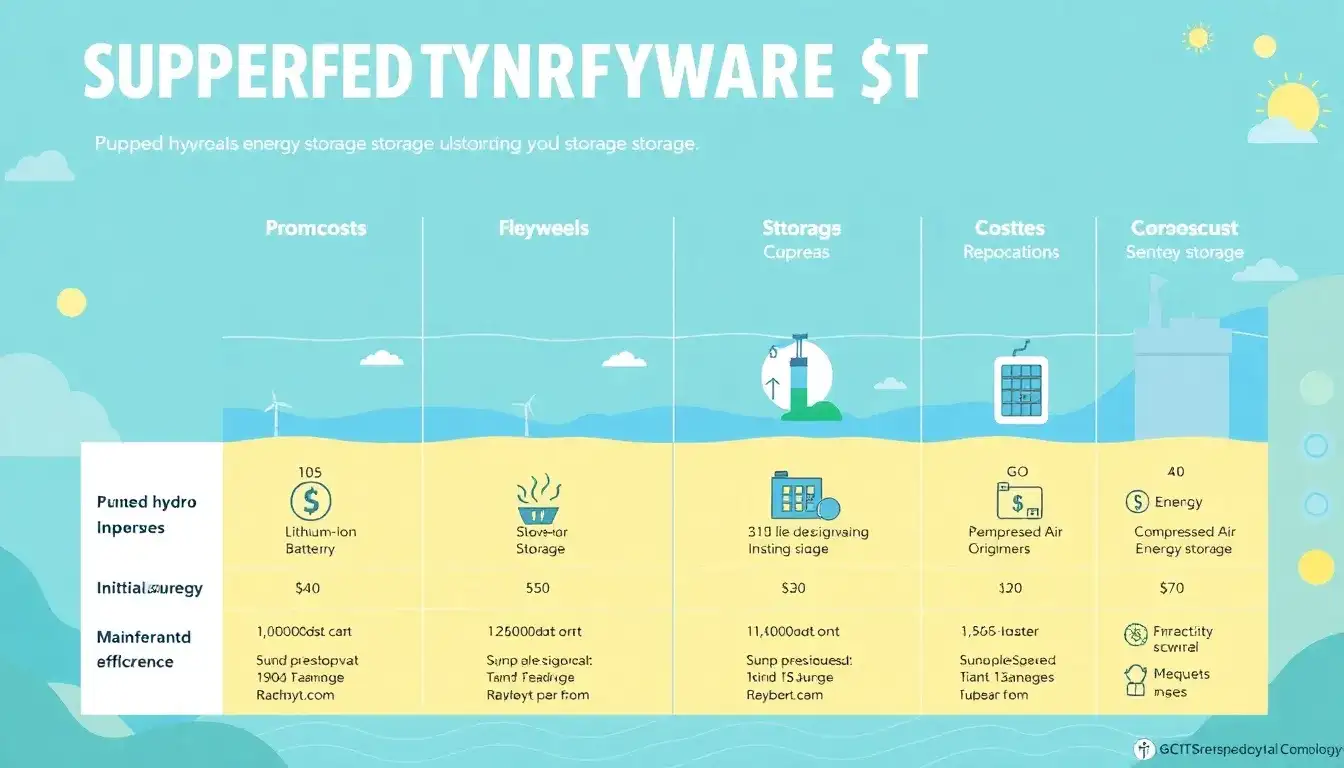
Cost Structure and Scale
- Capital costs: PSH has high upfront costs due to geological requirements and large infrastructure (dams, turbines, reservoirs), but achieves economies of scale for capacities exceeding 1,000 MW.
- Operating costs: Extremely low at ~0.002 EUR/kWh due to minimal maintenance and long asset lifetimes (50+ years).
- Efficiency: Modern systems achieve ~85% round-trip efficiency, comparable to lithium-ion batteries (85–90%) but lower than flywheels (90–95%).
Comparison to Other Technologies
| Technology | Capital Cost (USD/kWh) | Cycle Life | Efficiency | Scalability | Best Use Case |
|---|---|---|---|---|---|
| Pumped Hydro | $150–200 (large-scale) | 30,000+ cycles | 75–85% | High (GW+) | Long-duration grid storage |
| Lithium-Ion | $200–400 | 5,000 cycles | 85–90% | Medium | Short-term frequency regulation |
| Flow Batteries | $300–800 | 10,000 cycles | 70–80% | Medium | 4–12 hour storage |
| Compressed Air | $100–150 | 20,000 cycles | 40–70% | High | Large-scale storage |
| Green Hydrogen | $5–15 (storage only) | N/A | 30–50% | High | Seasonal storage |
Key Cost-Effectiveness Factors
- Energy arbitrage profitability: PSH requires significant price spreads to break even (e.g., 0.1 EUR/kWh pumping vs. 0.118–0.12 EUR/kWh generation), making it highly sensitive to electricity markets.
- Project lifetime: PSH’s 50-year lifespan spreads costs over decades, while lithium-ion typically lasts 10–15 years.
- Environmental costs: Closed-loop PSH (new reservoirs) has higher capital costs than systems using existing water bodies but lower permitting risks.
Niche Advantages
- Duration: PSH delivers 8+ hours of storage, outperforming lithium-ion (4–8 hours) and flow batteries (6–12 hours).
- Grid stability: Provides inertia and black-start capabilities absent in battery systems.
Cost Modeling Tools
NREL’s open-source PSH cost model and DOE’s valuation guidebook enable site-specific assessments, highlighting PSH’s competitiveness in regions with suitable topography and volatile electricity prices.
Conclusion
PSH remains the most cost-effective solution for multi-day energy storage at grid scale, but lithium-ion dominates shorter-duration applications due to modularity and faster deployment. Emerging technologies like green hydrogen could challenge PSH for seasonal storage but currently face lower efficiency.
Original article by NenPower, If reposted, please credit the source: https://nenpower.com/blog/how-does-pumped-hydro-storage-compare-to-other-energy-storage-technologies-in-terms-of-cost-effectiveness/

