

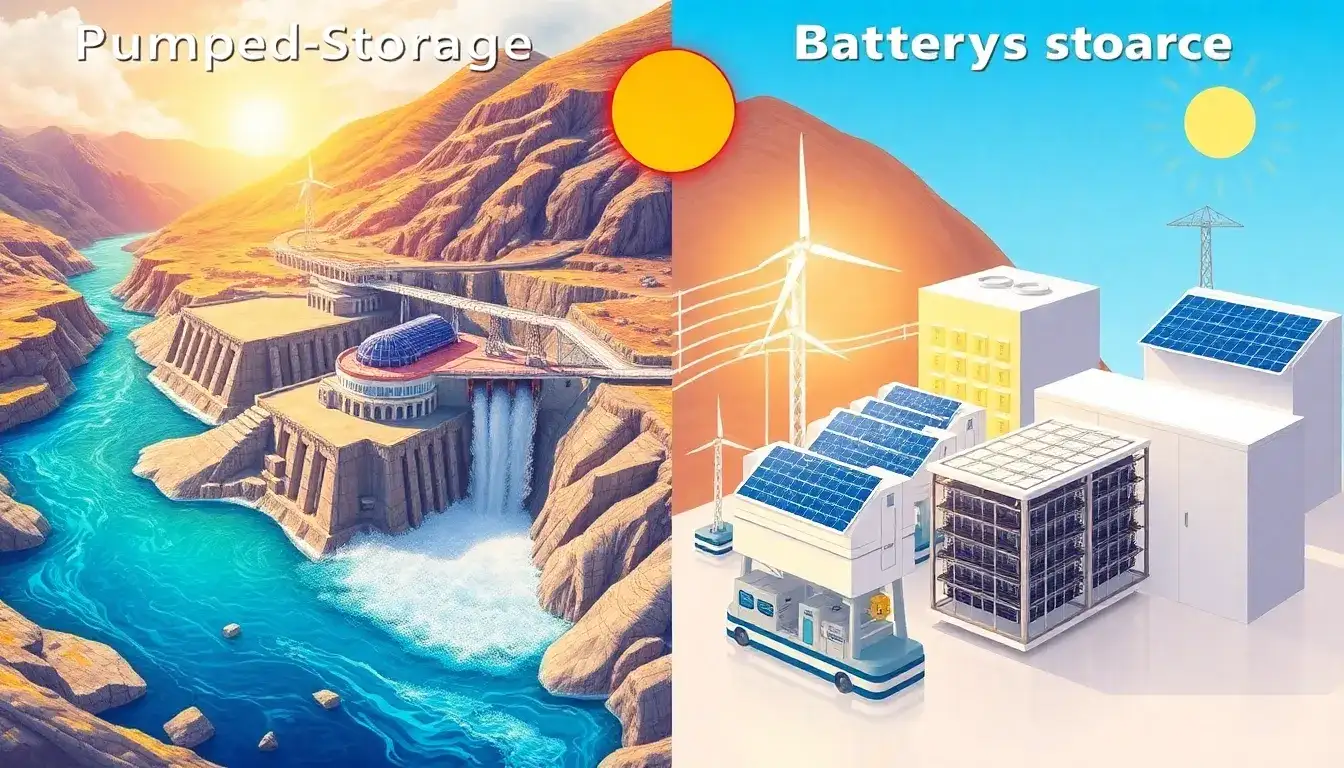
Pumped hydro storage (PHS) and battery storage are two leading technologies for storing solar energy, each with distinct characteristics regarding efficiency, capacity, cost, and operational aspects.
Efficiency and Storage Duration
- Pumped hydro storage is about 80% energy efficient over a full charge-discharge cycle, slightly lower than the typical round-trip efficiency of lithium-ion batteries but still very competitive.
- PHS generally provides longer-duration storage, typically 6 to 10 hours of electricity supply, whereas lithium-ion batteries commonly offer 2-6 hours, although battery durations are gradually increasing with technology improvements.
Capacity and Usage
- Pumped storage is currently the world’s largest form of energy storage by capacity, making up over 94% of installed storage capacity worldwide. It is well-suited for large-scale, long-duration energy storage needs.
- Batteries excel at rapid charging and discharging and provide flexibility for shorter duration services, with growing deployment especially in utility-scale applications paired with solar and wind.
Cost and Economics
- Pumped hydro projects tend to have higher upfront capital costs and face significant execution challenges due to the requirement for suitable geography (water reservoirs at different elevations) and longer development timelines.
- Batteries generally have higher upfront costs per unit of capacity but lower operational costs per kilowatt-hour. Battery costs have been declining rapidly, contributing to faster deployment and scalability.
Operational Factors
- PHS facilities often operate at utilization factors twice that of batteries due to their ability to provide sustained output over longer periods, making them favorable for grid-scale balancing and peak load management.
- Batteries offer fast response times and versatility, making them ideal for grid frequency regulation, peak shaving, and short-term energy shifting, complementing solar energy intermittency.
Summary Comparison
| Feature | Pumped Hydro Storage | Battery Storage (Lithium-ion) |
|---|---|---|
| Round-trip Efficiency | ~80% | Slightly higher than PHS |
| Typical Storage Duration | 6 to 10 hours | 2 to 6 hours (trending upward) |
| Installed Capacity Share | >94% of global energy storage capacity | Growing rapidly, significant but smaller share |
| Upfront Cost | High, with site-specific challenges | Generally higher cost per kW but falling |
| Operational Cost | Lower per kWh after installation | Higher per kWh but decreasing |
| Scalability | Limited by geography and construction time | Highly scalable, fast deployment |
| Use Case | Long-duration grid support, peak load | Fast response, short to medium duration storage |
In conclusion, pumped hydro storage is better suited for large-scale, long-duration energy storage with established reliability and cost-effectiveness over decades, while battery storage offers more flexibility, faster deployment, and better suitability for shorter-duration and rapid-response applications in solar energy integration. The optimal choice depends on geographic, economic, and grid-specific factors.
Original article by NenPower, If reposted, please credit the source: https://nenpower.com/blog/how-does-pumped-hydro-storage-compare-to-battery-storage-for-solar-energy/

