

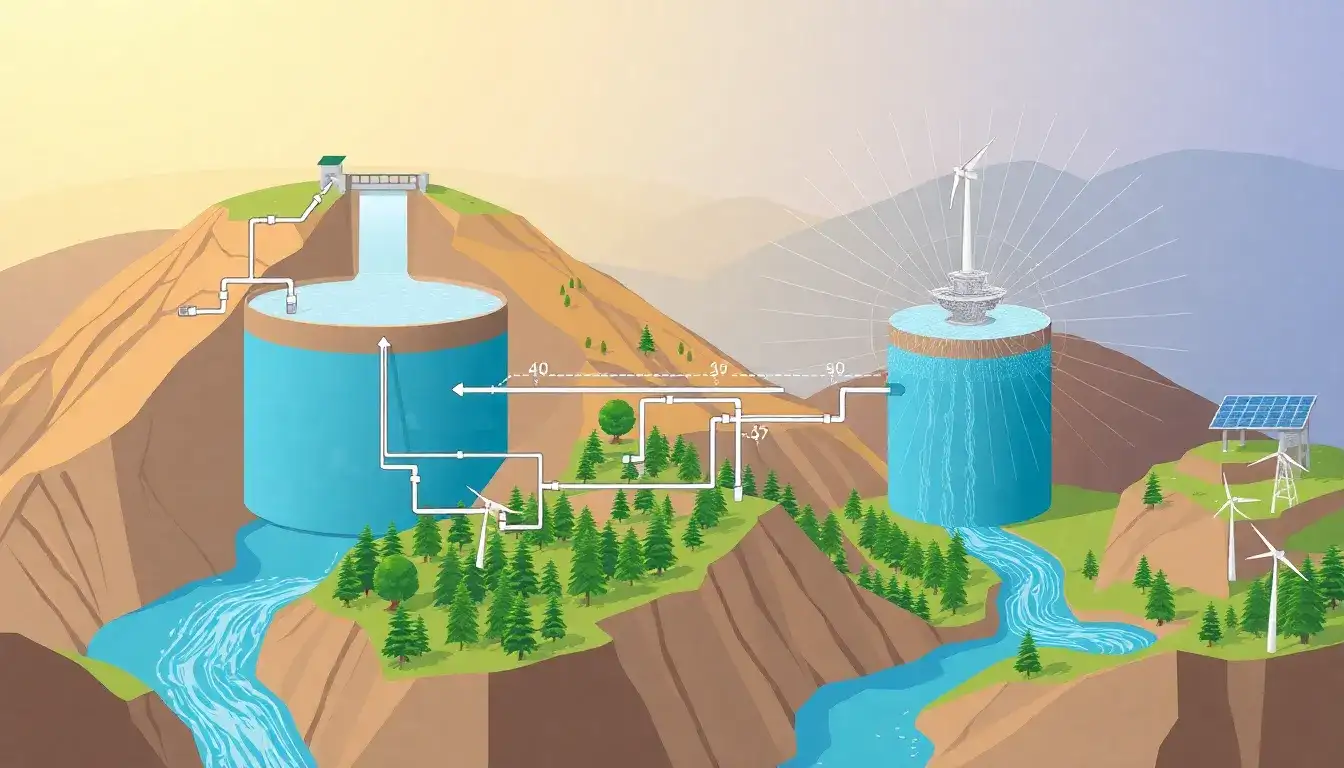
Pumped hydro energy storage (PHES) works by moving water between two reservoirs located at different elevations to store and generate electricity. The basic principle involves converting electrical energy into gravitational potential energy and then back into electrical energy as needed.
Here is how the process works in detail:
- Charging (storing energy): When there is excess electricity on the grid, typically during periods of low demand or high renewable generation like wind or solar, this surplus energy is used to pump water from the lower reservoir to the upper reservoir. This step consumes electricity and stores energy in the form of elevated water. Reversible turbines function as pumps during this phase.
- Discharging (generating electricity): When electricity demand is high, water from the upper reservoir is released back down through turbines, which spin generators to produce electricity. The water then flows into the lower reservoir. This step converts the stored gravitational potential energy back into electrical energy.
- Repeatable cycle: The same water can be used repeatedly, pumped back and forth between reservoirs to store and release energy as needed, much like a large rechargeable battery.
Key components include two reservoirs at different heights, reversible turbine-generators that can operate as both pumps and turbines, and conduits connecting the reservoirs. This system provides grid flexibility and helps balance supply and demand, offering long-duration energy storage capabilities which are crucial for integrating variable renewable energy sources.
Pumped hydro plants currently make up about 96% of utility-scale energy storage capacity in the U.S. and are widely used globally because they can respond quickly and provide ancillary grid services such as frequency regulation and inertia support.
In short, pumped hydro energy storage captures excess electrical energy by pumping water uphill and later releases this stored energy by letting the water flow back downhill through turbines to generate electricity when it is needed most.
Original article by NenPower, If reposted, please credit the source: https://nenpower.com/blog/how-does-pumped-hydro-energy-storage-work/

