

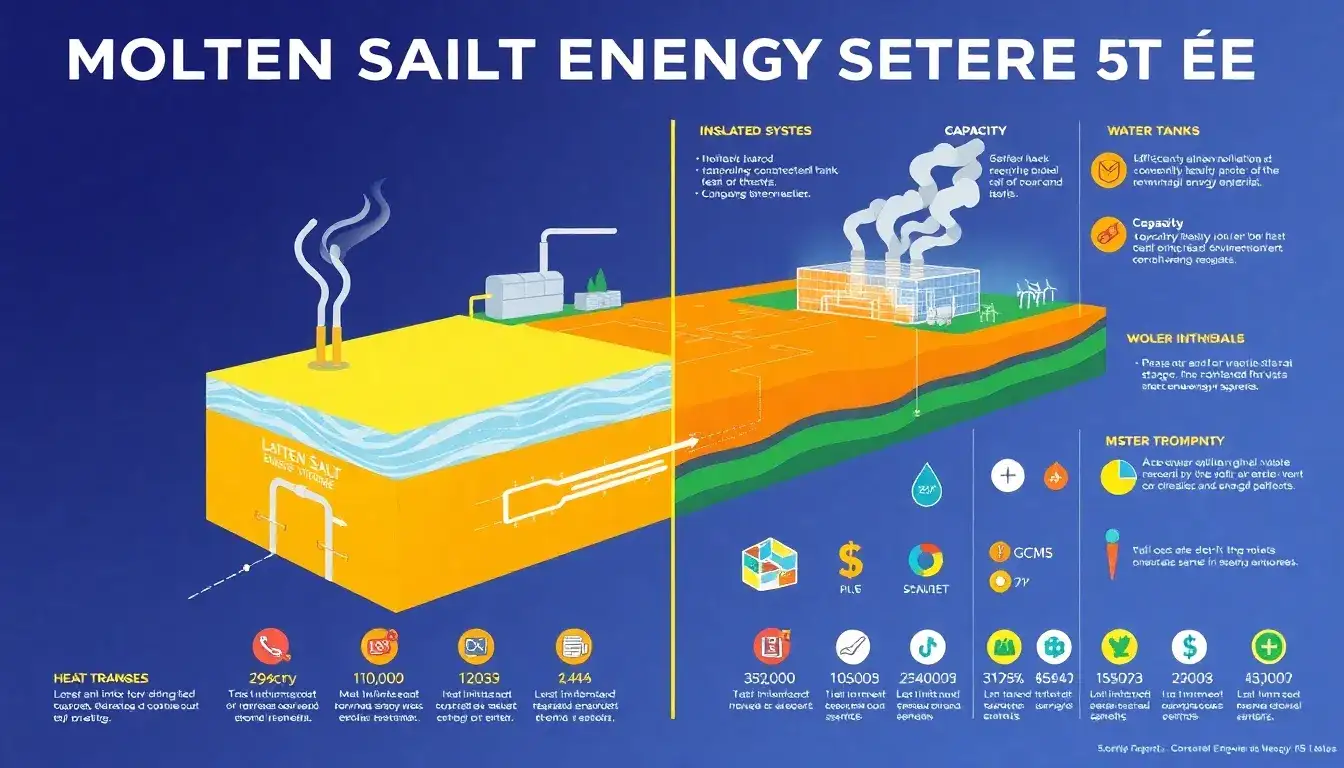
Molten Salt Energy Storage
- Advantages:
- High Energy Density: Molten salt systems can store a large amount of energy per volume, making them efficient for large-scale applications.
- Long Thermal Stability: They maintain heat well over time, which is beneficial for smooth power output.
- Cost-Effectiveness: Compared to lithium-ion batteries, molten salt storage is significantly cheaper, with costs ranging from 15 to 25 EUR/kWh.
- Good Storage Efficiency: The efficiency of molten salt storage systems is high, typically between 90% and 99%.
- Disadvantages:
- High Operating Costs and Maintenance Needs: While cheaper than batteries for storage, molten salt systems require significant maintenance and can be more expensive to operate due to high temperatures (150 to 560 °C).
- Complexity: Handling high temperatures and ensuring proper handling of molten salts can be challenging.
Liquid Air Energy Storage (LAES)
- Advantages:
- High Energy Density: Similar to molten salt, LAES has a high energy density, making it suitable for urban environments.
- Low Environmental Impact: LAES is considered environmentally friendly as it uses a non-toxic medium.
- Disadvantages:
- Low Efficiency: Compared to other methods, LAES suffers from lower efficiency, reducing its overall effectiveness.
Liquid Nitrogen Engine (LNE)
- Advantages:
- High Efficiency: LNE systems are highly efficient for energy storage and recovery.
- Low-Power Applications: Suitable for small-scale or low-power applications.
- Disadvantages:
- Limited Scalability: LNE systems require high-pressure storage, which limits their use for large-scale energy storage.
- Specialized Use: They are best suited for low-power applications due to their operational constraints.
Comparison Summary
| Technology | Molten Salt | LAES | LNE |
|---|---|---|---|
| Energy Density | High | High | Medium |
| Cost | Low compared to batteries | Varied (dependent on specific implementations) | Moderate (high-pressure tank required) |
| Efficiency | High (90-99%) | Low | High |
| Scalability | Suitable for large-scale applications | Suitable for urban environments | Limited to low-power applications |
| Environmental Impact | Moderate (due to material handling and high temps) | Low | Medium (due to energy consumption) |
| Operating Conditions | High temperatures (150-560 °C) | Requires air liquefaction | Requires high-pressure storage tanks |
Each technology has its strengths and weaknesses, making the choice dependent on the specific application and requirements of the energy storage system. Molten salt is favored for large-scale applications due to its high energy density and cost-effectiveness, while LAES is suitable for urban environments due to its low environmental impact. LNE is best for low-power applications where high efficiency is crucial.
Original article by NenPower, If reposted, please credit the source: https://nenpower.com/blog/how-does-molten-salt-energy-storage-compare-to-other-thermal-energy-storage-methods/

