

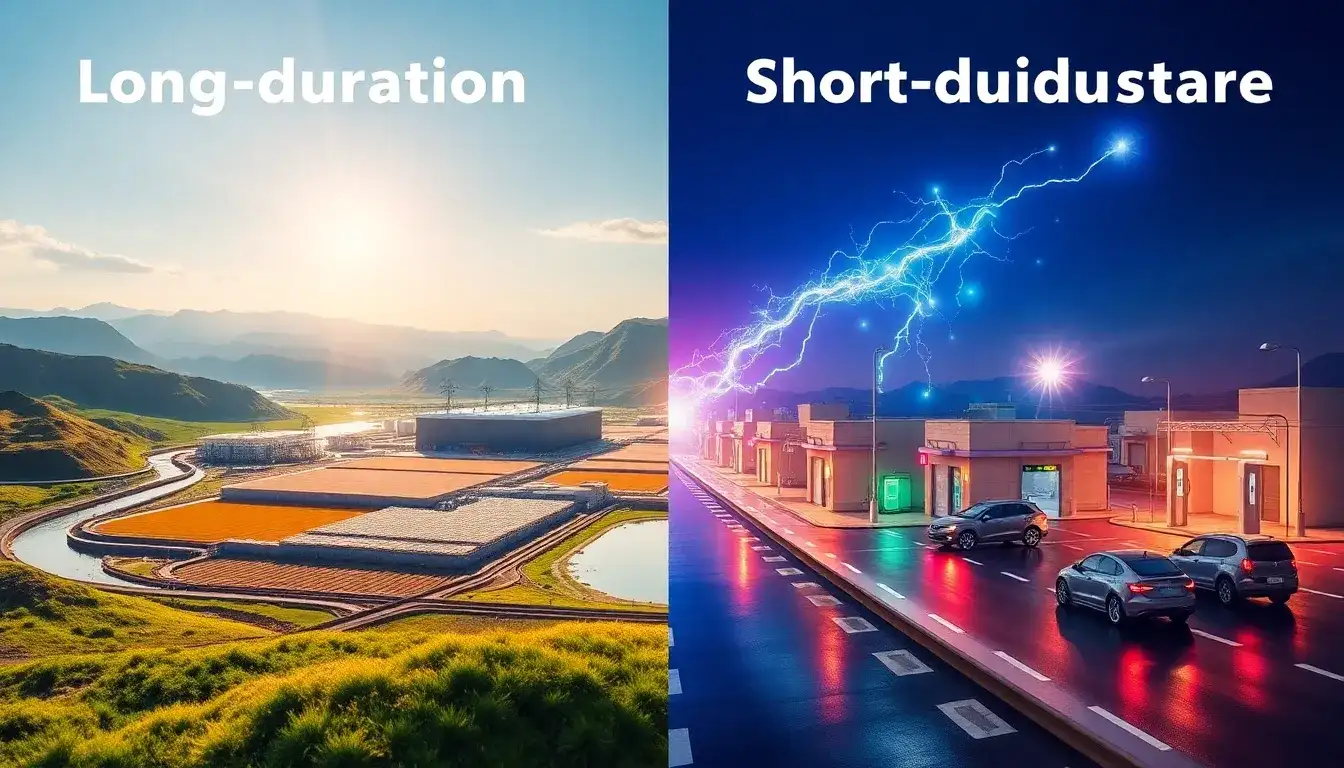
Long-duration energy storage (LDES) differs from short-duration energy storage (SDES) primarily in terms of the duration for which they can store and supply energy, as well as their applications and technological requirements.
Key Differences Between Long-Duration and Short-Duration Energy Storage
- Duration:
- Short-Duration Energy Storage (SDES): Provides energy for a few milliseconds up to four hours. Technologies like lithium-ion batteries, capacitors, and supercapacitors are often used for these applications.
- Long-Duration Energy Storage (LDES): Stores and supplies energy for longer periods, typically over four hours up to several days or weeks. Technologies such as pumped hydro storage, compressed air energy storage, and hydrogen storage systems are common in this category.
- Application:
- SDES: Often used for power quality improvement, frequency regulation, and short-term grid stability. It is ideal for smoothing the variability in renewable energy sources over short periods.
- LDES: Suitable for load shifting (e.g., storing electricity during off-peak hours and releasing it during peak demand), seasonal energy storage, and providing extended backup power during prolonged outages.
- Technologies:
- SDES: Technologies like lithium-ion batteries, flywheels, supercapacitors, and pumped hydro (for smaller scale applications) are prevalent. However, solar-to-hydrogen and lead-acid batteries may not be as suitable due to efficiency and durability issues.
- LDES: Technologies include large-scale pumped hydro, compressed air energy storage (CAES), hydrogen fuel cells, and emerging technologies like gravity-based storage. These systems can store energy over longer periods and are more suited for balancing seasonal energy demands.
- Cost and Efficiency:
- SDES: Generally has higher round-trip efficiency (e.g., lithium-ion batteries around 90-95%) and is cost-effective for short-term cycling. However, options like flywheels have high energy leakage over time.
- LDES: Often involves lower round-trip efficiency compared to SDES due to the complexities of storing energy over longer durations. Pumped hydro, for instance, has a lower efficiency compared to lithium-ion but offers large-scale storage capacity.
In summary, while both types of energy storage are crucial for grid stability and renewable integration, long-duration energy storage provides a solution for extending energy supply over more extended periods, typically involving larger and more complex systems.
Original article by NenPower, If reposted, please credit the source: https://nenpower.com/blog/how-does-long-duration-energy-storage-differ-from-short-duration-storage/

