

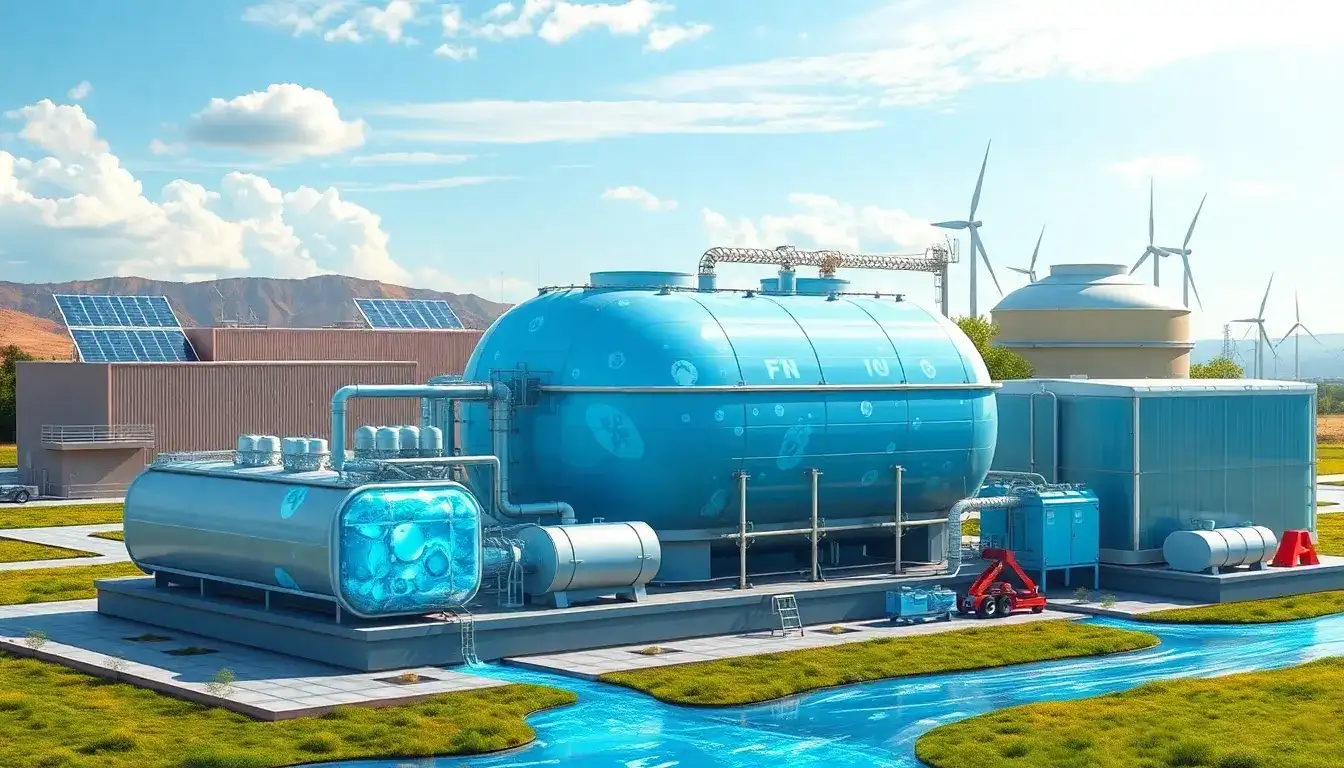
Liquid Air Energy Storage (LAES) offers distinct advantages and some trade-offs compared to other long-duration energy storage solutions such as Compressed Air Energy Storage (CAES), pumped hydro storage (PHS), and lithium-ion batteries.
How LAES Works
LAES stores energy by compressing and cooling air to a liquid state at cryogenic temperatures, thus storing thermal energy in liquid air. When energy is needed, the liquid air is pumped, reheated, and expanded through turbines to generate electricity.
Comparison with Other Long-Duration Storage Technologies
| Feature | Liquid Air Energy Storage (LAES) | Compressed Air Energy Storage (CAES) | Pumped Hydro Storage (PHS) | Lithium-ion Batteries |
|---|---|---|---|---|
| Energy Density & Space | Higher energy density; smaller size (about an order of magnitude smaller footprint than CAES and PHS) due to cryogenic storage. | Lower energy density; requires large underground or surface storage volume. | Requires large geographic and elevation differences, large reservoirs. | Very high energy density, very compact and modular. |
| Round-Trip Efficiency | Typically lower round-trip efficiency compared to CAES and batteries. | Generally higher round-trip efficiency than LAES. | Moderate to high efficiency. | High efficiency (often above 85%). |
| Cost | Levelized cost of storage (LCOS) about $60/MWh, approximately one-third the cost of lithium-ion batteries and about half that of pumped hydro. | Variable but generally competitive with LAES, depends on site conditions. | High capital cost; LCOS tends to be higher than LAES. | Higher LCOS relative to LAES for long-duration storage. |
| Geographical Constraints | Minimal geographical constraints; compact storage allows deployment without large reservoirs or underground caverns. | Requires suitable underground caverns or reservoirs. | Requires specific geography (mountains, waterways). | Can be installed almost anywhere; modular. |
| Scalability & Duration | Suitable for long-duration storage and large scales without site limitations; potential for hybrid applications using the cold byproduct. | Also suitable for long durations but limited by cavern size. | Large scale long-duration storage but restricted by sites. | Scalable but cost and material constraints for very large, long-duration uses. |
| Additional Benefits | Cryogenic cold output can be used for refrigeration or industrial cooling co-benefits. | Mechanical energy storage; no thermal benefits. | Mainly hydropower generation. | Can be fast responding with high power density. |
Key Insights
- Cost-effectiveness: LAES shows promising cost advantages for grid-scale, long-duration energy storage, with an LCOS around $60/MWh, making it more affordable than lithium-ion batteries and pumped hydro, which is significant given the growing need for large-scale storage that ensures energy security.
- Compactness and flexibility: Unlike pumped hydro or CAES, LAES does not require specific geographic features, enabling broader deployment options and smaller physical footprint due to its higher energy density.
- Efficiency trade-offs: Despite its advantages, LAES tends to have lower round-trip efficiencies than CAES or lithium-ion batteries, which is a notable limitation to consider.
- Future potential: While LAES may not yet be widely economically viable, ongoing research and development suggest it could play a key role in the future energy transition, particularly for long-duration storage needs where cost and site flexibility are crucial.
Conclusion
Liquid Air Energy Storage stands out as a compact, potentially lower-cost long-duration energy storage solution with fewer geographic limitations than pumped hydro or CAES. Its lower round-trip efficiency is a trade-off against its scalable, space-efficient design and cost benefits. LAES is especially promising for future grid-scale applications focused on long-duration storage where minimizing costs and maximizing flexibility are critical. Continued research and pilot projects are supporting its advancement as a viable complement or alternative to existing storage technologies.
Original article by NenPower, If reposted, please credit the source: https://nenpower.com/blog/how-does-liquid-air-energy-storage-compare-to-other-long-duration-storage-solutions/

