

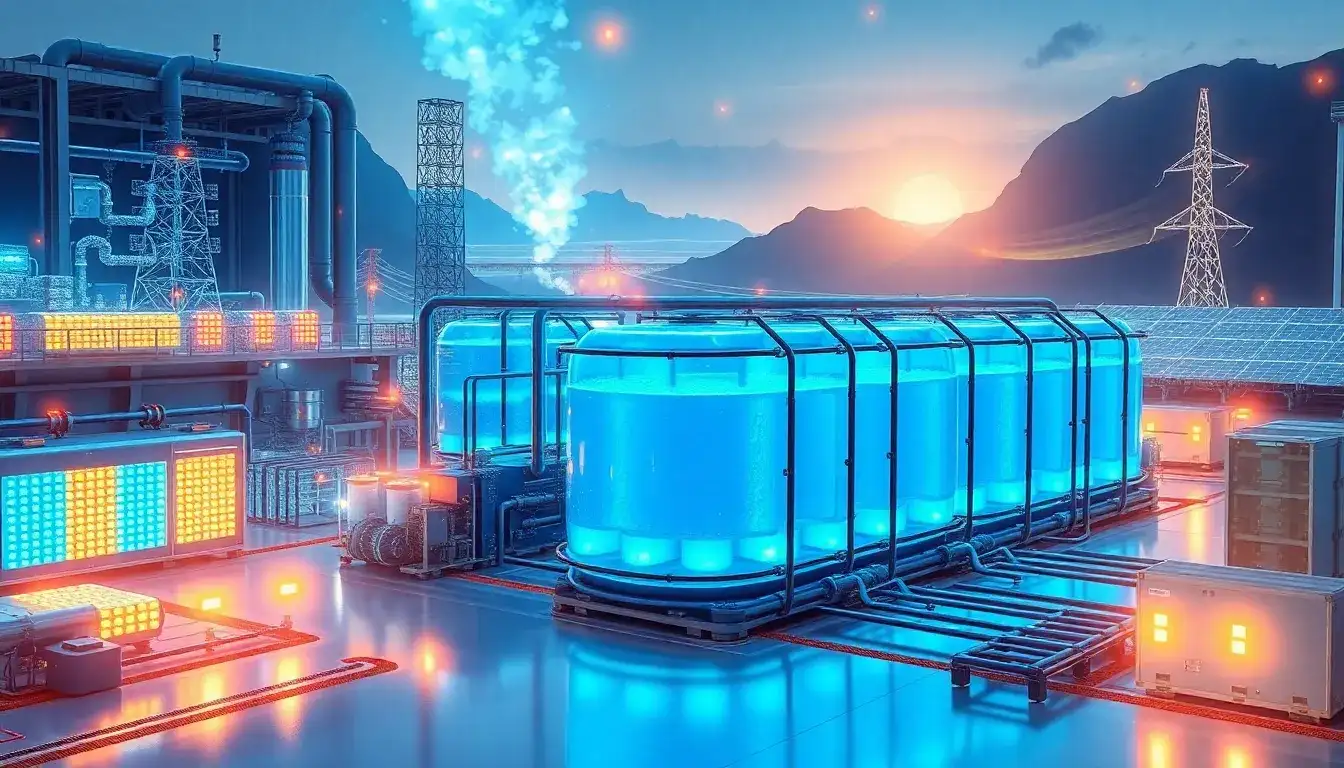
Liquid Air Energy Storage (LAES) offers a distinctive approach to grid-scale energy storage compared to other technologies like lithium-ion batteries, pumped hydro, and compressed air energy storage (CAES).
How LAES Works
LAES stores energy by liquefying air at very low temperatures, capturing energy as thermal energy within this highly cooled liquid air. When electricity is needed, the liquid air is warmed and expands to drive turbines and generate power. This contrasts with CAES, which stores energy mechanically by compressing air, and lithium-ion batteries, which store energy chemically.
Cost Comparison
- LAES has a levelized cost of storage (LCOS) estimated around $60 per megawatt-hour, which is about one-third the cost of lithium-ion battery storage and roughly half that of pumped hydro storage.
- This cost advantage makes LAES potentially the lowest-cost option for large-scale, continuous power supply, though current investment viability is still developing.
Efficiency and Energy Density
- LAES generally exhibits lower round-trip efficiency compared to lithium-ion batteries and pumped hydro, a typical drawback relative to these technologies.
- However, LAES benefits from much higher energy density than CAES or pumped hydro, allowing for significantly smaller physical footprint—potentially an order of magnitude smaller—making it suitable where land is limited.
Size, Lifetime, and Scalability
- LAES systems can offer very large-scale energy storage with mature components and a projected operational lifetime exceeding 30 years, comparable to pumped hydro plants.
- It fills a niche in grid-scale storage, particularly useful for balancing renewables and ensuring energy security where other storage expansion options are limited.
Summary Comparison
| Feature | LAES | Lithium-ion Batteries | Pumped Hydro | Compressed Air (CAES) |
|---|---|---|---|---|
| Storage Medium | Liquid air (cryogenic) | Chemical | Water | Compressed air (mechanical) |
| Levelized Cost (LCOS) | ~$60/MWh (lowest-cost option) | ~3x LAES | ~2x LAES | Higher than LAES |
| Round-trip Efficiency | Lower than lithium-ion & hydro | High (~85-95%) | Moderate to high (~70-85%) | Moderate |
| Energy Density | High (smaller footprint) | Moderate | Low (requires large sites) | Moderate |
| Lifetime | 30+ years | 10-15 years | 30-50 years | 20+ years |
| Footprint | Compact | Compact | Large | Moderate |
LAES stands out for its low cost and compactness at large scales but currently has lower efficiency and is less mature commercially compared to batteries and pumped hydro. It is a promising solution for future grid-scale energy storage, especially where cost, land use, and long-duration storage are critical factors.
Original article by NenPower, If reposted, please credit the source: https://nenpower.com/blog/how-does-liquid-air-energy-storage-compare-to-other-forms-of-energy-storage/

