

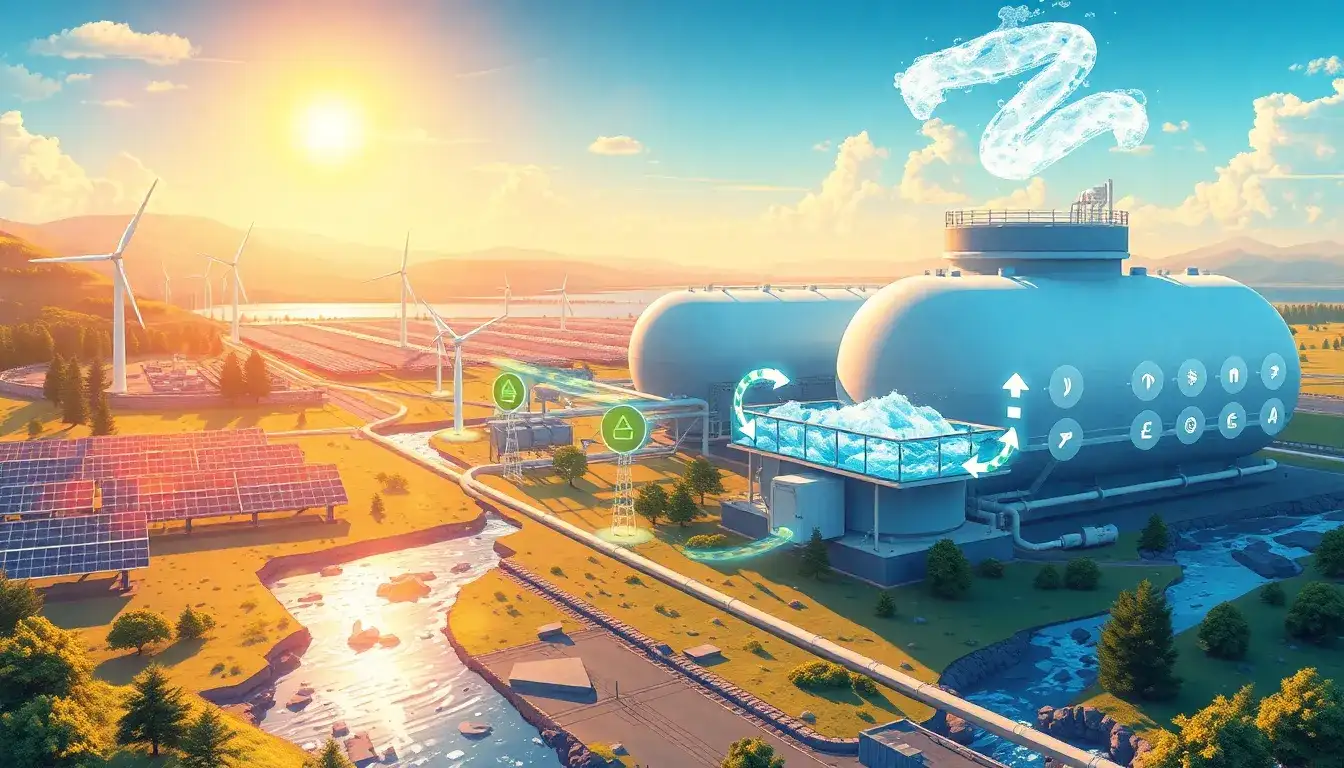
Liquid Air Energy Storage (LAES) significantly enhances the overall efficiency and viability of renewable energy systems by providing a clean, flexible, and scalable method to store and release energy on demand.
How LAES Works in Renewable Energy Systems
LAES operates through three main phases:
- Charging (Energy Storage): When renewable energy generation (e.g., wind or solar) exceeds demand, the surplus electricity is used to compress and cool ambient air until it liquefies. This process effectively stores energy in the form of liquid air held in insulated tanks at very low temperatures and atmospheric pressure.
- Storing: The liquid air remains in storage tanks, preserving the stored energy until it is needed. The system’s design allows for long-duration storage without significant losses.
- Discharging (Energy Release): When the grid requires additional power, the liquid air is pumped to higher pressure and heated, causing it to expand rapidly into a gas. This high-pressure gas drives a turbine to generate electricity that is sent back to the grid.
This ability to absorb excess renewable electricity during low demand and release it during high demand helps balance the grid, contributing to grid stability and reliability.
Contributions to Efficiency and Renewable Integration
- Clean and Sustainable: LAES uses only ambient air and electricity with no harmful emissions, making it as clean as the electricity used to charge it. Unlike some storage technologies, it does not rely on rare or costly materials, making it environmentally friendly and economically viable.
- Improved Energy Efficiency: Standalone LAES systems can achieve efficiencies of up to 57%, with ongoing research focusing on thermal integration improvements—such as utilizing waste heat or cold from industrial processes—to further increase energy recovery and reduce energy consumption during liquefaction.
- Grid Flexibility and Scalability: LAES systems can be built nearly anywhere and scaled to different sizes, offering flexibility to meet various regional energy demands and complementing the intermittent nature of renewables like solar and wind.
- Economic Viability: Because LAES components are commercially available and do not depend on expensive rare materials, the technology holds promise for cost-effective large-scale energy storage, enabling increased penetration of renewables without compromising supply reliability.
- Integration with Other Systems: Advances in LAES technology include novel systems that avoid external fuel use and CO2 emissions, enhancing sustainability and potentially combining with other thermal energy storage solutions to boost overall system efficiency and environmental benefits.
Summary
By providing a clean, efficient, and flexible method of large-scale energy storage, LAES addresses critical challenges in renewable energy systems—mainly, the mismatch between variable renewable generation and fluctuating demand. It enhances the efficiency of renewable energy use by storing excess electricity that would otherwise be wasted and releasing it when needed, thereby stabilizing the grid and facilitating wider adoption of renewables.
This makes LAES a pivotal technology for transitioning to a carbon-neutral and more sustainable energy future.
Original article by NenPower, If reposted, please credit the source: https://nenpower.com/blog/how-does-laes-contribute-to-the-overall-efficiency-of-renewable-energy-systems/

