

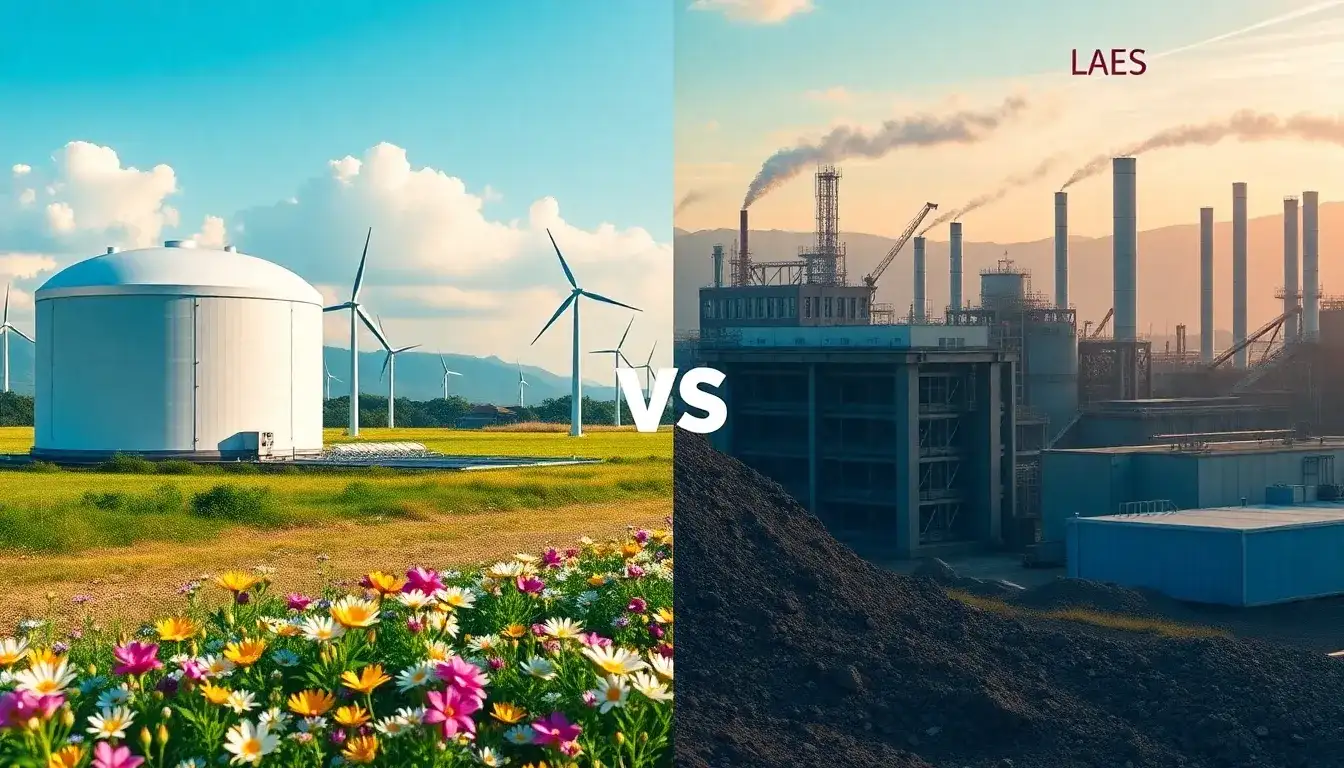
Liquid Air Energy Storage (LAES) and lithium-ion (Li-ion) batteries differ significantly in their environmental impacts, with each technology having distinct benefits and drawbacks.
Environmental Impact of LAES:
- LAES uses air, an abundant and non-toxic resource, as the storage medium, which results in minimal direct environmental impact during operation since it produces zero emissions and uses renewable electricity for air liquefaction.
- It has no geographic constraints and does not degrade in capacity over time, which contributes to its sustainability.
- However, LAES systems often use diathermic oil in their thermal management, which has a substantially high environmental impact, accounting for as much as 92% of the environmental burden during manufacture and disposal phases.
- The use of external fuels to enhance LAES efficiency can generate associated CO2 emissions, potentially offsetting some environmental benefits.
Environmental Impact of Lithium-ion Batteries:
- Lithium-ion batteries are well-established and have higher round-trip energy efficiency compared to LAES, which contributes to better environmental performance during electricity storage and delivery.
- They involve material extraction and chemical processing stages that can have significant environmental impacts, but their operation phase does not emit CO2.
- Li-ion batteries face concerns such as resource depletion (lithium, cobalt), potential toxicity, and recycling challenges, but overall, they are currently environmentally more favorable mainly due to higher efficiency and lower manufacturing-phase impacts relative to LAES when considering the entire life cycle.
Summary Comparison:
| Aspect | LAES | Lithium-ion Batteries |
|---|---|---|
| Storage Medium | Liquefied air (abundant, non-toxic) | Lithium-based chemical cells |
| Emissions During Operation | Zero emissions | Zero emissions |
| Energy Efficiency | Lower round-trip efficiency | Higher round-trip efficiency |
| Environmental Burden in Manufacture | High impact mainly from diathermic oil used | Impact from mining and processing metals |
| Scalability and Durability | Highly scalable, no capacity degradation | Capacity degrades with cycling |
| Geographical Constraints | None | Dependent on siting and material sourcing |
| CO2 Emissions from Auxiliary Use | Possible when external fuels are used | None in operation |
Overall, lithium-ion batteries environmentally outperform LAES currently, mainly because of their higher energy efficiency and the notable environmental impact associated with the diathermic oil used in LAES systems. However, LAES holds strong advantages in sustainability regarding resource use, scalability, and zero emissions during operation, suggesting its potential in reducing wasteful renewable energy curtailment and CO2 emissions when well integrated.
Original article by NenPower, If reposted, please credit the source: https://nenpower.com/blog/how-does-laes-compare-to-lithium-ion-batteries-in-terms-of-environmental-impact/

