

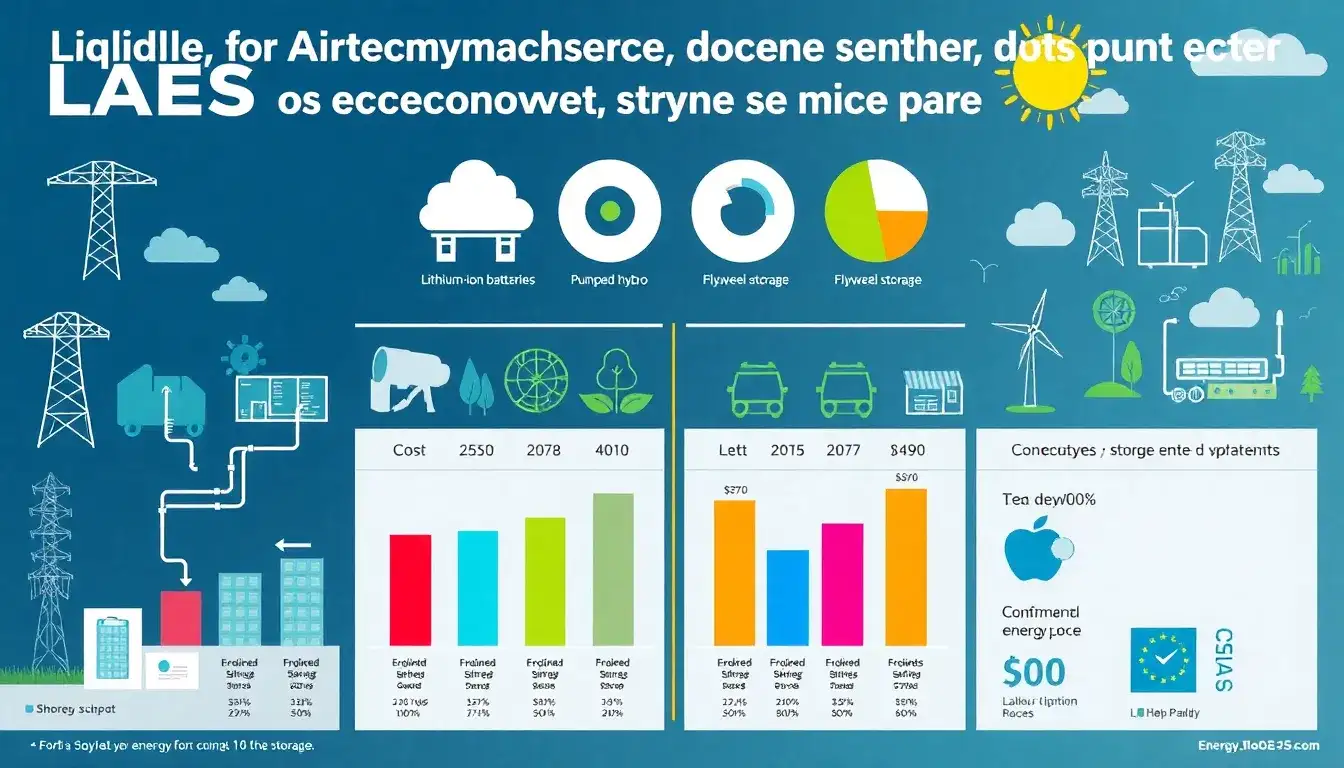
Economic Comparison of LAES with Other Energy Storage Technologies
Liquid Air Energy Storage (LAES) is a promising long-duration energy storage technology that involves the conversion of excess electrical energy into liquid air, which can be stored and then expanded to generate electricity when needed. Here’s how LAES compares economically to other energy storage technologies:
Key Economic Metrics: Levelized Cost of Storage (LCOS)
- LAES: The Levelized Cost of Storage (LCOS) for LAES is approximately $60 per megawatt-hour, which is competitive compared to other technologies.
Comparison with Other Technologies
- Lithium-Ion Batteries: The LCOS for lithium-ion batteries is about three times higher than LAES, at roughly $180 per megawatt-hour or more.
- Pumped Hydro Storage (PHS): PHS costs about twice as much as LAES, with an LCOS of approximately $120 per megawatt-hour.
- Compressed Air Energy Storage (CAES): CAES is generally cheaper than batteries on a per-hour basis, especially at large scales, but its LCOS is less frequently compared directly to LAES. However, CAES remains one of the lowest-cost options for long-duration storage.
Factors Influencing Economic Viability
- Government Policies: Economic viability is heavily influenced by government policies and financial incentives. These can significantly impact the deployment and operational costs of energy storage technologies.
- Scalability and Location: The economic benefits of LAES can vary based on location and scale, making it a potential candidate for strategic implementations where geography and infrastructure favor large-scale storage.
Future Prospects
- Cost Reductions: Innovations and cost reductions are expected to play a crucial role in making LAES and other long-duration storage technologies more viable. The U.S. Department of Energy has set targets for cost reductions in storage technologies.
- Market Conditions: The economic feasibility of LAES also depends on market conditions and the integration of renewable energy sources into the grid, which are driving the demand for efficient and scalable energy storage solutions.
Original article by NenPower, If reposted, please credit the source: https://nenpower.com/blog/how-does-laes-compare-economically-to-other-energy-storage-technologies/

