

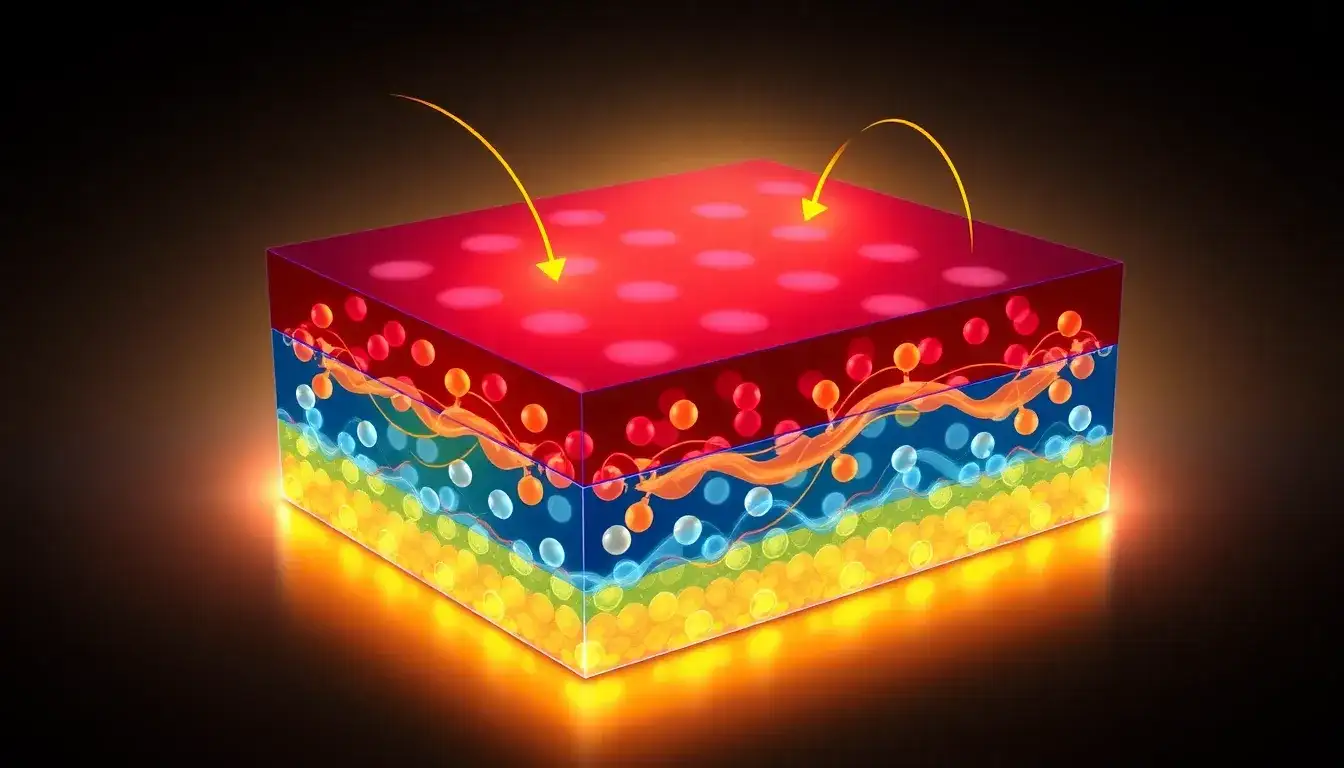
Ion migration plays a key role in causing current-voltage (I-V) hysteresis in perovskite solar cells (PSCs), a phenomenon where the measured current under forward voltage sweeping differs from that under reverse sweeping. This hysteresis affects device performance characterization and stability.
How Ion Migration Contributes to I-V Hysteresis
Ion migration mechanism:
In hybrid halide perovskites, certain ions, typically halide ions (such as I⁻) and sometimes cations (like Cs⁺ or methylammonium), can move through the perovskite layer under the influence of an electric field during device operation. This migration results from the mobile ionic species responding to the internal electric field established between contacts.
Accumulation and screening effects:
As ions migrate and accumulate near interfaces—typically at the contacts or at grain boundaries—they create space charge regions that alter the local electric field within the device. This ionic redistribution changes the internal potential landscape dynamically during the voltage sweep, effectively screening or modifying the electrostatic environment.
Impact on charge carrier dynamics:
The redistributed ions affect charge carrier recombination and extraction processes. For example, ion accumulation near an interface can increase interfacial recombination or modify the band alignment, impacting photocurrent and photovoltage. The interplay between ionic charge accumulation and electronic charge transport leads to time-dependent changes in current, causing the hysteresis phenomenon.
Dependence on device architecture and interfaces:
Not all perovskite solar cells exhibit hysteresis to the same extent because the effects of ion migration can be partially screened by photogenerated carriers depending on device design and contact layers. Changes in interfacial materials can influence recombination rates and ionic screening, thus affecting the hysteresis magnitude—even though ion migration still occurs.
Timescale and stability implications:
Ion migration occurs over timescales from milliseconds to hours and can persist under operational conditions and even during device aging. This ongoing ionic movement not only causes hysteresis but also contributes to device degradation through interface reactions and phase changes induced by migrating ions.
Summary
| Aspect | Description |
| Origin of migrating ions | Mostly halide ions (e.g., I⁻), sometimes cations (e.g., Cs⁺) |
| Migration driver | Internal electric field during device operation |
| Effect on device physics | Creates ionic charge accumulation near interfaces, altering internal electric fields |
| Influence on hysteresis | Dynamic ionic screening changes recombination and charge extraction, causing current-voltage hysteresis |
| Dependence on interfaces | Interfacial recombination and contact materials modulate hysteresis severity |
| Timescale | From milliseconds to hours, affecting both transient device behavior and long-term stability |
Ion migration is therefore a fundamental solid-state electrochemical process that directly causes or contributes to the peculiar current-voltage hysteresis in perovskite solar cells by dynamically modulating the device’s internal electric field and interfacial charge recombination properties during voltage scans. Understanding and controlling ion migration is critical for improving the accuracy of performance measurements and the long-term stability of perovskite solar cells.
Original article by NenPower, If reposted, please credit the source: https://nenpower.com/blog/how-does-ion-migration-contribute-to-current-voltage-hysteresis-in-perovskite-solar-cells/

