

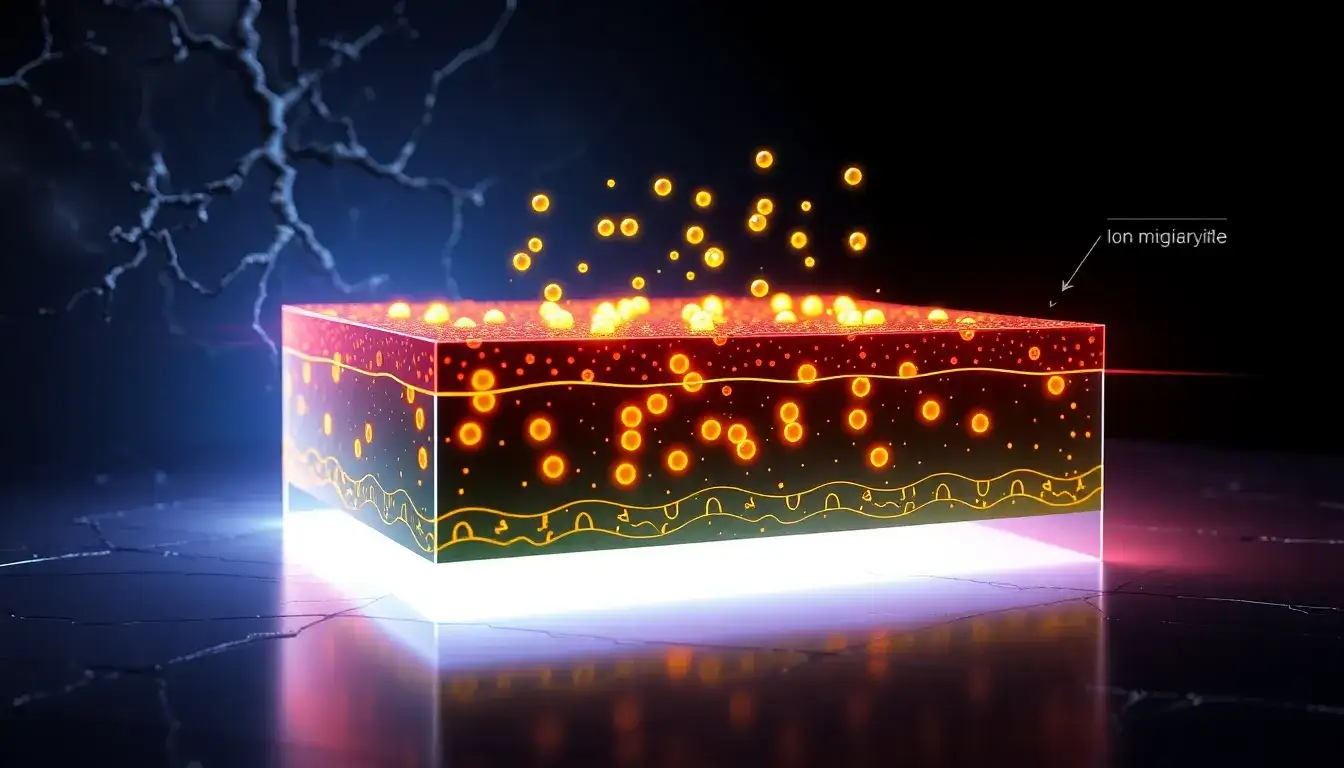
Effects of Ion Migration on Perovskite Solar Cells
- Photocurrent Hysteresis: Ion migration is often linked to photocurrent hysteresis, which affects the reliability and accuracy of measurements and device performance.
- Stability Issues: Ion migration can lead to a decrease in device stability, influencing both long-term operational stability under illumination and in the dark. It contributes to the degradation of perovskite solar cells.
- Impeded Charge Transport: Ion migration can impede charge transport, leading to the growth of macroscopic defects over time, particularly during aging under forward bias conditions.
- Performance Reduction: The movement of ions, such as iodide and methylammonium ions, can alter the electrical properties of the material, reducing device efficiency and enhancing the risk of phase separation and other structural changes.
Strategies to Mitigate Ion Migration
Several strategies have been proposed to mitigate the adverse effects of ion migration:
- Bulk, Interface, and Grain Boundary Passivation: These methods help stabilize the perovskite films by reducing ion movement at critical interfaces and within the bulk material.
- Materials Engineering: Improving the structural integrity and stability of perovskites through tailored composition and interfaces is crucial for reducing ion migration.
- Suppressing Ion Migration: Techniques that suppress ion migration, such as using low-dimensional perovskites or other stabilizing additives, can enhance device stability.
Overall, addressing ion migration is crucial for enhancing the stability and performance of perovskite solar cells to make them viable for commercial applications.
Original article by NenPower, If reposted, please credit the source: https://nenpower.com/blog/how-does-ion-migration-affect-the-stability-of-perovskite-solar-cells/

