

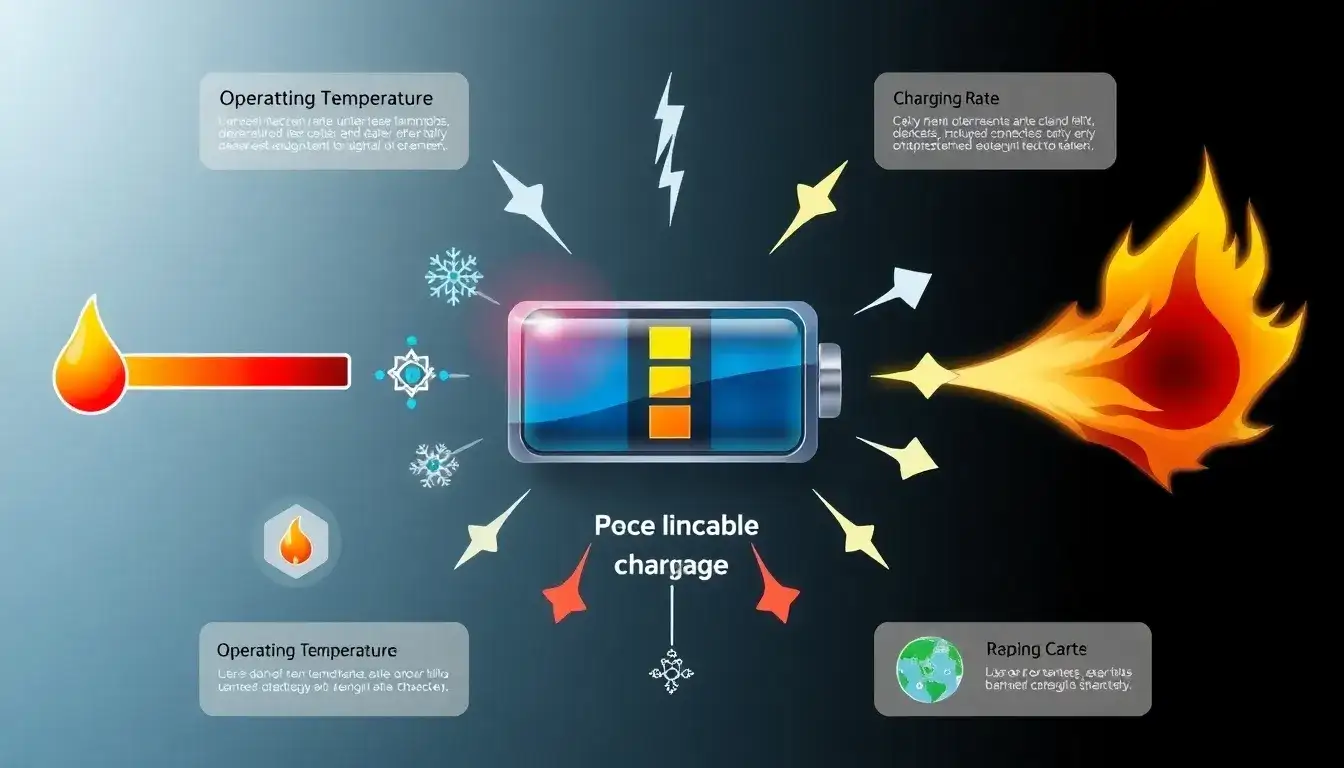
Increasing the operating temperature and charging rate both accelerate battery degradation, particularly for lithium-ion batteries used in devices and electric vehicles.
Effect of Increasing Operating Temperature on Battery Degradation
- Higher temperatures significantly speed up degradation. For example, batteries operated at 45°C (113°F) can experience more than double the capacity loss after 200 charge cycles compared to those at 25°C (77°F). Specifically, capacity loss can be about 6.7% at 45°C versus 3.3% at 25°C over 200 cycles.
- The accelerated degradation is primarily due to enhanced chemical reactions inside the battery, such as growth of the solid-electrolyte interphase (SEI) layer and lithium plating, which reduce effective capacity and battery lifespan.
- Excessive heat also increases internal stresses and can lead to malfunction or safety risks.
Effect of Increasing Charging Rate on Battery Degradation
- High charging rates (fast charging) exacerbate degradation. Charging at high current causes increased heat generation inside the battery, which compounds the temperature-related degradation mechanisms.
- Charging lithium-ion batteries outside their optimal temperature window (typically 10°C to 30°C) can cause lithium plating, especially at low temperatures or when charging rapidly, which leads to permanent performance loss and safety concerns.
- Batteries charged too quickly at elevated temperatures face a combined effect of thermal and mechanical stress, accelerating capacity fade.
Summary
| Factor | Effect on Battery Degradation |
|---|---|
| Increasing Operating Temperature | Accelerates chemical reactions, increases SEI growth & lithium plating, more than doubles degradation at ~45°C vs 25°C. |
| Increasing Charging Rate | Causes more heat, enhances degradation mechanisms, risks lithium plating at improper temps, reduces battery life. |
Managing temperature and charging rates by limiting charging speed, avoiding high temperatures, and controlling charge levels can help mitigate battery degradation and extend battery life. For example, advanced chargers and cooling systems are effective in maintaining optimal temperatures during charge cycles.
In conclusion, both higher operating temperatures and faster charging rates significantly shorten lithium-ion battery lifespan by accelerating capacity loss through increased internal chemical and mechanical stresses.
Original article by NenPower, If reposted, please credit the source: https://nenpower.com/blog/how-does-increasing-the-operating-temperature-and-charging-rate-affect-battery-degradation/

