

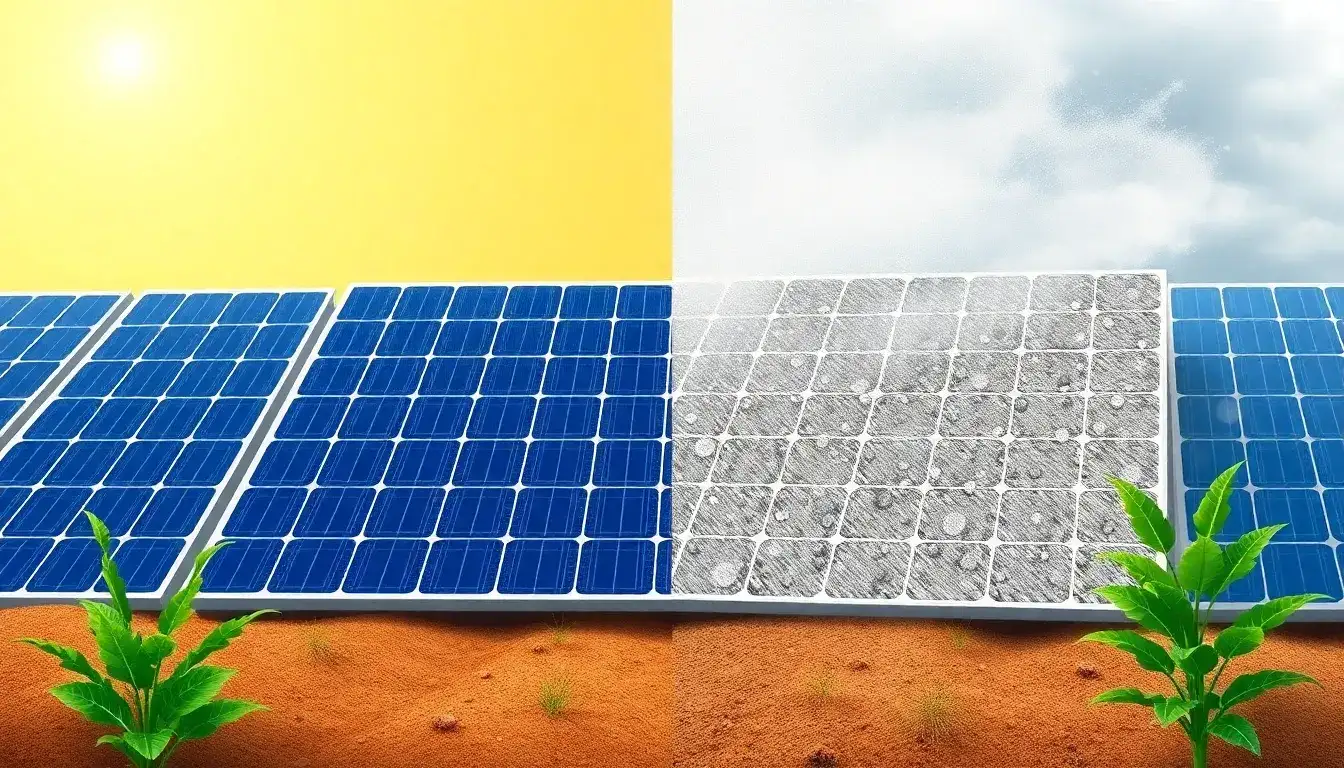
Humidity’s influence on dust accumulation on solar panels is complex and region-dependent:
1. Adhesion vs. accumulation rate
Studies show conflicting effects:
- Increased adhesion: In Saudi Arabia, humidity enhanced dust adhesion, reducing efficiency by 6% over five weeks even with lower dust quantities.
- Slower accumulation: Pakistani studies found humid climates accumulated dust at 6.4 g/m² (15% efficiency loss), while dry climates reached 10.3 g/m² (25% loss) over the same period.
2. Regional variability
- Dust composition matters: Spherical particles like silt adhere more readily in humid conditions, while industrial or agricultural dust (e.g., rice farming residue) shows different adhesion patterns regardless of humidity.
- Post-accumulation effects: Humidity without rain creates a sticky environment, while rainfall can reset efficiency by washing away dust, as observed in California and Jordan.
3. Interaction with cleaning methods
Recent MIT research notes humidity ≥30% enables electrostatic dust removal systems to work effectively, as moisture helps particles acquire charge for repulsion. In arid regions, waterless cleaning becomes more challenging below this threshold.
This duality means humidity both exacerbates dust’s harmful effects through adhesion while potentially slowing initial accumulation rates in some climates.
Original article by NenPower, If reposted, please credit the source: https://nenpower.com/blog/how-does-humidity-influence-dust-accumulation-on-solar-panels/

