

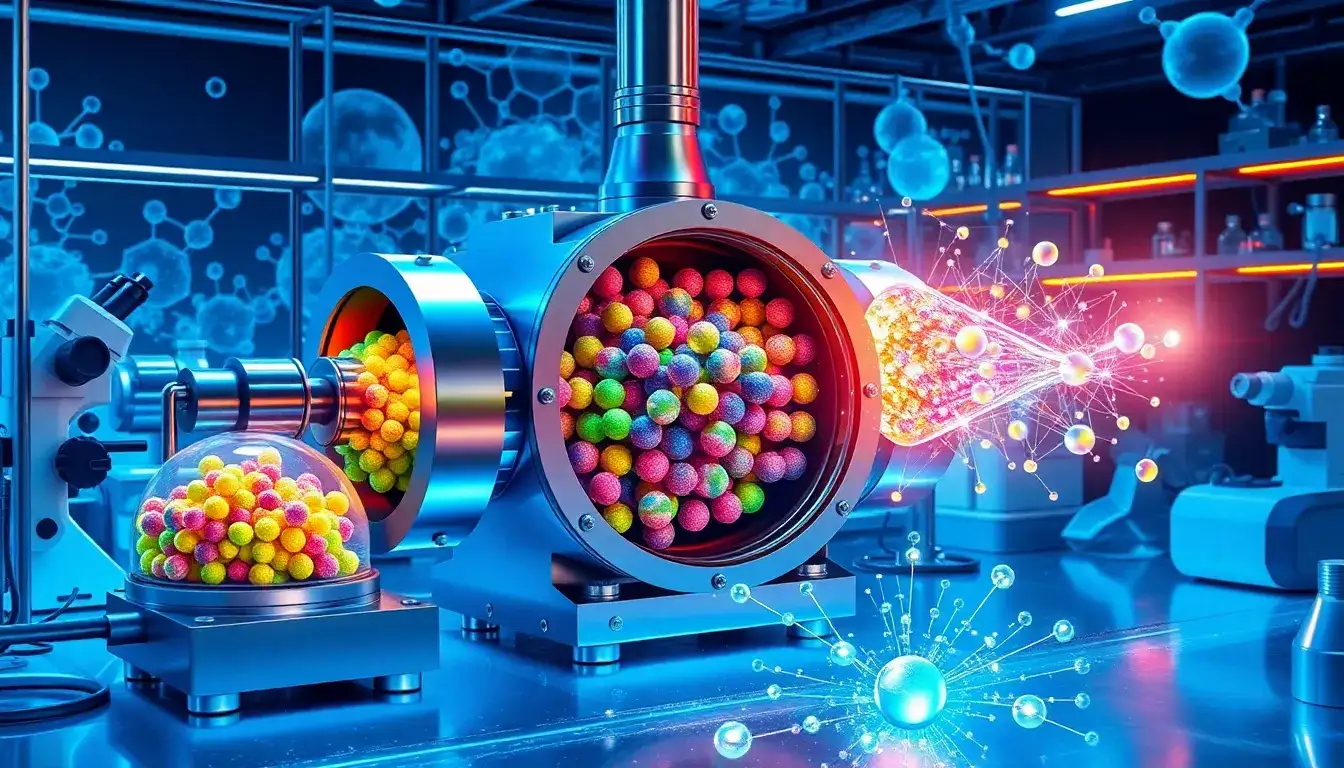
High-energy Ball Milling (HEBM) and Ionic Conductivity
High-energy ball milling (HEBM) is a mechanical treatment method that significantly affects the ionic conductivity of solid electrolytes. Here’s how it influences their properties:
Effects on Ionic Conductivity
- Structure and Phase Formation: HEBM can induce the formation of specific structural phases that enhance ionic conductivity. For example, in NaCB11H12, it stabilizes the body-centered cubic (bcc) polymorph at room temperature, which has higher ionic conductivity than other polymorphs due to increased sodium sites and configurational entropy.
- Particle Size Reduction: The process reduces particle size, which can increase the surface area and facilitate improved ionic conductivity by reducing grain boundaries’ resistance.
- Nanocrystallization: By producing nanocrystalline structures, HEBM can increase the ionic conductivity of materials like γ-AgI, although the effect might be limited compared to other factors influencing conductivity.
- Mechanical Induced Defects: The milling process can introduce defects and disorder in the crystal structure, which can act as diffusion pathways for ions, enhancing conductivity.
Comparison with Other Methods
- Ball Milling vs. Liquid-Phase Synthesis: Ionic conductivity achieved through ball milling can be comparable to other synthesis methods, such as liquid-phase synthesis, as seen in the case of Li3PS4.
Overall, high-energy ball milling is a versatile technique that can enhance ionic conductivity by altering the structure, particle size, and defect density of solid electrolytes.
Original article by NenPower, If reposted, please credit the source: https://nenpower.com/blog/how-does-high-energy-ball-milling-affect-the-ionic-conductivity-of-solid-electrolytes/

