

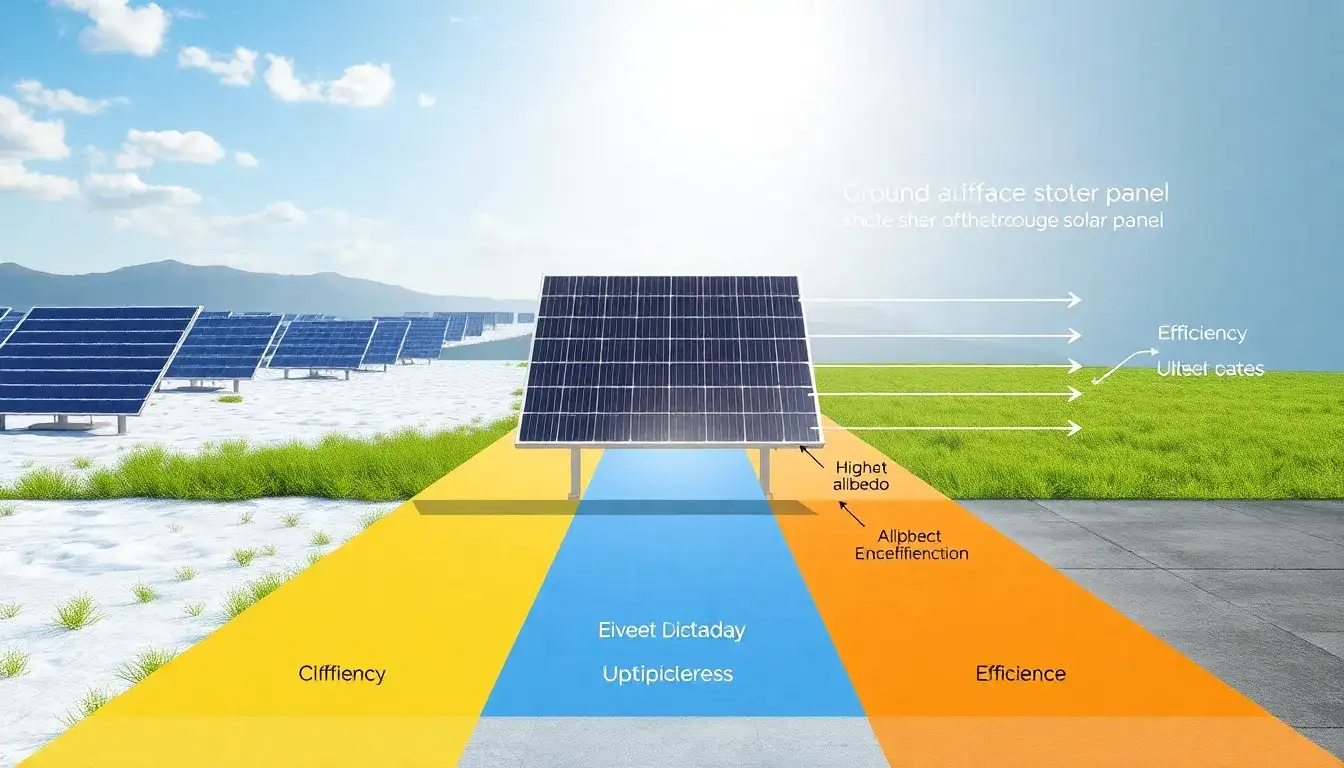
Ground surface albedo significantly impacts the efficiency of bifacial solar panels by affecting the amount of solar radiation reflected onto the rear side of the panels. Here’s a detailed explanation of this relationship:
What is Albedo?
- Albedo is the measure of reflectivity of a surface, expressed as a value between 0 and 1 or a percentage between 0% and 100%, indicating how much incoming sunlight is reflected by that surface back into the environment rather than absorbed.
Impact on Bifacial Solar Panel Efficiency
- Bifacial solar panels generate electricity from sunlight incident on both their front and rear surfaces. The rear surface captures solar radiation reflected from the ground or nearby surfaces.
- The higher the ground albedo, the more sunlight is reflected onto the rear side, thereby increasing the total irradiance the panel receives and enhancing its overall energy yield.
- Typical albedo values vary by surface type; for example:
- Fresh snow: 0.65 to 0.85
- Old snow: 0.4 to 0.65
- Sand: 0.2 to 0.3
- Agricultural land: 0.2 to 0.25
- Grassland: 0.1 to 0.2
- Forested areas and water have much lower albedo values, around 0.05 to 0.1.
- For conventional monofacial panels, ground-reflected radiation usually contributes only 1-2% of total solar input and is less critical. However, for bifacial panels, the ground albedo is a key factor because rear-side generation depends heavily on reflected light.
Quantitative Effects and Practical Observations
- Studies show that increasing albedo can increase bifacial gains substantially, but electrical output improvements may be less than proportional due to system and environmental factors.
- For example, in a field study in Brazil, raising albedo from approximately 0.20 (natural soil) to about 0.50 (with white reflective polymeric ground cover) more than doubled the reflective albedo value. Despite this, the module power increased by only about 3.5% in nominal output, highlighting diminishing returns and practical limitations.
- Bifaciality (the rear side’s efficiency relative to the front) and installation parameters such as height above the ground and tilt angle also influence how effectively the reflected radiation improves panel output.
- The timing of the rear side’s irradiance tends to peak during early morning and late afternoon when the sun angle is low, maximizing reflected light available to the rear surface.
Summary Table of Albedo Effect and Panel Performance
| Aspect | Description |
|---|---|
| Albedo definition | Fraction of solar radiation reflected by ground surface (0 to 1 scale). |
| Effect on bifacial panels | Higher albedo → more reflected light on rear side → higher energy yield and efficiency gain. |
| Typical albedo values | Snow (0.4-0.85), Sand (0.2-0.3), Agricultural land (0.2-0.25), Grass (0.1-0.2), Water (~0.05) |
| Impact magnitude | Increased albedo can raise energy yield by up to 30% compared to monofacial, though practical gain smaller in some cases. |
| Other influencing factors | Bifaciality ratio, module height, tilt angle, shading, and dirt accumulation affect output. |
| Real-world study example | Doubling albedo from 0.2 to 0.5 raised power output by ~3.5% in Brazilian field test. |
Conclusion
Ground surface albedo directly affects bifacial solar panel efficiency by determining the quantity of solar radiation reflected to the panel’s rear side. Surfaces with high albedo, such as snow or specially treated reflective grounds, can significantly boost energy yield. However, practical gains depend on multiple factors, and increasing albedo alone does not always lead to proportional improvements in power output. Proper site assessment and installation optimization are crucial to maximizing bifacial panel benefits.
Original article by NenPower, If reposted, please credit the source: https://nenpower.com/blog/how-does-ground-surface-albedo-specifically-impact-bifacial-solar-panel-efficiency/

