

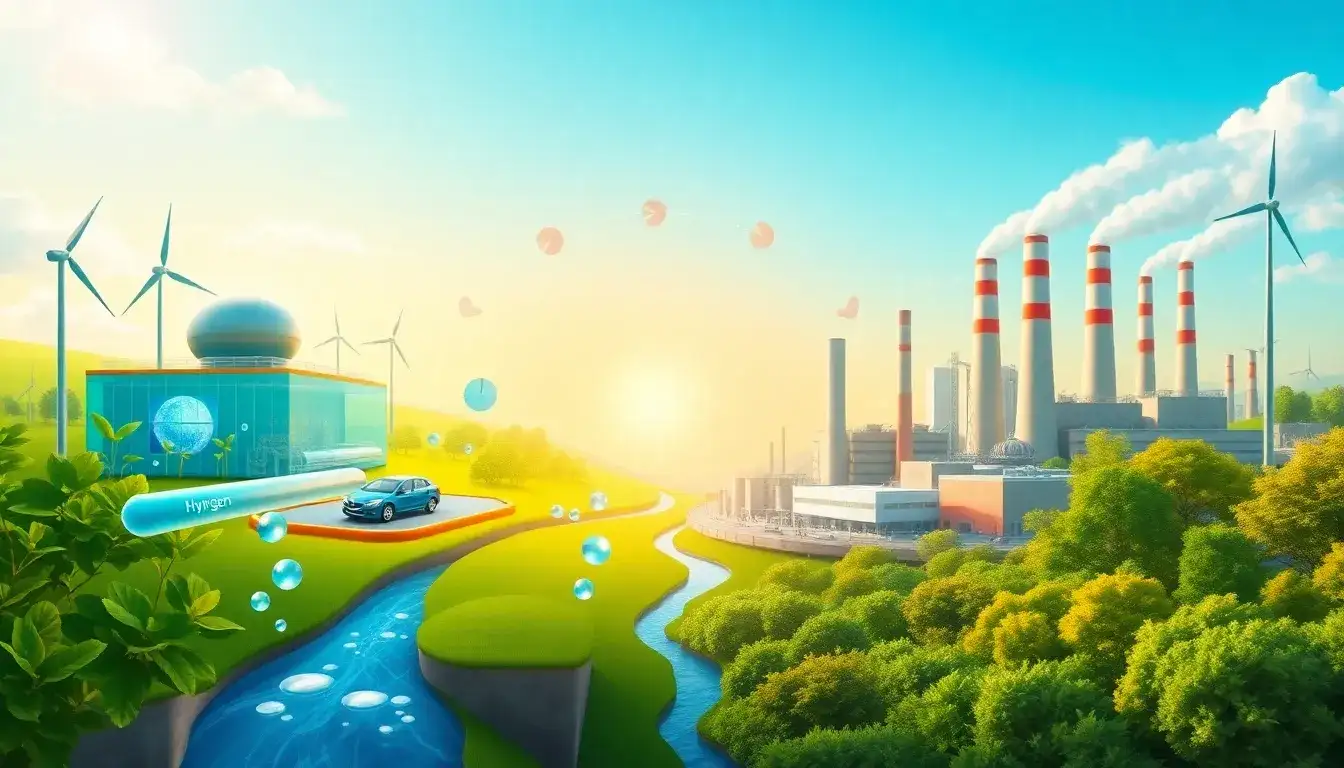
Green hydrogen stands out among low-carbon fuels for its potential to significantly reduce emissions, but its exact impact depends heavily on how it is produced and used compared to other alternatives.
Emissions Reduction from Green Hydrogen
Production Emissions:
- Green hydrogen is produced via electrolysis powered by renewable energy sources like wind or solar, splitting water into hydrogen and oxygen without burning fossil fuels. This process emits very little CO2, typically about 1 kilogram or less per kilogram of hydrogen produced, mainly from embedded emissions associated with manufacturing equipment rather than operational emissions.
- The overall carbon footprint of green hydrogen decreases further when renewable power plants operate efficiently and consistently, since embedded emissions are spread over greater hydrogen output.
- In contrast, blue hydrogen (made from natural gas with carbon capture) reduces greenhouse gas emissions only by 5–36% compared to grey hydrogen (fossil-based without capture), indicating green hydrogen’s advantage in lower lifecycle emissions if powered by additional renewables.
Lifecycle and Comparative Emissions:
- Life-cycle assessments suggest green hydrogen outperforms fossil-based hydrogen variants in greenhouse gas reduction, especially when electricity comes from additional renewable capacity rather than existing infrastructure.
- Alternative uses of renewable electricity (such as direct electrification) may sometimes achieve greater emissions reductions in the short term than producing green hydrogen, indicating the context and energy system integration are crucial factors.
Comparison with Other Low-Carbon Fuels
| Feature | Green Hydrogen | Blue Hydrogen | Electrification (Renewable Electricity) | Biofuels |
|---|---|---|---|---|
| Emissions (Lifecycle) | Very low, mainly embedded emissions from equipment | Moderate reduction vs. grey hydrogen (5–36%) | Very low (direct use of renewables) | Variable, depends on feedstock and processing |
| Carbon Dioxide Release | None at point of use | Some CO2 released despite capture | None at point of use | CO2 emitted, but potentially offset by biomass growth |
| Scalability | Growing but currently limited (<1% hydrogen production) | More scalable currently but reliant on fossil gas | Scalable where grids allow | Limited by land and resource availability |
| Use Cases | Hard-to-electrify sectors (industry, heavy transport) | Same as green hydrogen, transitional solution | Best for light transport, buildings, and direct power | Transport and some industry |
| Energy Efficiency | Generally lower due to conversion losses | Similar or slightly less than green hydrogen | High efficiency (no conversion losses) | Moderate efficiency |
Summary
Green hydrogen offers a cleaner alternative to fossil-based fuels and even blue hydrogen by enabling near-zero operational emissions when produced with additional renewable energy. It is particularly valuable for decarbonizing sectors where direct electrification is challenging, such as heavy industry and long-haul transport. While green hydrogen production currently accounts for less than 1% of total hydrogen production, its emissions intensity improves as renewable electricity deployment and electrolyzer efficiency increase.
However, in the short term, using renewable electricity directly for energy services often results in greater greenhouse gas reductions compared to converting that electricity into green hydrogen. Thus, green hydrogen is best viewed as a complementary low-carbon fuel suited for specific applications rather than a universal replacement across all sectors.
Overall, green hydrogen is one of the most promising low-carbon fuels for deep emissions reduction, especially when integrated with expanding renewable energy infrastructure and targeted towards sectors difficult to electrify with current technologies.
Original article by NenPower, If reposted, please credit the source: https://nenpower.com/blog/how-does-green-hydrogen-compare-to-other-low-carbon-fuels-in-terms-of-emissions-reduction/

