

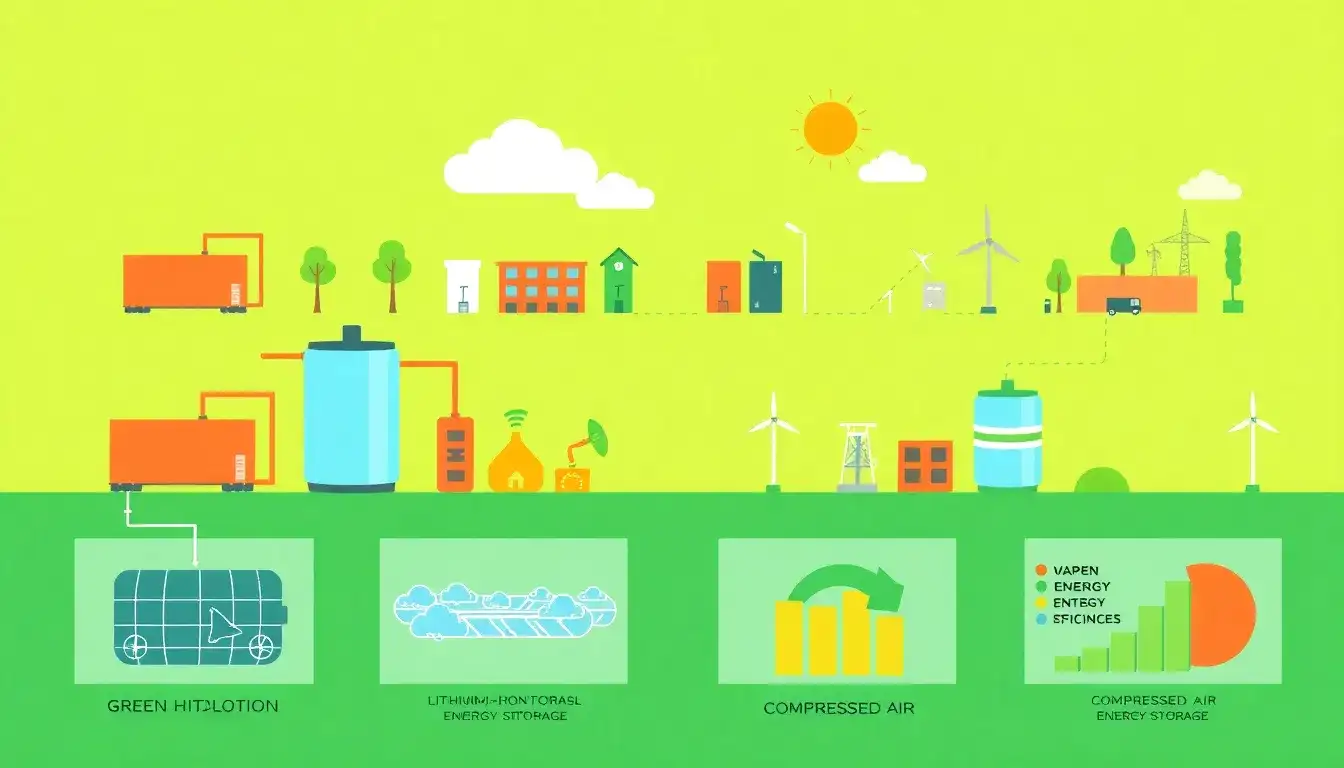
Comparison of Green Hydrogen with Other Energy Storage Solutions
Efficiency Metrics
Green hydrogen’s round-trip efficiency (converting electricity to hydrogen and back to power) ranges between 18%–46%. This is significantly lower than alternatives like pumped-storage hydropower (70%–85%), flow batteries (60%–80%), and compressed air energy storage (42%–67%).
Key Trade-offs
- Energy density: Compressed hydrogen has a high energy density per unit mass (~33.3 kWh/kg), making it suitable for sectors like heavy transport and aviation.
- Scalability vs. constraints: While hydrogen storage lacks geographical limitations (unlike pumped hydro), its lower efficiency remains a barrier for grid-scale power storage compared to batteries.
- Emissions: Green hydrogen production emits 0 kgCO₂/kg H₂, unlike blue (3.5–4 kgCO₂/kg H₂) or grey hydrogen (10 kgCO₂/kg H₂).
Applications
- Long-duration storage: Hydrogen excels in scenarios requiring seasonal storage or industrial decarbonization, where efficiency is secondary to capacity.
- Fuel cells: Hydrogen’s conversion efficiency in fuel cells outperforms combustion-based systems, but it still lags behind lithium-ion batteries for short-term energy needs.
| Solution | Round-Trip Efficiency | Emissions (kgCO₂/kg H₂) | Best Use Case |
|---|---|---|---|
| Green Hydrogen | 18–46% | 0 | Long-duration storage |
| Pumped Hydro | 70–85% | N/A | Grid stabilization |
| Flow Batteries | 60–80% | N/A | Medium-duration storage |
| Compressed Air | 42–67% | N/A | Grid-scale storage |
While green hydrogen offers zero emissions and high energy density, its lower efficiency positions it as a complementary solution rather than a direct competitor to established technologies like batteries or pumped hydro.
Original article by NenPower, If reposted, please credit the source: https://nenpower.com/blog/how-does-green-hydrogen-compare-to-other-energy-storage-solutions-in-terms-of-efficiency/

