

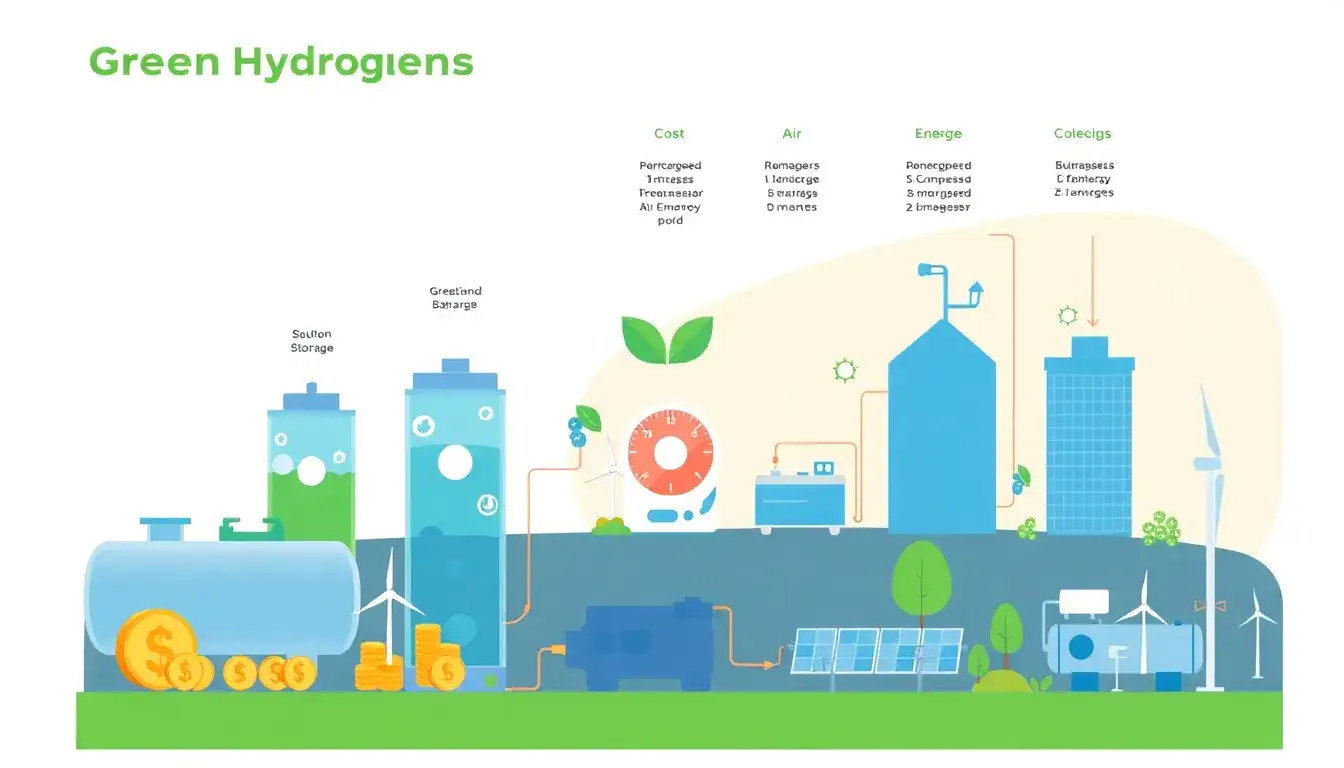
Green hydrogen and other energy storage solutions, particularly lithium-ion batteries, differ significantly in cost and efficiency, each having distinct advantages depending on the application and duration of storage.
Efficiency Comparison
- Batteries: Lithium-ion batteries exhibit high round-trip efficiency, typically around 80-90%, meaning a large portion of the input energy can be retrieved for use. This efficiency makes batteries highly effective for short-term storage, such as daily or hourly grid balancing and powering electric vehicles.
- Green Hydrogen: Green hydrogen storage currently has a lower round-trip efficiency, roughly between 30-50%. Energy is lost in the electrolysis process (splitting water into hydrogen and oxygen) and during conversion back to electricity via fuel cells. Despite this, hydrogen’s ability to store energy chemically allows it to hold energy for much longer durations without significant loss.
Cost Comparison
- Batteries: Lithium-ion battery costs have fallen dramatically over the past decade thanks to technological advancements and large-scale manufacturing. This has made battery storage solutions increasingly affordable for short to medium-term applications.
- Green Hydrogen: The cost of green hydrogen storage is still relatively high, largely due to expensive electrolyzers and fuel cells. However, costs are decreasing as technology matures and economies of scale improve. The U.S. Department of Energy targets achieving the cost of $1 per kilogram of hydrogen within the next decade, which would make green hydrogen more competitive.
Energy Density and Storage Duration
- Hydrogen: Green hydrogen boasts a high energy density by weight and can be stored for weeks to months, making it suitable for seasonal and long-duration energy storage. This advantage allows hydrogen to address the intermittency of renewable energy sources over extended periods and be used in heavy transport and industrial applications.
- Batteries: While batteries have lower energy density and are more compact, their storage duration is currently limited to hours or a few days economically. They are ideal for rapid energy release and short-term grid stability rather than long-term storage.
Scalability and Infrastructure
- Hydrogen: The scalability of green hydrogen is a key benefit. Storage capacity can be increased by enlarging hydrogen storage tanks or underground caverns, enabling grid-scale and seasonal storage solutions to support large-scale renewable energy integration.
- Batteries: Battery storage scales by adding more cells or modules, but large-scale storage can become costly and space-intensive compared to hydrogen. Batteries are more suited to distributed storage, residential, and commercial use cases.
Summary Table
| Feature | Green Hydrogen | Lithium-ion Batteries |
|---|---|---|
| Round-trip Efficiency | ~30-50% | ~80-90% |
| Energy Density | High by weight, better for long-term | Lower, more compact |
| Storage Duration | Long-term (weeks to months) | Short-term (hours to days) |
| Cost Trend | Currently high, decreasing with scale | Lower, rapidly decreasing |
| Best Use Case | Seasonal/grid-scale storage, heavy transport, industry | Short-term grid balancing, EVs, home/commercial storage |
| Scalability | Easily scalable with larger storage tanks | Scalable but can be space/cost-intensive at large scale |
| Environmental Impact | Clean, produces only water when used | Clean, but manufacture involves resource extraction |
In conclusion, green hydrogen is less efficient and currently more expensive than batteries but excels in long-duration, large-scale energy storage and applications requiring high energy density. Batteries dominate short-term, high-efficiency storage with rapidly declining costs but are limited in duration and scalability for seasonal storage needs. As technology advances, green hydrogen’s costs are expected to fall, potentially increasing its competitiveness in the future.
Original article by NenPower, If reposted, please credit the source: https://nenpower.com/blog/how-does-green-hydrogen-compare-to-other-energy-storage-solutions-in-terms-of-cost-and-efficiency/

