

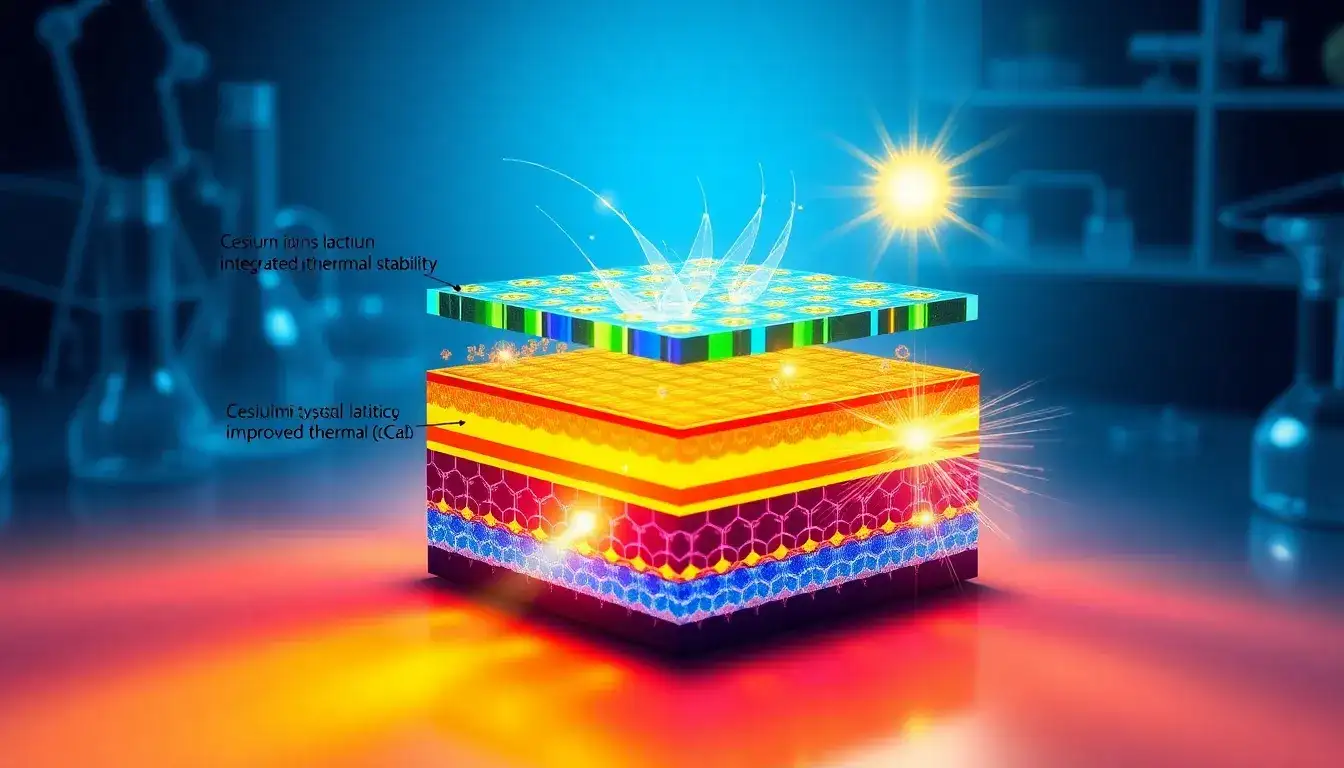
Cesium (Cs) Doping Enhances the Thermal Stability of Perovskite Solar Cells
Cesium (Cs) doping enhances the thermal stability of perovskite solar cells through several key mechanisms related to the structural and compositional improvements of the perovskite material:
Key Mechanisms of Thermal Stability Enhancement by Cs Doping
- Improved Structural Stability and Reduced Microstrain: Cs incorporation in formamidinium-based perovskites (FA-Cs perovskites) reduces microstrain in the perovskite lattice, which contributes to enhanced thermal stability under heat stress. This structural relaxation helps prevent degradation during thermal cycling or prolonged heating.
- Faster Film Deposition and Morphology Control: Introducing Cs into the precursor solution accelerates the film deposition rate, resulting in smaller grain sizes but increased film thickness. These morphological changes lead to denser films with fewer defects and trap states, which are typically associated with halide vacancies that can worsen under thermal annealing. This suppression of trap states reduces non-radiative recombination and degradation pathways at elevated temperatures.
- Suppression of Trap States: Cs doping mitigates halide deficiency-related trap states that usually form during thermal annealing. By stabilizing these sites, Cs helps maintain the integrity of the perovskite crystal structure under thermal stress.
- Phase Stability and Prevention of Phase Separation: In Cs-rich FA-Cs perovskites, proper compositional tuning (e.g., Cs content below ~30%) avoids phase separation even after annealing at temperatures like 140°C or exposure to UV light. This stable phase retention under thermal and photothermal stress is crucial for maintaining device performance and stability.
- Enhanced Device Performance Linked to Thermal Stability: The combined structural and morphological benefits lead to improved photovoltaic parameters such as higher short-circuit current densities (JSC) and overall power conversion efficiency (PCE). For example, a composition with Cs doping around x=0.09 in MAPbI3 hybrids showed enhanced thermal stability with improved JSC and PCE reaching 18.1%.
Summary Table of Cs Doping Effects on Thermal Stability
| Effect | Description | Impact on Thermal Stability |
|---|---|---|
| Structural lattice relaxation | Reduced microstrain in lattice of FA-Cs perovskites | Less structural degradation at elevated heat |
| Faster film deposition | Leads to smaller grains but thicker films with fewer defects | Denser, more uniform films resist thermal damage |
| Trap state suppression | Reduces halide deficiency-related trap states formed during thermal annealing | Maintains electronic quality under heat |
| Phase stability | Prevents phase separation in Cs-rich compositions under annealing and UV exposure | Preserves optical/electronic properties |
| Enhanced device metrics | Improved JSC, Voc, fill factor, and overall PCE | Indicates stable performance under operating conditions |
In conclusion, Cs doping acts by stabilizing the perovskite crystal structure, improving film morphology, suppressing defect sites, and preventing phase degradation, all of which collectively enhance the thermal stability of perovskite solar cells and thereby prolong their operational lifetime.
Original article by NenPower, If reposted, please credit the source: https://nenpower.com/blog/how-does-cs-doping-enhance-the-thermal-stability-of-perovskite-solar-cells/

