

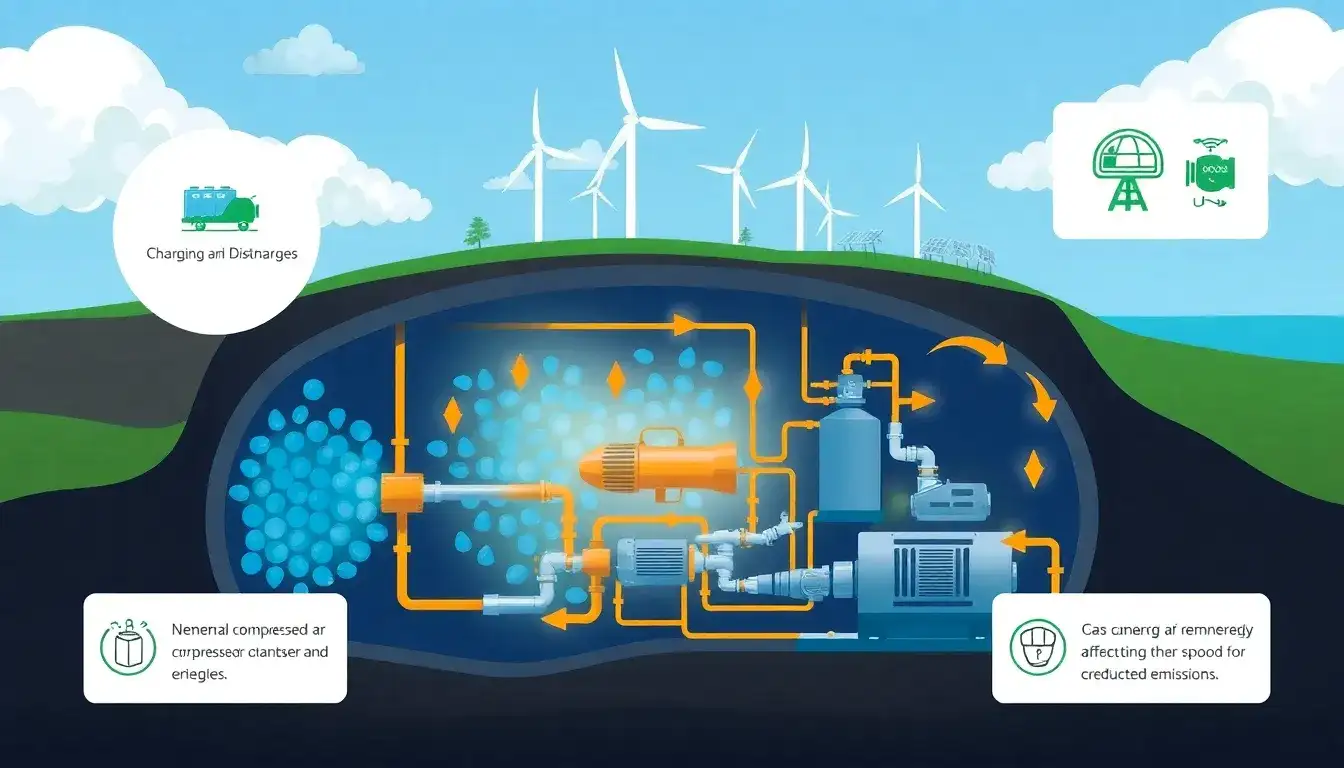
How CAES Works
1. Charging Phase:
During off-peak hours, electricity (often from renewable sources like wind or solar) powers compressors to compress ambient air. The compressed air is stored in underground caverns, above-ground tanks, or underwater reservoirs. Compression generates heat, which is either wasted (in traditional systems) or stored (in advanced designs).
2. Discharging Phase:
When electricity is needed, stored air is released and heated—either by burning natural gas (in older systems) or using pre-stored heat (in advanced systems)—to drive turbines connected to generators. This expansion produces electricity to meet peak demand.
Types of CAES
- Diabatic: Loses heat during compression, requiring natural gas combustion during discharge (efficiency: 40–55%).
- Adiabatic: Stores heat from compression and reuses it during expansion, achieving over 70% efficiency.
- Isothermal: Maintains constant temperature during compression/expansion but is less practical for large-scale use.
Advantages of CAES
- Bulk Storage: Suitable for large-scale (utility-level) energy storage, enabling long-duration discharge.
- Renewable Integration: Smooths fluctuations in wind/solar output by storing excess energy and releasing it during shortages.
- Low Environmental Impact: Adiabatic systems eliminate natural gas use, reducing emissions.
- Grid Stability: Provides ancillary services like frequency regulation and peak shaving.
- Cost-Effectiveness: Leverages existing geological formations (e.g., salt caverns) for low-cost air storage.
Key limitations include geographic dependence on suitable storage sites and lower round-trip efficiency compared to batteries in small-scale applications.
Original article by NenPower, If reposted, please credit the source: https://nenpower.com/blog/how-does-compressed-air-energy-storage-caes-work-and-what-are-its-advantages/

