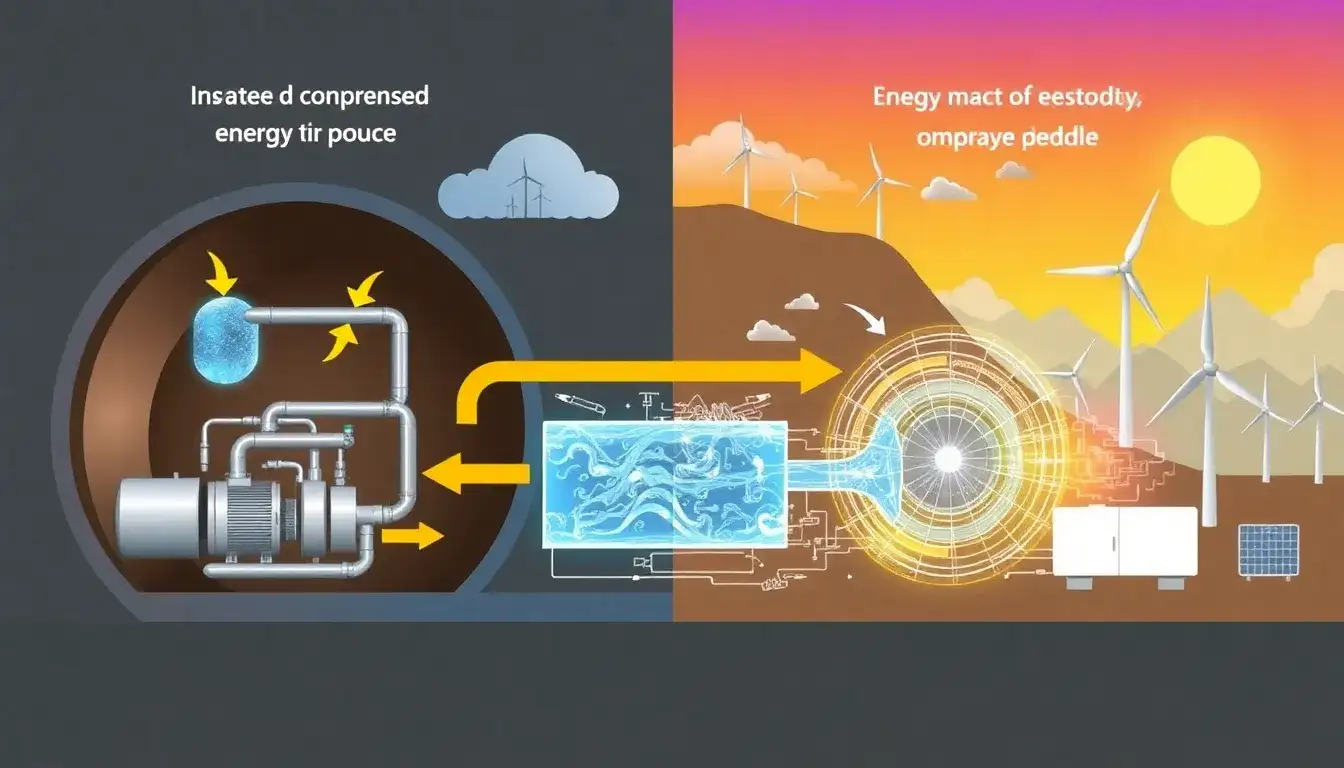
Compressed air energy storage (CAES) functions by using electricity to compress air during periods of low demand or excess renewable energy production, storing this compressed air under high pressure, and later releasing it to generate electricity during peak demand.
How CAES Works in Detail
1. Compression (Charging Phase):
- Surplus electricity powers an electric motor that runs an air compressor.
- Ambient air is compressed to high pressures (up to about 100 times atmospheric pressure) and stored in large-scale, airtight underground reservoirs such as salt caverns, aquifers, or specially designed tanks.
- This process converts electrical energy into potential energy stored as compressed air.
- The compression generates heat, which traditionally has been a challenge to manage efficiently since it can reduce operational efficiency and risk equipment damage.
2. Storage:
- The compressed air is held in subterranean reservoirs which can safely withstand high pressures for extended periods.
- Salt caverns are a common choice due to their natural ability to contain the pressurized air without leakage.
3. Expansion (Discharging Phase):
- When electricity demand is high, the compressed air is released.
- The air is typically heated—often using natural gas in conventional systems—to increase expansion efficiency.
- The heated, expanding air drives a turbine connected to a generator, converting the stored potential energy back into electrical energy to supply the grid.
- Some advanced CAES designs aim to reduce or eliminate fossil fuel use during this reheating phase (adiabatic CAES), but many existing plants still rely on natural gas combustion for reheating.
Summary of Key Features
| Phase | Process Description | Energy Form | Notes |
|---|---|---|---|
| Compression | Electricity powers compressor to compress air | Electrical → Potential (compressed air) | Heat generated during compression is a challenge |
| Storage | Compressed air stored underground in caverns or tanks | Potential (compressed air) | Large-scale, long-term storage possible |
| Expansion | Compressed air heated and expanded to drive turbine | Potential → Mechanical → Electrical | Often uses natural gas heating; adiabatic CAES aims to avoid this |
Advantages and Challenges
- Advantages: CAES systems can store large amounts of energy for long durations, have low self-discharge rates, and provide grid balancing especially useful for integrating intermittent renewable sources like wind and solar.
- Challenges: Thermal management of heat during compression and expansion, upfront capital costs, and reliance on natural gas for reheating in most current systems limit environmental performance and efficiency.
In essence, CAES acts as a large-scale rechargeable battery by storing electricity as compressed air and later converting it back to electricity when needed, thus helping balance energy supply and demand on the grid.
Original article by NenPower, If reposted, please credit the source: https://nenpower.com/blog/how-does-compressed-air-energy-storage-caes-function/