

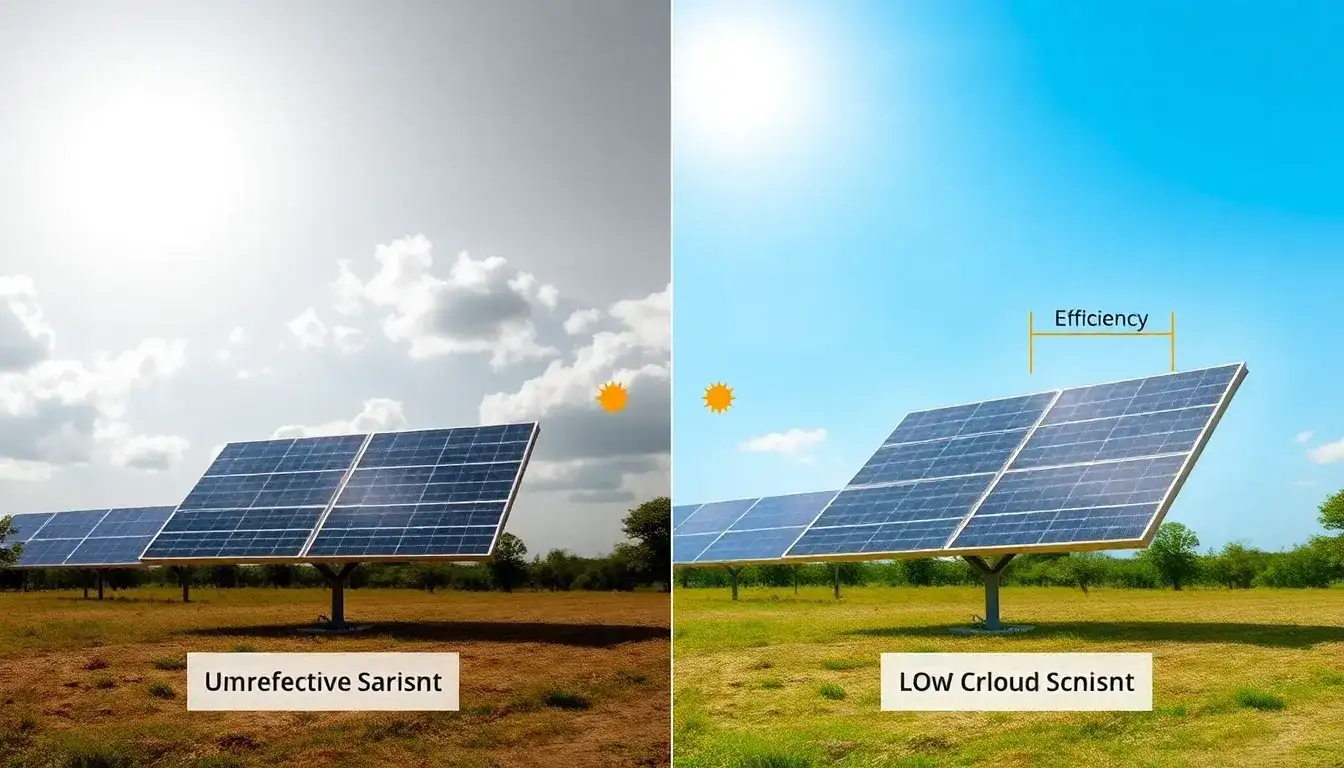
Effect of Cloud Density on Bifacial Solar Panels
Bifacial solar panels, unlike their monofacial counterparts, can harness energy from both sides, capturing direct sunlight and reflected light from surroundings, including the ground, buildings, and even clouds. This ability enhances their performance under various environmental conditions, including cloudy weather. Here’s how cloud density affects their efficiency:
Cloud Density and Solar Panel Output
- High Clouds: High clouds tend to have less impact on solar panels compared to thick, low-level clouds. In fact, a phenomenon known as “cloud lensing” can occur with high clouds, where ice crystals act like a magnifying glass, focusing the sun’s rays and potentially boosting power output.
- Moderate Clouds: Moderate cloud density reduces solar panel efficiency more than thin clouds. Bifacial panels are less affected but still experience efficiency losses. The benefit is that they can capture diffuse light more efficiently than monofacial panels.
- Thick Clouds: Thick, overcast conditions significantly reduce solar panel output, often allowing less than 10% of normal production. However, bifacial panels can still capture some energy from reflected light, improving efficiency over monofacial panels in such conditions.
Advantages of Bifacial Panels on Cloudy Days
- Increased Energy Yield: Bifacial panels can generate up to 30% more energy than conventional monofacial panels, particularly in environments with diffuse light, such as cloudy conditions.
- Improved Resilience: They are less susceptible to shading and soiling, common issues in urban areas or dusty regions, making them more resilient under varied conditions.
- Enhanced Diffuse Light Utilization: Bifacial panels can exploit the diffuse light scattering through clouds more effectively than monofacial panels, enhancing their performance on cloudy days.
In summary, bifacial solar panels are more efficient than monofacial ones on cloudy days due to their ability to capture reflected light and diffuse sunlight. However, their efficiency still varies with cloud density, with thicker clouds reducing output more significantly.
Original article by NenPower, If reposted, please credit the source: https://nenpower.com/blog/how-does-cloud-density-affect-the-efficiency-of-bifacial-solar-panels/

