

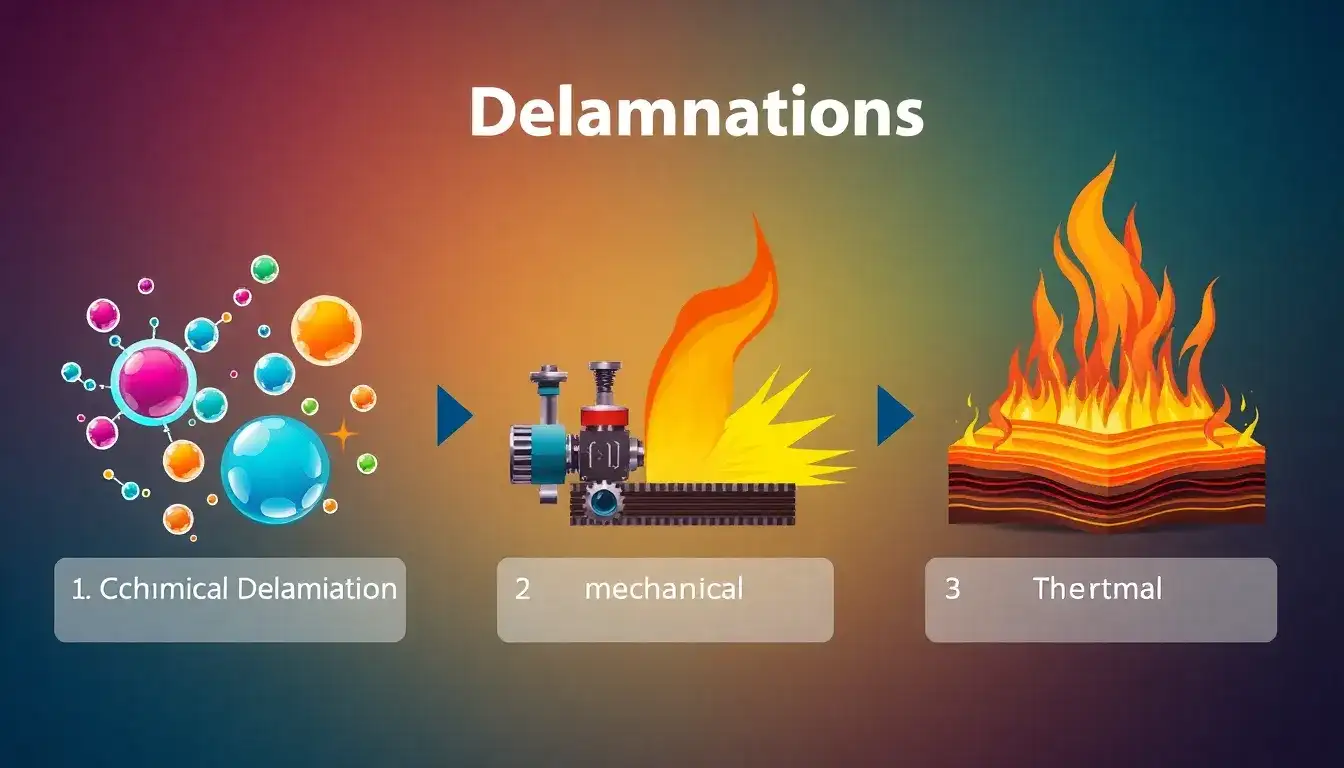
Delamination techniques
Delamination techniques, such as chemical, mechanical, and thermal methods, are used in various industrial processes, including the recovery of materials from waste products like solar panels or tempered glass. Here’s a comparison of these methods in terms of efficiency and cost:
Efficiency Comparison
- Chemical Delamination: This process involves using chemicals to dissolve or degrade the adhesive layers or materials, allowing for the separation of components. It can be highly selective and efficient for specific applications but often requires careful control of chemical usage and disposal, which can be time-consuming and environmentally challenging.
- Mechanical Delamination: Mechanical methods involve physically peeling or separating layers using mechanical forces. They are generally faster and more sustainable because they do not require the use of chemicals or high-temperature processing. Mechanical delamination is considered cost-effective and environmentally friendly compared to other methods.
- Thermal Delamination: Thermal methods use heat to soften or degrade materials, facilitating their removal. This approach can be efficient for certain materials, such as polymers in photovoltaic modules, as it allows for the recovery of valuable components without significant damage. However, the process can be energy-intensive and requires precise temperature control to avoid material degradation.
Cost Comparison
- Chemical Delamination: Chemical methods often require expensive chemicals and specialized equipment for application and disposal. This can make them more costly compared to mechanical methods, although they might be cost-effective in specific niche applications where high precision is required.
- Mechanical Delamination: Mechanical techniques are generally considered cost-effective because they involve minimal specialized equipment. They are often simpler and more sustainable in terms of environmental impact.
- Thermal Delamination: Thermal processes can be energy-intensive, which might increase their operational costs. However, they can offer efficiency in terms of recovering high-value materials from products like photovoltaic modules, potentially offsetting the costs over time through material recovery.
Summary
| Method | Efficiency | Cost |
|---|---|---|
| Chemical | High selectivity, environmentally challenging | Often expensive due to chemicals and disposal |
| Mechanical | Fast, sustainable, simple equipment | Cost-effective, environmentally friendly |
| Thermal | Energy-intensive, precise temperature control needed | Can be costly due to energy use, but valuable for material recovery |
In summary, mechanical delamination tends to be more cost-effective and environmentally friendly, while thermal delamination can be efficient for specific applications, such as photovoltaic modules, despite its energy-intensive nature. Chemical delamination is often more expensive and environmentally challenging but offers high precision in certain applications.
Original article by NenPower, If reposted, please credit the source: https://nenpower.com/blog/how-does-chemical-delamination-compare-to-mechanical-and-thermal-delamination-in-terms-of-efficiency-and-cost/

