

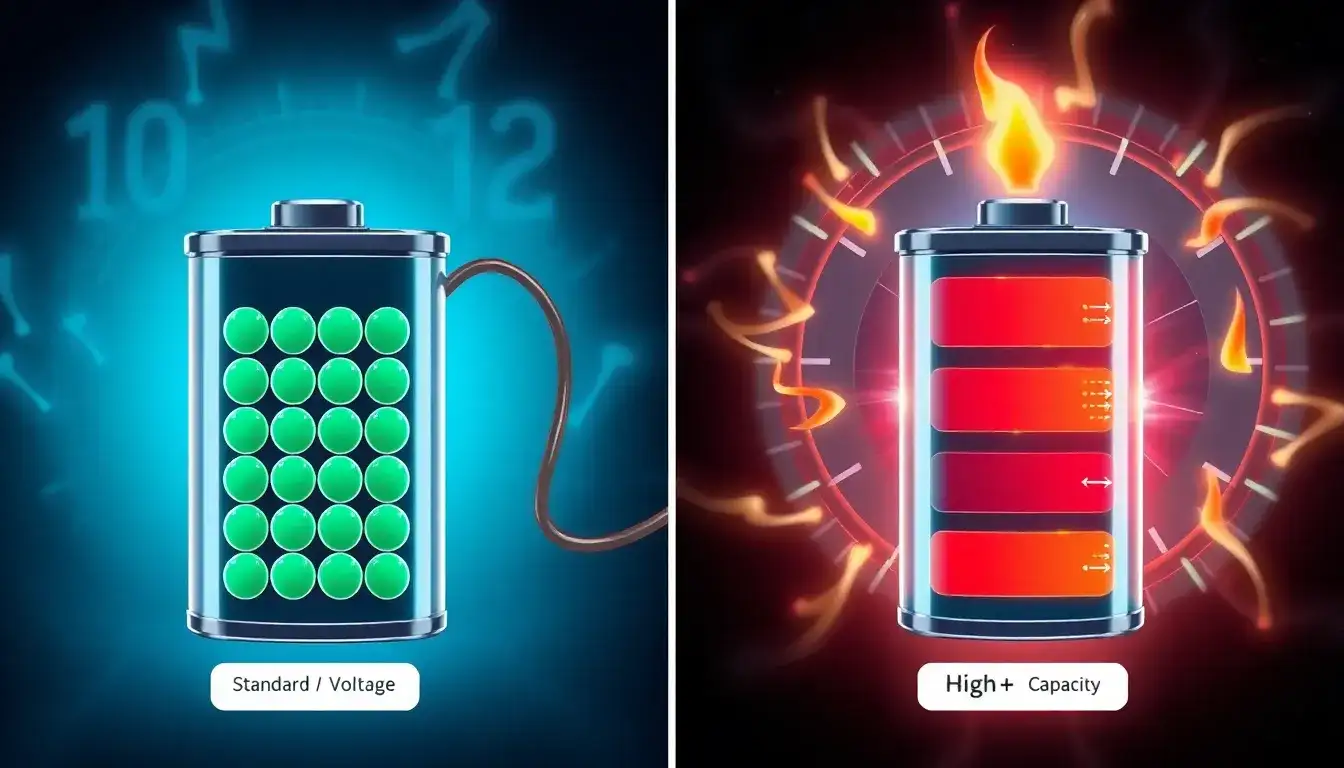
The charging voltage has a significant impact on the lifespan of lithium-ion batteries, primarily by influencing the number of charge-discharge cycles the battery can endure before capacity degrades.
Impact of Charging Voltage on Battery Lifespan
- Standard Charge Voltage and Cycle Life: Most lithium-ion cells are charged to a nominal voltage of 4.20 volts per cell. At this voltage, typical cycle life ranges from about 300 to 500 cycles. However, reducing the peak charge voltage can dramatically increase cycle life.
- Voltage Reduction Benefits:
- Every 0.10V reduction in the peak charge voltage per cell approximately doubles the cycle life.
- For example:
- Charging to 4.10V/cell can extend lifespan to around 600–1,000 cycles.
- Charging to 4.00V/cell can extend it further to 1,200–2,000 cycles.
- Charging to 3.90V/cell can provide 2,400–4,000 cycles.
- The optimal voltage to maximize longevity is around 3.92V/cell, which eliminates much of the voltage-related stress on the battery.
- Trade-Offs:
- Lowering the peak voltage reduces the battery’s usable capacity. On average, every 70 mV reduction in charge voltage results in about a 10% loss in capacity.
- This loss is reversible by applying the higher peak voltage in a subsequent charge cycle.
- Additional Factors:
- The initial charging protocol at the factory also matters: recent research shows that charging lithium-ion batteries at high currents during their first charge can increase their lifespan by 50% and speed up the charging process significantly. This effect relates to changes in the battery’s internal chemistry, specifically the formation of protective layers on electrodes.
Summary
Charging lithium-ion batteries to a slightly lower voltage than the conventional 4.20V per cell notably prolongs their lifespan, sometimes by several multiples of charge cycles, but at the cost of reduced immediate capacity. The ideal balance for longevity is near 3.92V/cell. Additionally, charging conditions such as current during the initial charge also influence the battery’s long-term performance. Therefore, controlling charging voltage is a critical factor for optimizing lithium-ion battery life.
References:
- Battery University BU-808 on prolonging lithium batteries.
- SLAC-Stanford research on high current initial charging improving lifespan.
Original article by NenPower, If reposted, please credit the source: https://nenpower.com/blog/how-does-charging-voltage-impact-the-lifespan-of-lithium-ion-batteries/

