

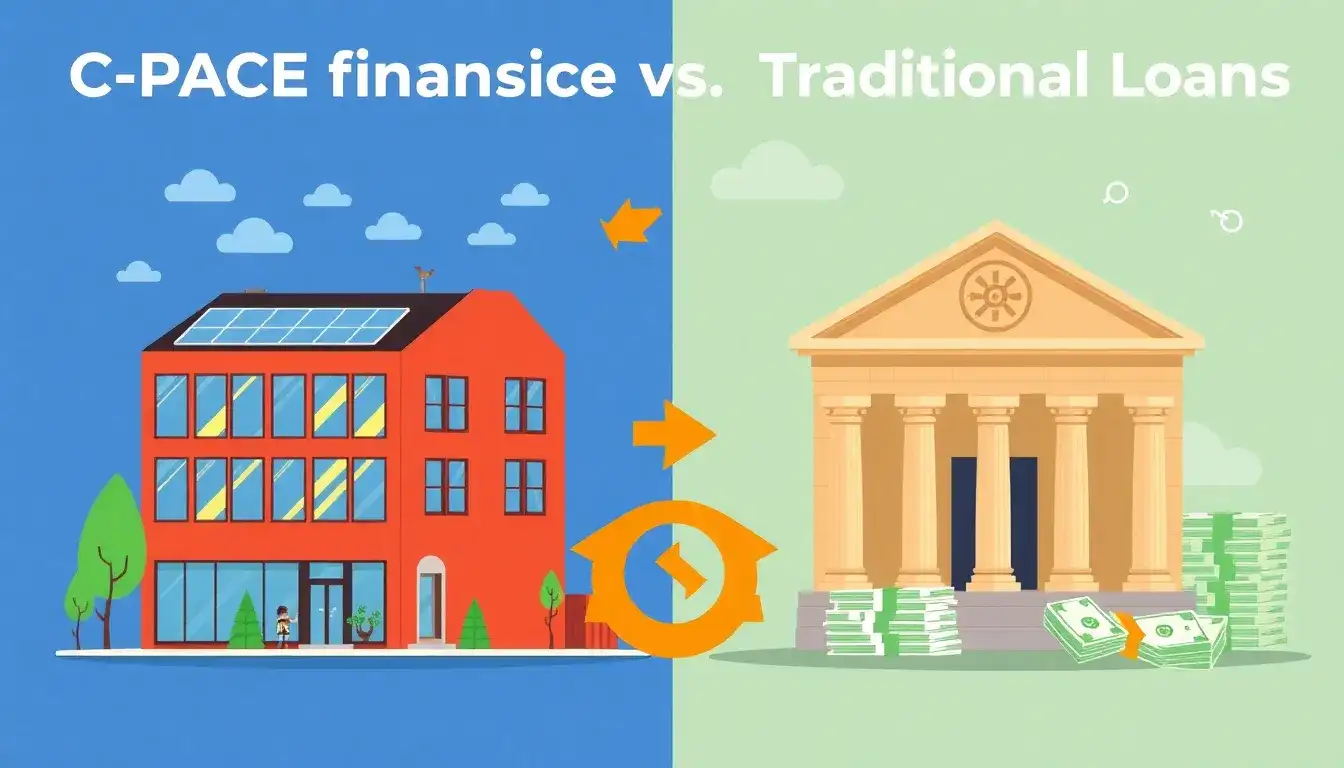
C-PACE vs. Traditional Bank Loans
C-PACE (Commercial Property Assessed Clean Energy) financing and traditional bank loans differ significantly in terms of their structure, advantages, and usage. Below is a comparison highlighting these differences:
Key Differences and Advantages
-
Purpose and Use Case:
- C-PACE: Primarily used to finance energy-efficient improvements, renewable energy installations, and resiliency projects. It is a specialized financing tool aimed at enhancing a property’s sustainability.
- Traditional Bank Loans: Used for a wide range of purposes, including new construction, property acquisition, and general renovations. They are more versatile than C-PACE.
-
Interest Rates and Terms:
- C-PACE: Offers fixed-rate, long-term financing (often up to 30 years), which can be lower than bank rates, especially compared to mezzanine or bridge loans. Interest rates typically range from about 5.75% to 8%, depending on the state and terms.
- Traditional Bank Loans: Rates are variable or fixed for a shorter period (e.g., 3-10 years), often at a higher rate than C-PACE for comparable long-term financing.
-
Repayment Mechanism:
- C-PACE: Repaid as an assessment on the property tax bill, which is collected by local governments. This makes it non-recourse and non-accelerating, reducing personal liability for borrowers.
- Traditional Bank Loans: Repaid through scheduled loan payments. Most bank loans are recourse-based, potentially increasing personal liability for borrowers in case of default.
-
Cost and Flexibility:
- C-PACE: Typically requires no upfront capital, and payments can be deferred for a few years. It can cover up to 30% of project costs, making it an attractive option for energy-efficient upgrades without increasing equity contributions.
- Traditional Bank Loans: Often require a significant upfront down payment and have stricter amortization schedules. Interest may be due immediately on the full amount drawn.
-
Liability and Risk:
- C-PACE: Non-recourse, meaning borrowers are not personally liable for the loan. The assessment is tied to the property rather than the borrower.
- Traditional Bank Loans: Typically recourse-based, with lenders able to pursue personal assets in case of default.
-
Senior Lender Consent:
- C-PACE: Requires consent from senior lenders due to its senior lien position to many mortgage liens.
- Traditional Bank Loans: Generally do not require such consent as they are the primary form of financing and carry the risk directly.
Benefits and Drawbacks
Benefits of C-PACE:
- Lower costs compared to some other forms of debt.
- Fixed-rate, long-term financing.
- No upfront costs and non-recourse.
Drawbacks of C-PACE:
- Limited to energy-efficient improvements.
- Requires senior lender consent.
- Assessment can impact property sale or refinance.
Benefits of Traditional Bank Loans:
- More flexibility in terms of use cases.
- Wider availability and understanding among lenders.
- Can be structured for a variety of project needs.
Drawbacks of Traditional Bank Loans:
- Often more expensive than C-PACE for long-term financing.
- Typically require personal guarantees.
- Repayment terms may be less flexible.
In summary, while both types of financing have their place in the market, C-PACE is particularly advantageous for projects focused on energy efficiency and sustainability, offering lower costs and greater flexibility. Traditional bank loans, however, are more versatile and widely used for a broader range of projects.
Original article by NenPower, If reposted, please credit the source: https://nenpower.com/blog/how-does-c-pace-financing-compare-to-traditional-bank-loans/

