

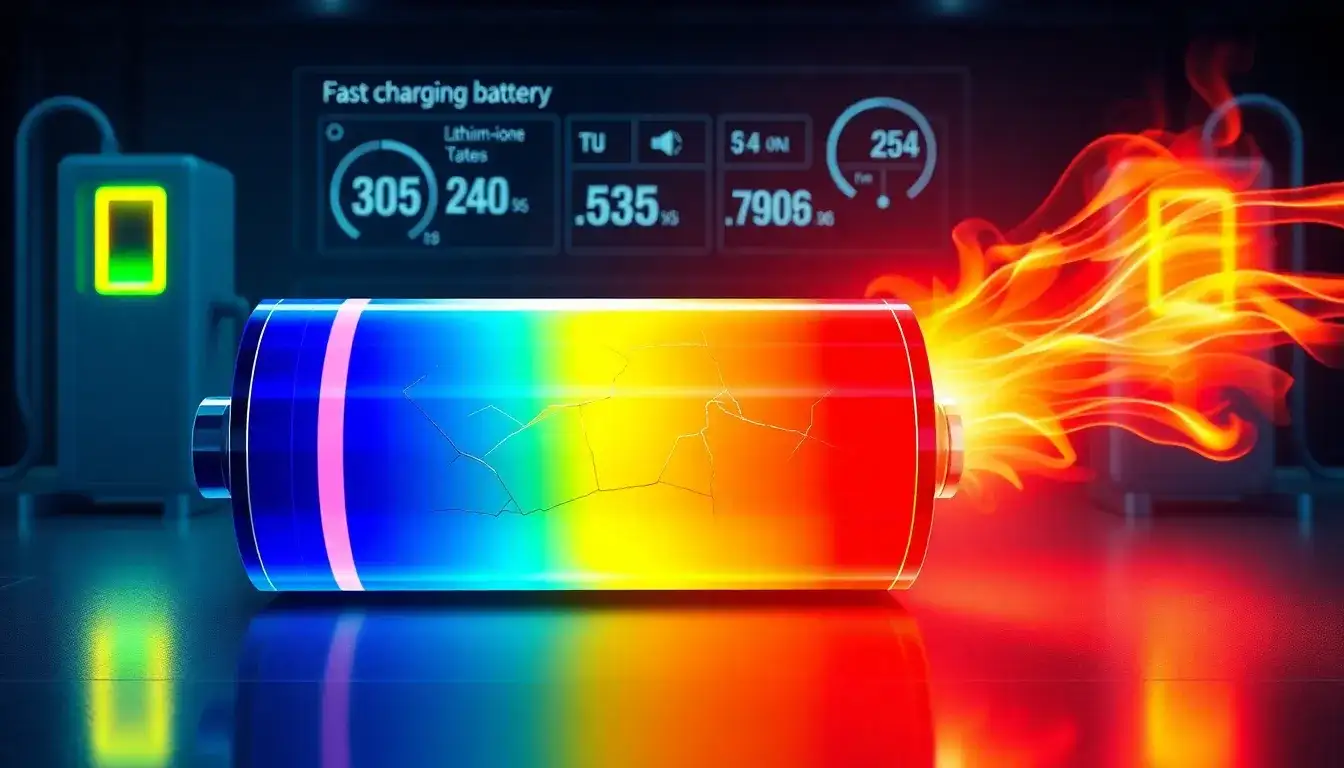
Battery temperature significantly affects the degradation rate of lithium-ion batteries during fast charging, with both elevated and low temperatures influencing degradation through different mechanisms.
Effect of Temperature on Battery Degradation from Fast Charging
- Higher temperatures (e.g., around 45°C or 113°F) accelerate battery degradation substantially. For example, after 200 charge cycles, a battery kept at 45°C can lose about 6.7% of its capacity, more than twice the loss seen at 25°C (77°F), which is about 3.3%. This faster degradation at high temperatures is primarily due to increased chemical reactions inside the battery, notably the growth of the solid-electrolyte interphase (SEI) layer and lithium plating, both of which reduce effective battery capacity.
- Conversely, charging at moderate warm temperatures around 25°C greatly reduces the risk of lithium plating and enables a much longer cycle life (over 3,000 full cycles before significant capacity loss), according to real-world EV battery data. This temperature appears to be optimal for balancing the chemical processes inside the battery during fast charging.
- Cold battery temperatures increase the risk of lithium plating during fast charging because lithium ions cannot diffuse properly into the graphite particles. This plating irreversibly damages the battery and accelerates degradation. Therefore, cold temperatures worsen degradation during fast charging more than moderate or warm temperatures.
- Although warmer temperatures reduce lithium plating risk, excessively high temperatures promote SEI layer thickening, which causes long-term capacity loss. Hence, there is a trade-off: too cold leads to lithium plating, too hot leads to SEI growth and accelerated aging.
Summary
- Optimal battery temperature for minimizing degradation during fast charging is around 25°C (77°F).
- High temperatures (e.g., 45°C) more than double degradation rates compared to 25°C.
- Low temperatures increase lithium plating risk, significantly damaging the battery during fast charging.
- Battery management systems in EVs adjust charging rates and temperature controls to keep the battery within this optimal range to mitigate degradation effects.
In practice, maintaining moderate temperatures during fast charging is essential for prolonging battery life by minimizing both lithium plating at low temperatures and SEI layer growth at high temperatures.
Original article by NenPower, If reposted, please credit the source: https://nenpower.com/blog/how-does-battery-temperature-affect-the-degradation-rate-from-fast-charging/

