

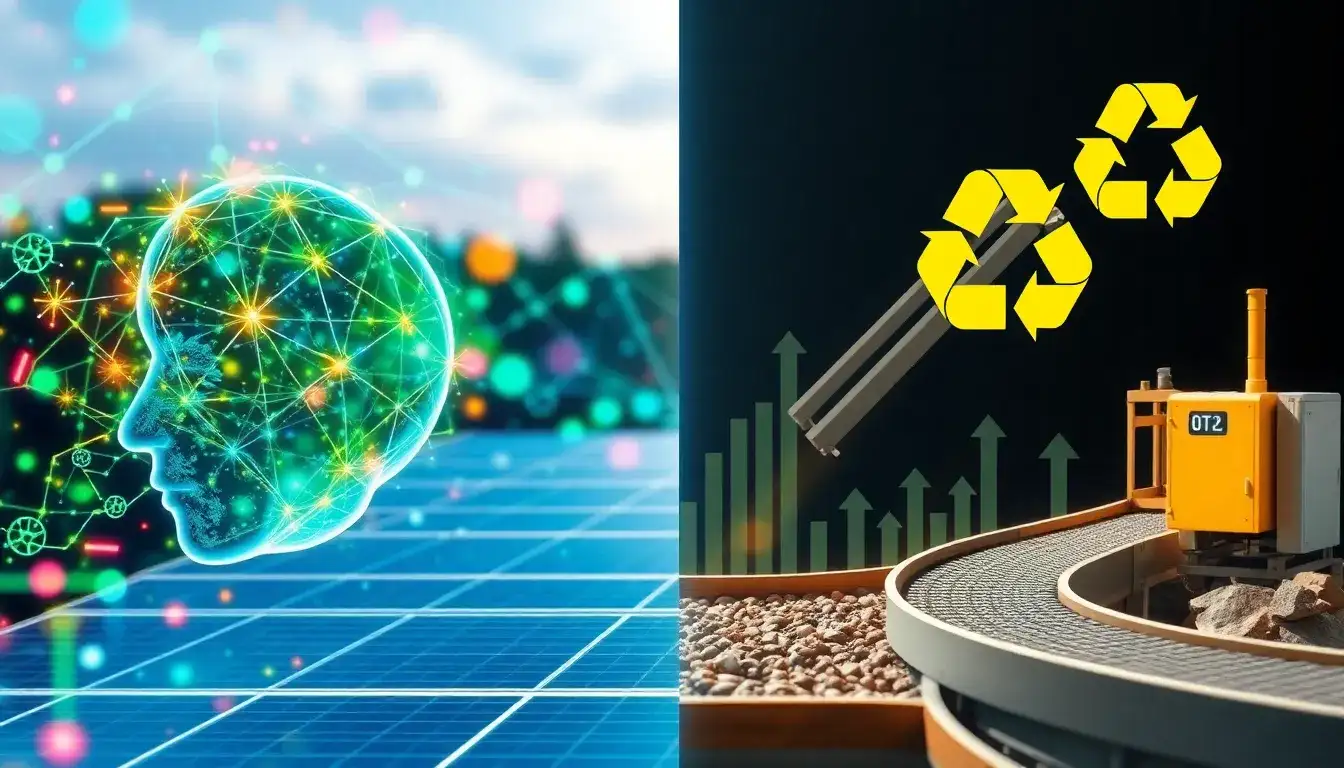
AI vision technology significantly outperforms traditional methods in photovoltaic (PV) solar panel recycling efficiency through improved automation, precision, and material recovery.
Key Advantages of AI Vision Technology over Traditional Methods in PV Recycling
- Automated Identification and Sorting
AI vision systems utilize cameras, sensors, and machine learning algorithms to scan solar panels and identify materials such as glass, aluminum, silicon, copper, and plastics with high accuracy. This contrasts with traditional manual or semi-automated methods that rely on less precise human sorting or mechanical separation without adaptive recognition capabilities. - Enhanced Processing Efficiency
For example, the U.S. startup’s PV Circulator machine processes one panel per minute (60-cell or 72-cell), automatically removing aluminum frames and junction boxes, milling the rest of the materials layer-by-layer, and using airflow cooling to prevent chemical reactions. This automated process greatly reduces human labor and error, improving throughput and lowering waste. - Material Integrity and Recovery Quality
AI vision enables selective separation that preserves the semiconductor and conductive properties of silicon and metals. By carefully identifying and separating components, AI-assisted recycling prevents contamination and mixing of materials, which traditional methods often suffer from, thereby enhancing the quality and usability of recovered materials for reuse. - Continuous Learning and Optimization
AI systems are built with neural networks that share learning experiences across units, allowing ongoing self-optimization without duplicated machine learning efforts. Traditional systems do not have this adaptive capability, limiting their efficiency improvements over time. - Support for Circular Economy
By improving the precision in recycling and enabling the recovery of high-quality secondary materials (e.g., ground glass pozzolan for cement), AI vision recycling technologies contribute to sustainable circular economy goals more effectively than traditional recycling.
Summary Comparison Table
| Feature | Traditional PV Recycling | AI Vision-Based PV Recycling |
|---|---|---|
| Material Identification | Manual or mechanical, less precise | AI-powered vision and sensor-based, highly accurate |
| Processing Speed | Slower, dependent on manual labor | High throughput, automated 1 panel/minute or more |
| Material Recovery Quality | Risk of contamination, mixed materials | Preserves material properties, selective separation |
| Automation Level | Low to medium, human-intensive | High, fully automated with self-optimization |
| Adaptability and Optimization | Limited, fixed processes | Neural-network based continuous learning |
| Contribution to Circular Economy | Moderate | High, enables reuse of valuable materials |
In conclusion, AI vision technology provides a more efficient, precise, and sustainable approach to PV recycling compared to traditional methods, resulting in better material recovery, faster processing, and lower environmental impact.
Original article by NenPower, If reposted, please credit the source: https://nenpower.com/blog/how-does-ai-vision-technology-compare-to-traditional-methods-in-pv-recycling-efficiency/

