

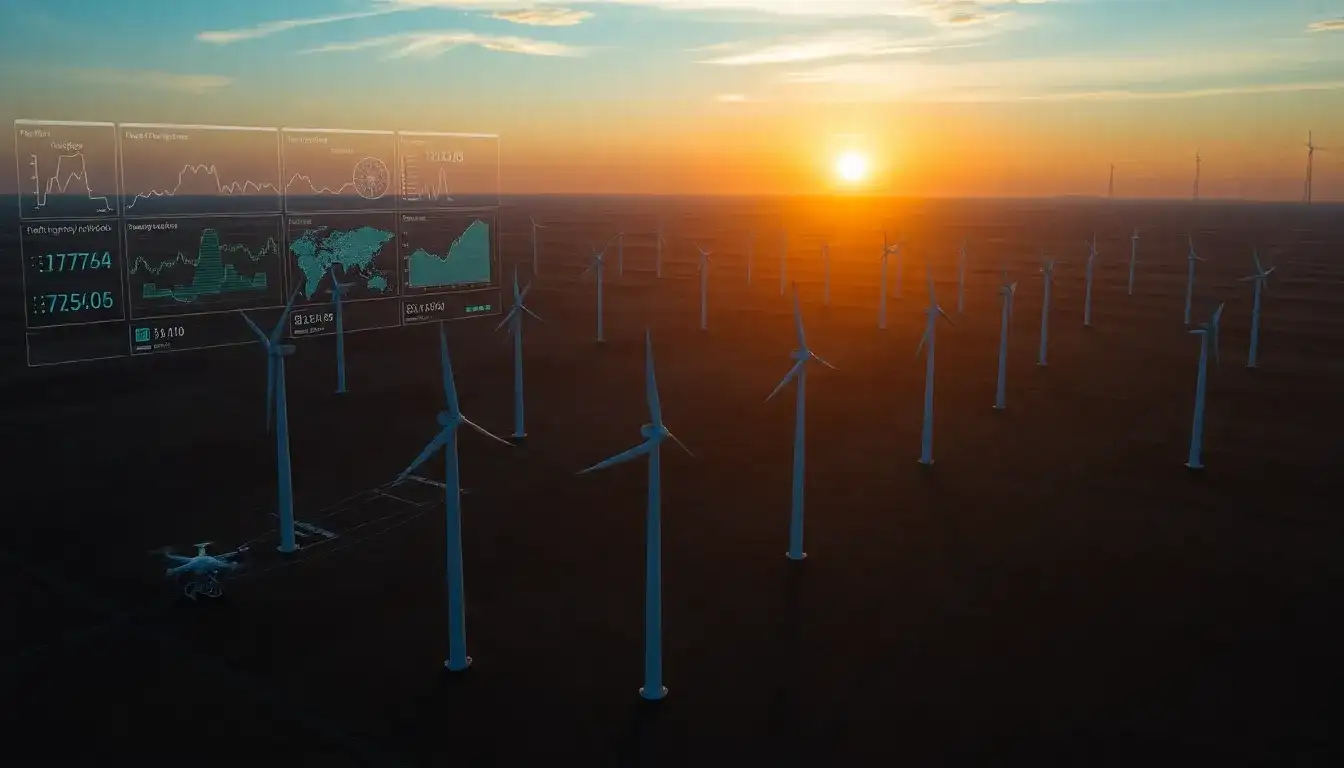
AI optimizes wind farm layouts primarily by improving turbine placement and operational strategies to maximize energy production and reduce costs while minimizing environmental impact.
Key AI Optimization Strategies for Wind Farm Layouts
Wake Steering Optimization
One of the most significant AI contributions is optimizing wake steering — the control of turbine operations so that the wake (turbulent airflow) from upstream turbines is redirected away from downstream turbines, thus reducing energy losses. AI models, such as the Wind Plant Graph Neural Network (WPGNN) developed by NREL, are trained on extensive simulations of tens of thousands of wind farm layouts under various wind and environmental conditions. This allows the AI to determine optimal turbine positions and yaw settings to enhance overall plant energy output.
Reduction in Land Use and Cost
By applying wake steering and other AI-driven optimizations, future wind farms can reduce land requirements by an average of 18%, and in some cases by up to 60%, enabling more turbines in a smaller area and potentially lowering project costs. This also provides greater site-planning flexibility and economies of scale for developers.
Integration of Machine Learning and Evolutionary Algorithms
Beyond wake steering, traditional physics-based flow models combined with AI search algorithms like genetic algorithms are used to explore and find optimal turbine layouts efficiently. Machine learning surrogate models accelerate this process by approximating complex flow physics, enabling faster design iterations and better solutions.
Site Selection and Suitability Analysis
AI employs machine learning to analyze large datasets, including wind patterns, topography, and environmental constraints, to assess and rank potential sites for wind farms. Satellite imagery and object detection algorithms help identify obstacles and land features to exclude unsuitable locations early in the development process, saving time and resources.
Adaptive Turbine Operation
AI also optimizes turbine control parameters such as blade pitch and yaw angles in real time according to shifting wind conditions. This dynamic adjustment maximizes energy capture and turbine lifespan.
Summary Table
| Optimization Aspect | AI Technique / Tool | Benefit |
|---|---|---|
| Wake Steering | Graph Neural Networks (WPGNN), FLORIS | Improved energy production; reduced wake losses |
| Layout Design | Evolutionary algorithms, ML surrogate models | Faster optimization; cost reduction |
| Site Suitability Analysis | ML models, satellite imagery, object detection (YOLO, Faster R-CNN) | Efficient site selection; risk reduction |
| Turbine Operation & Maintenance | AI predictive maintenance, real-time control optimization | Reduced downtime; increased energy output |
In conclusion, AI optimizes wind farm layouts by simulating numerous design and operational scenarios, enabling smarter turbine placement and angle adjustments (wake steering), better site selection, and predictive maintenance, thereby increasing efficiency, reducing land use, and lowering costs.
Original article by NenPower, If reposted, please credit the source: https://nenpower.com/blog/how-does-ai-optimize-the-layout-of-wind-farms/

