

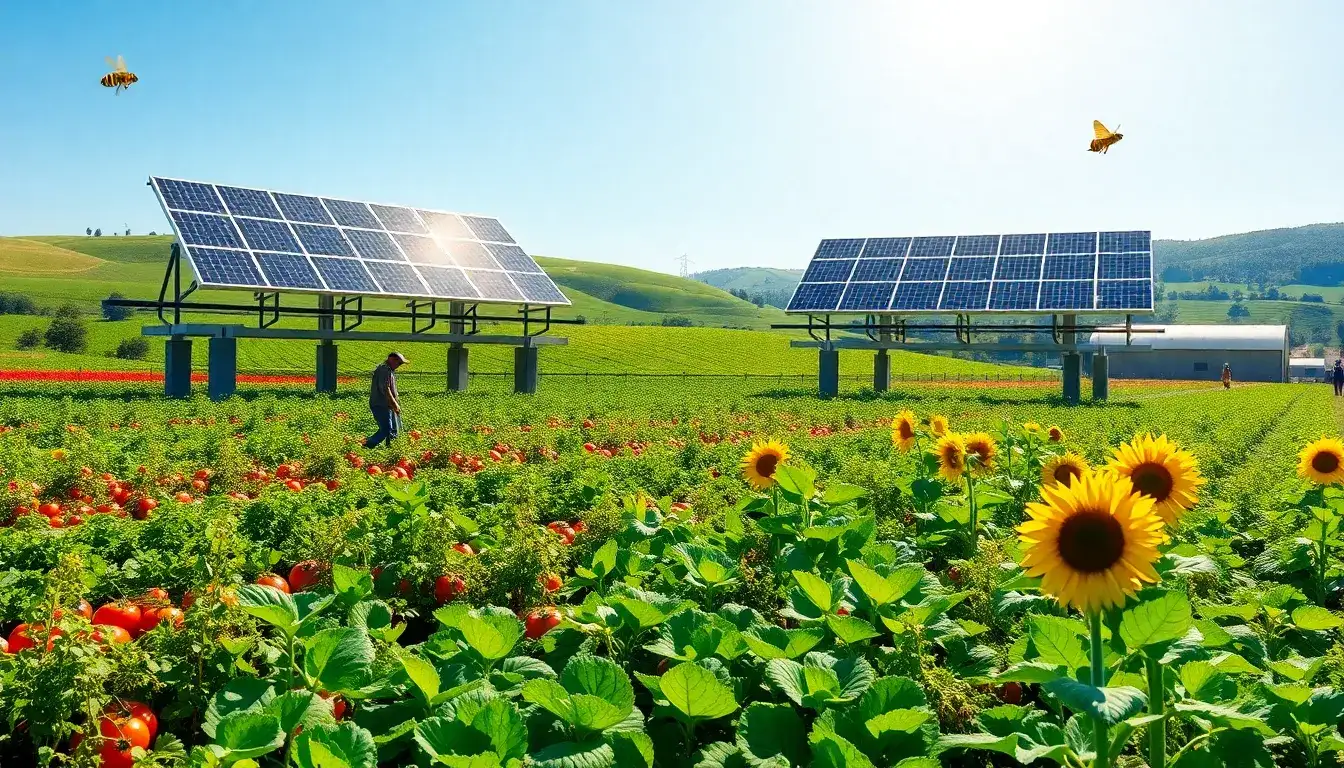
Agrivoltaics integrates solar energy with agriculture by combining the production of solar photovoltaic energy and agricultural activities on the same land. This dual use of land allows farmers to harvest solar energy while simultaneously growing crops or raising livestock, effectively maximizing land productivity and providing a diversified income stream.
How Agrivoltaics Works
Agrivoltaic systems are designed to mutually benefit both solar energy generation and agricultural production by carefully planning the placement, height, and orientation of solar panels in relation to crops or livestock. There are three primary system designs:
- Interleaved arrays and crops: Solar panels installed between rows of crops.
- Elevated arrays above crops/livestock: Panels mounted on structures several meters above the ground to allow farm machinery access and continued agricultural use.
- Arrays on greenhouses: Solar panels integrated onto greenhouse roofs to support crop growth underneath.
The solar panels provide partial shade, which can reduce heat stress on plants, help retain soil moisture, and lower temperatures, creating a favorable microclimate for certain crops. This shade is especially beneficial for shade-tolerant plants like lettuce, basil, spinach, and some peppers, and it can protect livestock as well.
Benefits of Integrating Solar and Agriculture
- Increased land-use efficiency: Agrivoltaics enables simultaneous use of land for energy and food production, avoiding competition for land resources.
- Improved crop microclimate: Partial shading lowers air temperature, reduces water evaporation, and can enhance crop quality and yields for some species.
- Enhanced solar panel efficiency: The cooler microclimate created by evapotranspiration from plants or soil moisture helps cool solar panels, which improves their energy output.
- Economic diversification: Farmers benefit from both agricultural products and solar energy revenue, which can stabilize income and reduce financial risks.
- Environmental benefits: Agrivoltaics can reduce greenhouse gas emissions and fossil energy use compared to separate agricultural or solar systems, contributing to sustainability goals.
Challenges and Considerations
- Shade tolerance: Not all crops thrive under solar panels; selecting shade-tolerant species is critical to success.
- Trade-offs: There may be some loss in crop yield or quality for full-sun crops, requiring balancing between optimizing energy production and agricultural output.
- Cost and design complexity: Elevated solar panel structures and agrivoltaic installations involve higher initial investment and operational costs, demanding careful financial planning and sometimes government incentives.
- Land use and management: Proper integration requires planning for maintenance, grazing (if livestock is involved), and ensuring access for farming equipment.
Examples and Applications
- Crops like lettuce, basil, broccoli, spinach, and tomatoes have shown increased yields or improved quality under solar panels.
- Livestock grazing, especially sheep, can be integrated within solar panel arrays to manage vegetation without mowing, offering a win-win for solar maintenance and farming operations.
- Pollinator-friendly plants can also be cultivated on solar sites to support ecosystem health.
In summary, agrivoltaics strategically combines solar energy systems with agricultural production on the same land to create synergistic benefits, enhancing land productivity, microclimate conditions, solar panel efficiency, and farm income, while also supporting environmental sustainability. This integration involves optimizing solar panel placement and selecting suitable crops or livestock to minimize trade-offs between energy and food production.
Original article by NenPower, If reposted, please credit the source: https://nenpower.com/blog/how-does-agrivoltaics-integrate-solar-energy-with-agriculture/

