

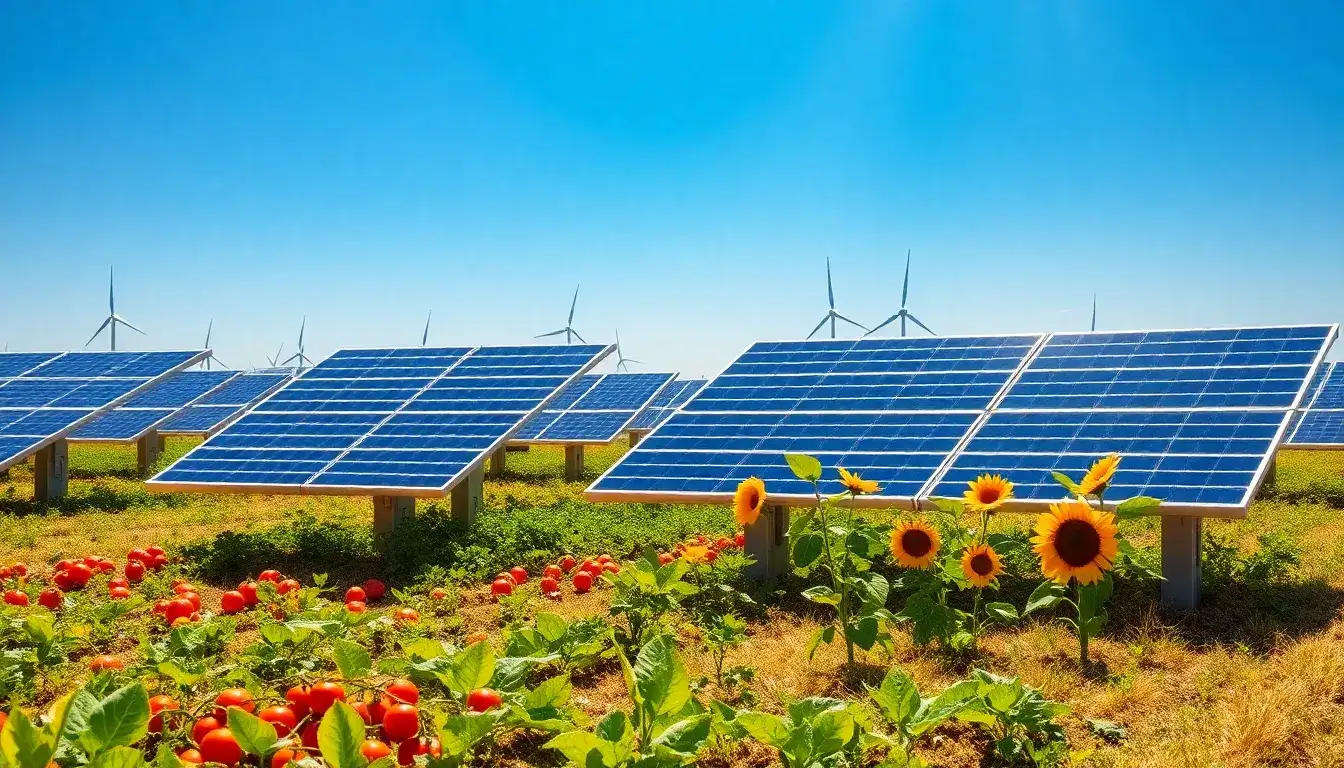
Agrivoltaics contributes to reducing greenhouse gas (GHG) emissions through several interconnected mechanisms by integrating solar power generation with agricultural production on the same land. This dual use of land helps decarbonize agriculture, lowers dependence on fossil fuels, and enhances land-use efficiency, all of which reduce overall carbon emissions. Key points include:
Decarbonizing Agriculture and Energy Supply
- Agriculture and forestry collectively contribute up to 22% of global CO₂ emissions, second only to the energy sector. Agrivoltaics allows simultaneous food production and renewable energy generation, which can significantly reduce emissions from both sectors by replacing fossil fuel-based energy.
- By generating solar electricity onsite, farms can power operations without burning fossil fuels, reducing farm energy-related emissions and costs.
- A small conversion of agricultural land to agrivoltaics (e.g., less than 1%) could meet a substantial portion of energy demand—for example, 20% of U.S. energy needs—highlighting the potential impact on fossil fuel reduction.
Improved Crop and Energy Synergies
- Solar panels provide partial shade, protecting crops from excessive heat and drought stress, which can improve crop resilience in a warming climate and reduce water demand. Reduced water use decreases energy needed for irrigation and associated emissions.
- Evapotranspiration from crops cools the solar panels, enhancing their energy conversion efficiency, which increases renewable energy output per land area.
- Certain agrivoltaic systems have demonstrated increases in crop yields (e.g., 20% increase in potato yield under panels) and doubled fruit production in some cases, indicating more productive land use that can limit land conversion and deforestation elsewhere.
Enhanced Carbon Sequestration and Reduced Emissions from Farming Practices
- Growing vegetation beneath solar panels can enhance soil carbon sequestration by increasing biomass and soil organic carbon, removing CO₂ from the atmosphere.
- Transitioning to pasture-based agricultural practices integrated with solar panels can reduce methane emissions by promoting natural grazing over feed production and mechanized mowing, as well as cutting energy use for feed processing.
Economic and Policy Support Facilitating Adoption
- Financial incentives like the Investment Tax Credit (ITC) and loan guarantees under recent legislation lower the upfront costs of agrivoltaic systems, encouraging wider deployment that accelerates emissions reductions.
Summary Table of Agrivoltaics Contributions to GHG Emissions Reduction
| Contribution Aspect | Description | Impact on Emissions |
|---|---|---|
| Renewable energy generation | Solar power replaces fossil fuel energy on farms | Direct reduction in CO₂ from energy use |
| Dual land use efficiency | Combined crop growth and solar on same land reduces land conversion | Limits deforestation/land-use change emissions |
| Crop microclimate improvement | Shade reduces crop heat/drought stress, lowers irrigation needs | Reduces energy use and water demand |
| Enhanced solar panel efficiency | Plant cooling improves solar panel output | More renewable energy per area |
| Increased soil carbon sequestration | More biomass and healthier soils capture more atmospheric CO₂ | Sequestration reduces net atmospheric CO₂ |
| Sustainable farming practices | Pasture-based grazing reduces emissions from feed and mowing | Reduces methane and energy-related emissions |
| Economic incentives and policy support | Tax credits and loans reduce barriers to adoption | Accelerates deployment and emissions reduction |
In conclusion, agrivoltaics offers a synergistic approach to simultaneously meet energy and food production needs while lowering greenhouse gas emissions. By maximizing land use, improving agricultural resilience, and facilitating renewable energy, agrivoltaics plays a promising role in the global effort to achieve net-zero emissions.
Original article by NenPower, If reposted, please credit the source: https://nenpower.com/blog/how-does-agrivoltaics-contribute-to-reducing-greenhouse-gas-emissions/

