

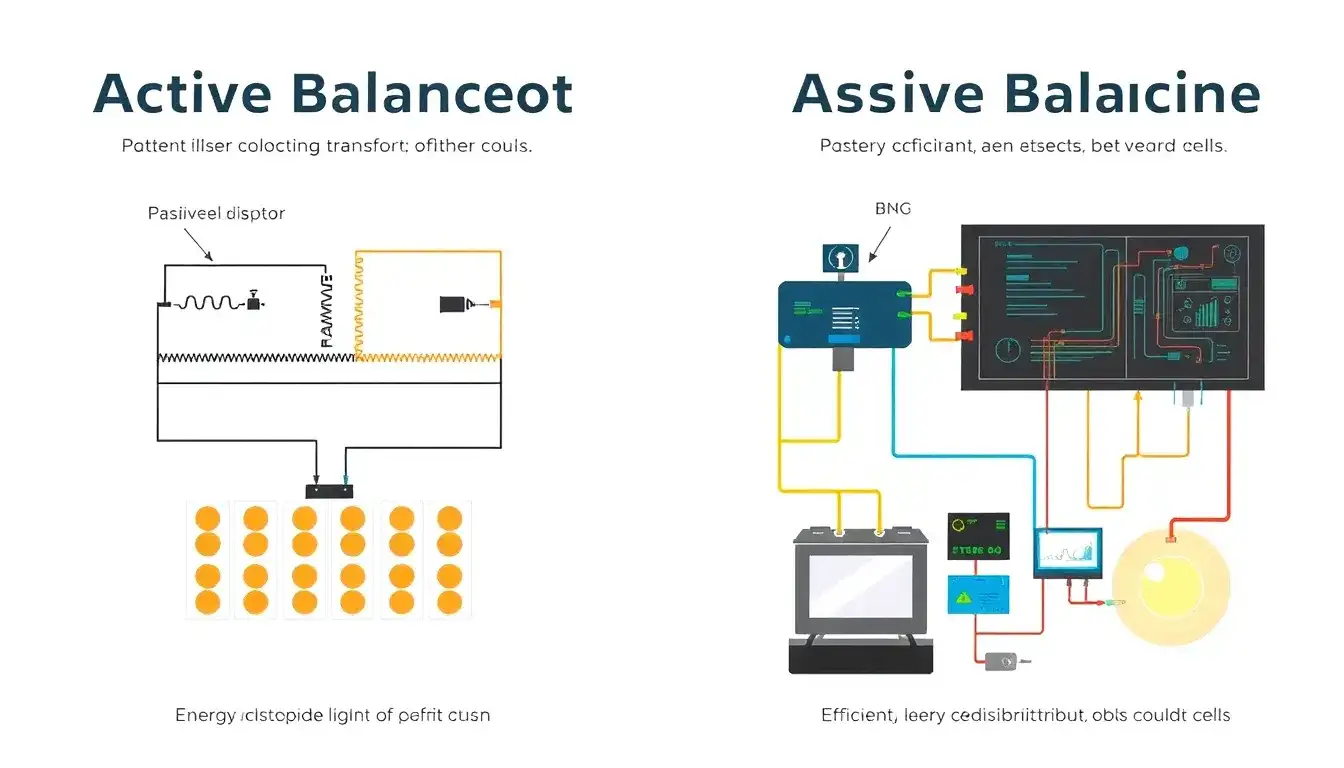
Active Balancing vs. Passive Balancing in Battery Management Systems (BMS)
Active balancing and passive balancing in battery management systems (BMS) differ primarily in how they maintain cell balance within a battery pack. Here’s a comparison of these two methods:
Key Differences
1. Energy Handling
- Active Balancing: This method involves actively transferring energy from higher-charged cells to lower-charged cells. It maintains efficiency by redistributing energy instead of dissipating it, which is beneficial for improving overall battery performance and prolonging battery life.
- Passive Balancing: This method uses resistors to dissipate excess energy from overcharged cells as heat. This process reduces efficiency because it does not redistribute energy but rather wastes it as heat.
2. Speed and Accuracy
- Active Balancing: It is faster and more accurate than passive balancing. Active balancing can be performed in real-time and supports higher current flows, which allows for quicker balancing.
- Passive Balancing: It is slower and less accurate. Passive balancing depends on the natural discharge rate of cells, requiring more time to achieve balance.
3. Complexity and Cost
- Active Balancing: Requires additional circuitry and a more complex BMS design. This complexity increases the cost but offers better performance and efficiency.
- Passive Balancing: It is simpler and less expensive to implement since it requires minimal additional components beyond the basic BMS.
4. Operational Flexibility
- Active Balancing: Can operate during both charge and discharge cycles, offering more flexibility in balancing strategies.
- Passive Balancing: Is typically used during charging cycles, as using it during discharge can hasten energy depletion.
Summary
Active balancing offers superior efficiency, faster balancing times, and improved battery life but at a higher cost and complexity. Passive balancing is simpler and cheaper, but less efficient and effective. The choice between these methods depends on the application’s specific requirements and constraints.
Original article by NenPower, If reposted, please credit the source: https://nenpower.com/blog/how-does-active-balancing-differ-from-passive-balancing-in-a-bms/

