

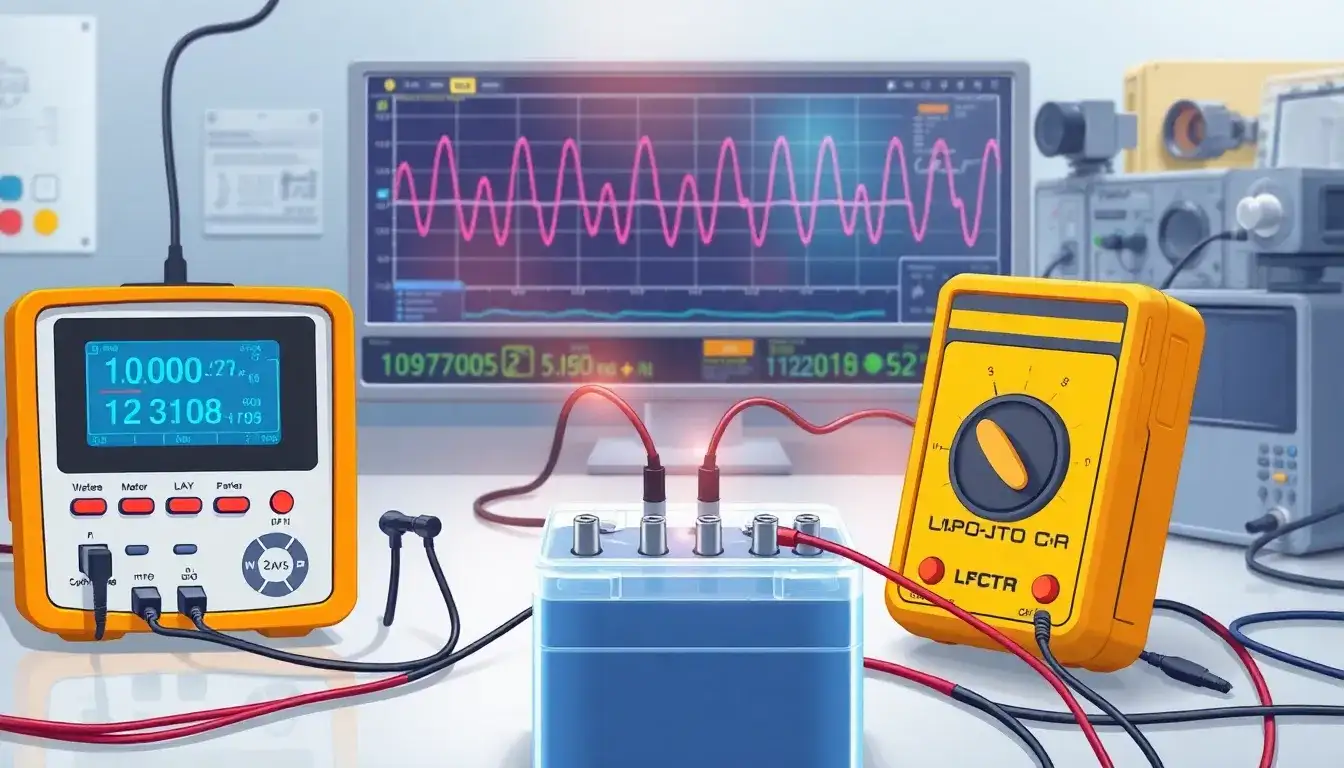
To measure the internal impedance and resistance of a battery system, there are several established methods and equipment depending on the precision and detail required. Here are the key approaches:
Measuring Internal Impedance Using AC Excitation
Principle:
The battery is loaded with a small alternating current (AC), and the resulting AC voltage response is measured. The internal impedance ( Z_i ) is calculated by dividing the output AC voltage ( v_{out} ) by the output AC current ( i_{out} ):
Z_i = \frac{v_{out}}{i_{out}}
Setup:
- An AC current injector generates a sinusoidal AC current fed into the battery.
- The AC current is measured via a current sensor (e.g., current monitor output).
- The AC voltage across the battery terminals is measured with a voltage probe.
- The equipment used might include devices like the Bode 100 and a current injector (e.g., J2111A).
- The maximum battery voltage for such setups is usually limited (e.g., up to 40 VDC in one example).
This method allows accurate measurement of the battery’s impedance over a range of frequencies, which can reveal not only resistive but also reactive components of impedance relating to electrochemical processes inside the battery.
Measuring Internal Resistance Using DC Load Method
Principle:
This method uses Ohm’s law, measuring the battery voltage under two conditions:
- Open-circuit voltage (OCV) — no load applied.
- Loaded voltage — applying a known load and measuring the reduced voltage.
The current through the battery during the load test is calculated by dividing the load voltage by the load resistance. Then, the internal resistance ( R ) is calculated by:
R = \frac{V_{no\ load} – V_{load}}{I_{load}}
where ( V_{no\ load} ) is the open-circuit voltage, ( V_{load} ) the voltage under load, and ( I_{load} ) the current through the load.
Best Practices:
- Use separate wiring for voltage measurement and current load to avoid measurement errors due to lead resistance.
- Measure both battery terminals properly to capture total internal resistance.
- The resistance values typically lie in the milliohm range, so high precision is needed.
Advanced Measurement: Cole-Cole (Nyquist) Plot via Electrochemical Impedance Spectroscopy (EIS)
Principle:
Using impedance analyzers or specialized battery testers, the battery is subjected to a range of AC frequencies (e.g., from 100 mHz to 1 kHz). The effective resistance and reactance are measured and presented as Cole-Cole or Nyquist plots. This method breaks down the internal impedance into:
- Ohmic resistance (including weld resistance)
- Charge transfer resistance (reaction resistance)
- Diffusional resistance (Warburg impedance)
It is a comprehensive method that gives insights into the battery’s electrochemical behavior and aging.
Equipment:
- Battery impedance testers (e.g., Hioki BT4560, BT3562) capable of frequency sweeps and Cole-Cole plot generation.
- Software tools (LabVIEW or specialized software) to analyze equivalent circuits and extract resistance components.
Summary Table of Methods
| Method | Measurement Setup | Key Parameters | Accuracy / Details |
|---|---|---|---|
| AC Impedance Measurement | AC current injection, voltage probe | Z_i = \frac{v_{out}}{i_{out}} | Measures impedance (resistance + reactance) at given frequency; good for detailed analysis. |
| DC Load Method (Ohm’s Law) | Voltmeter, known load resistor | R = \frac{V_{no\ load} – V_{load}}{I_{load}} | Simple, estimates internal resistance; affected by load accuracy. |
| Electrochemical Impedance Spectroscopy (EIS) | Frequency sweep with specialized tester | Cole-Cole plot parameters (R, X) | Detailed impedance spectrum; breaks down resistance components; requires specialized equipment. |
In conclusion, the choice of method depends on required detail and equipment availability. For quick estimation, the DC load method is common, while AC impedance measurement and EIS provide nuanced insights into the battery’s internal electrochemical properties. For precise and frequency-dependent impedance measurement, using an AC current injection with dedicated instruments and software analysis is the standard approach.
Original article by NenPower, If reposted, please credit the source: https://nenpower.com/blog/how-do-you-measure-the-internal-impedance-and-resistance-of-a-battery-system/

