

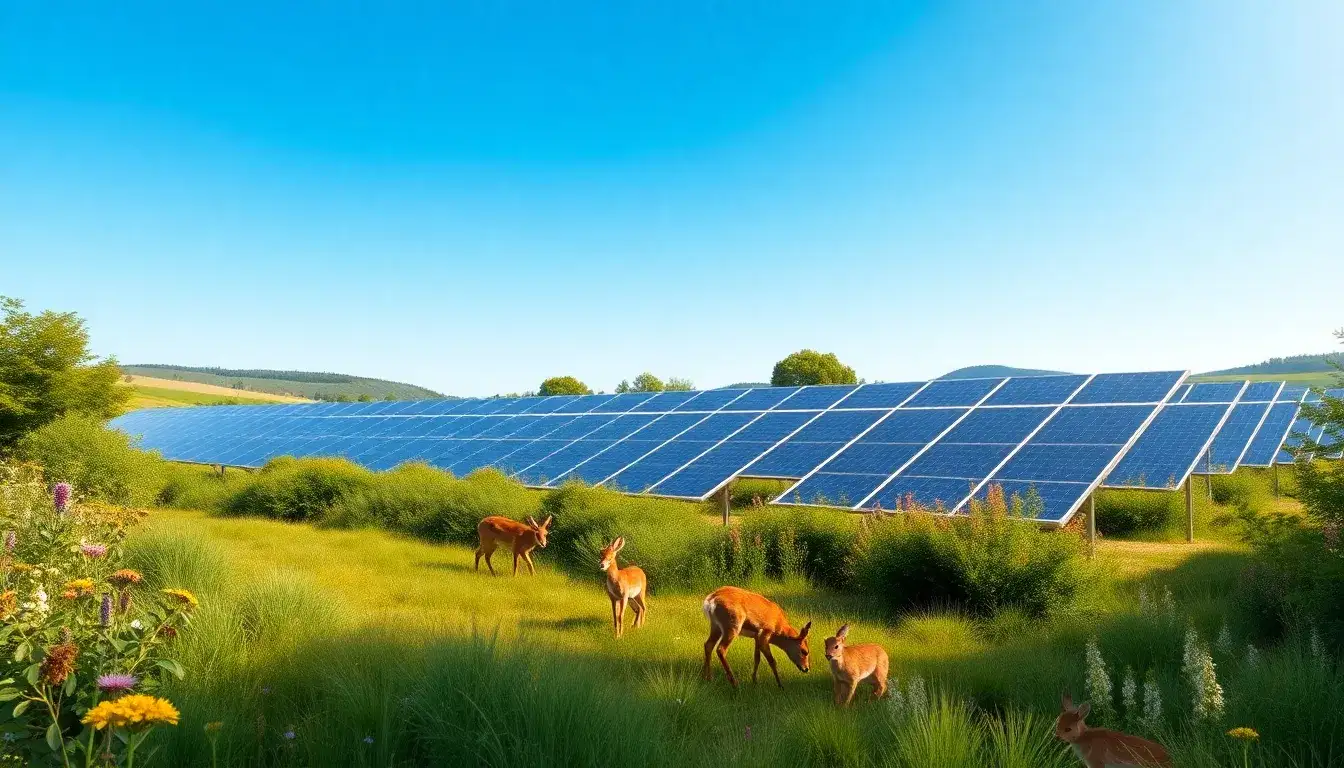
Wildlife-friendly solar energy projects ensure minimal habitat disruption through a combination of careful site selection, innovative design, and active management tailored to protect local wildlife and ecosystems.
Key Strategies to Minimize Habitat Disruption
1. Thoughtful Site Selection
Projects prioritize placement away from high conservation value areas, such as critical wildlife habitats, and instead use locations with less ecological sensitivity like retired agricultural lands, near urban infrastructure, or previously disturbed areas. This reduces direct habitat loss and fragmentation.
2. Innovative Solar Panel Placement and Design
- Panels are installed to preserve existing vegetation and natural topography rather than clearing entire areas.
- Increasing spacing between panels (e.g., from industry standard 14 feet to 20 feet) allows more sunlight to reach the ground, supporting plant growth underneath and maintaining habitat quality for native species.
- Elevating solar panels higher off the ground (e.g., setting panels 42 inches above ground vs. the standard 24 inches) enables understory vegetation and facilitates wildlife movement below the panels.
3. Maintaining Habitat Connectivity
- Wildlife passageways are incorporated into fencing designs by creating openings allowing animals to safely pass through the solar project boundaries, thus preserving migration or movement corridors.
- Permeable fencing allows medium-sized mammals and other wildlife to move freely, preventing habitat fragmentation and isolation.
4. Wildlife-Specific Protection Measures
- Temporary relocation of sensitive species like desert tortoises before construction avoids direct harm, combined with radio tracking to monitor their long-term residency and movements.
- Staff training on local wildlife issues (e.g., desert tortoise awareness) reduces negative interactions during maintenance.
- Limiting maintenance vehicle size and speed reduces disturbance and mortality risks.
5. Habitat Restoration and Enhancement
- Solar projects often incorporate native vegetation and pollinator-friendly plants beneath and around panels, creating valuable habitats for insects, birds, and small mammals.
- By protecting land from urban sprawl and eliminating the use of water and pollutants typical of fossil fuel generation, solar projects contribute to healthier ecosystems overall.
6. Monitoring and Adaptive Management
- Use of camera traps and wildlife monitoring informs ongoing management to balance energy production with conservation goals.
- Real-time monitoring systems in some projects track sensitive species movements to adapt protective measures as needed.
Summary Table
| Approach | Description | Wildlife Benefits |
|---|---|---|
| Site selection | Avoid high conservation areas, prioritize disturbed lands | Minimizes habitat loss and fragmentation |
| Panel placement/design | Elevated, spaced panels to allow vegetation and movement | Supports plant growth, animal underpass |
| Habitats connectivity | Fencing with openings; permeable fencing | Maintains wildlife corridors and genetic flow |
| Species-specific protection | Temporary relocation, staff training, slow vehicle speeds | Reduces direct harm to at-risk species |
| Habitat restoration | Native vegetation, pollinator habitats | Enhances biodiversity, supports ecosystem services |
| Monitoring and adaptive management | Camera traps, radio telemetry, mitigation adjustments | Informs and improves conservation outcomes |
By combining these approaches, wildlife-friendly solar projects can successfully meet renewable energy goals while maintaining functional habitats and supporting local wildlife populations, demonstrating that energy development and conservation can coexist effectively.
Original article by NenPower, If reposted, please credit the source: https://nenpower.com/blog/how-do-wildlife-friendly-solar-energy-projects-ensure-minimal-habitat-disruption/

