

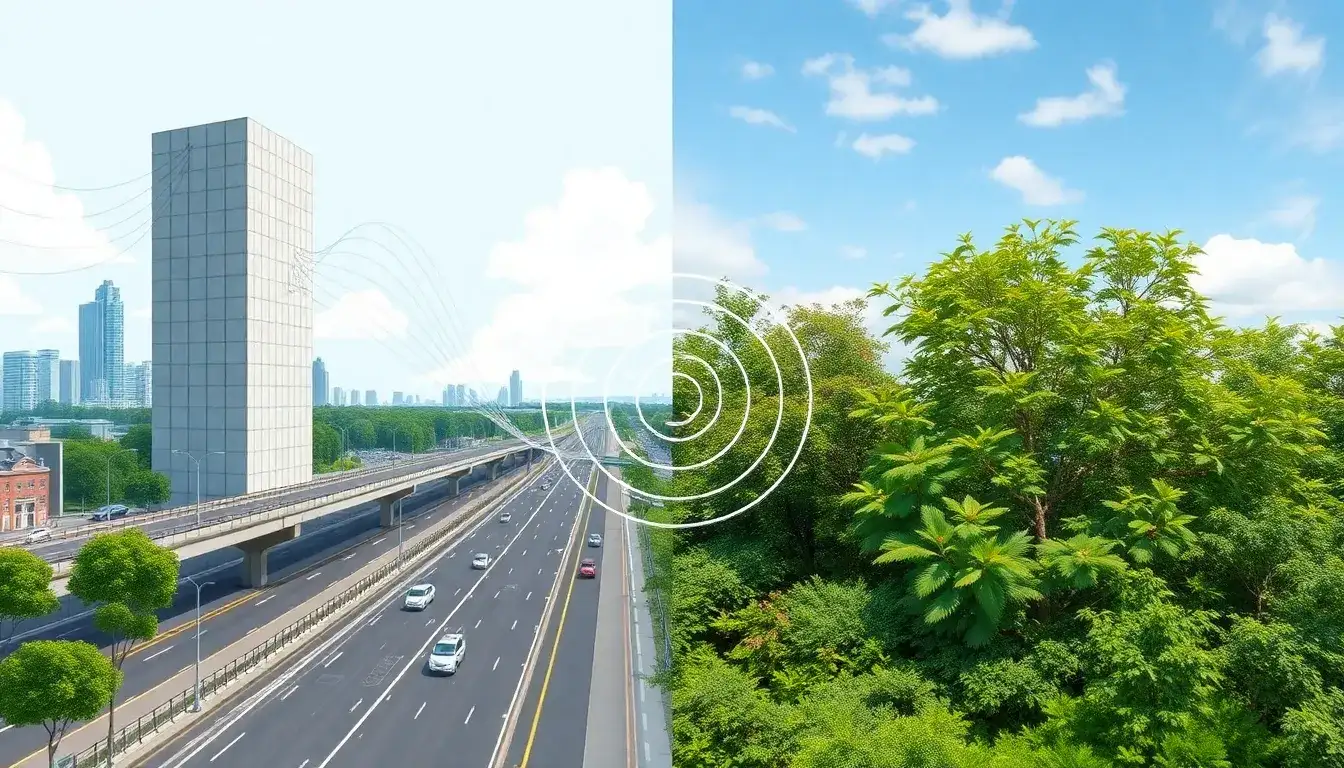
Vegetative barriers and traditional noise barriers differ significantly in their noise reduction effectiveness and additional benefits.
Effectiveness in Noise Reduction
- Traditional Noise Barriers (e.g., concrete walls, soundproof fences) provide immediate and substantial noise reduction by physically blocking sound waves. Their solid structures reflect and absorb sound efficiently, offering significant relief from noise pollution near the source.
- Vegetative Barriers reduce noise by absorbing, deflecting, and scattering sound waves rather than blocking them entirely. Their effectiveness depends on factors such as tree species, density, height, and placement relative to the noise source. Dense foliage, broad leaves, and rough bark surfaces contribute to sound scattering and absorption. Additionally, the combination of trees with shrubs and grasses helps absorb lower-frequency sounds that vegetation or barriers alone might not mitigate.
- Vegetative barriers generally require wide and dense planting strips near the noise source to effectively abate traffic noise, as scattered and absorbed sounds reduce noise intensity, particularly in mid- and high-frequency ranges.
- Research shows that vegetation alone is less effective than solid noise barriers at reducing noise levels but can complement them when used together. For example, vegetation planted to a height exceeding that of a solid noise barrier improves airflow and enhances pollutant and sound reduction downwind, suggesting a synergistic effect.
Additional Benefits of Vegetative Barriers
- Unlike traditional noise barriers, vegetative barriers offer ecological and psychological benefits, such as improving air quality, regulating temperature, stabilizing soil, and providing wildlife habitats.
- The natural rustling of leaves can create a white noise effect that helps mask unpleasant urban sounds.
Summary Comparison
| Aspect | Traditional Noise Barriers | Vegetative Barriers |
|---|---|---|
| Noise Reduction | Immediate, significant, physical block | Moderate, through absorption and scattering |
| Frequency Range | Effective across a broad range | More effective for mid- to high-frequency sounds |
| Additional Benefits | Limited to noise control | Air quality improvement, temperature regulation, habitat creation |
| Visual/Aesthetic Impact | Often visually harsh | Visually appealing and natural |
| Synergy | Can be combined with vegetation for enhanced results | Can supplement solid barriers but less effective alone |
In conclusion, while traditional noise barriers are more effective for direct and immediate noise reduction, vegetative barriers provide moderate noise attenuation with important environmental and aesthetic benefits. The best overall noise mitigation strategy often involves combining both methods to leverage their complementary strengths.
Original article by NenPower, If reposted, please credit the source: https://nenpower.com/blog/how-do-vegetative-barriers-compare-to-traditional-noise-barriers-in-terms-of-effectiveness/

