

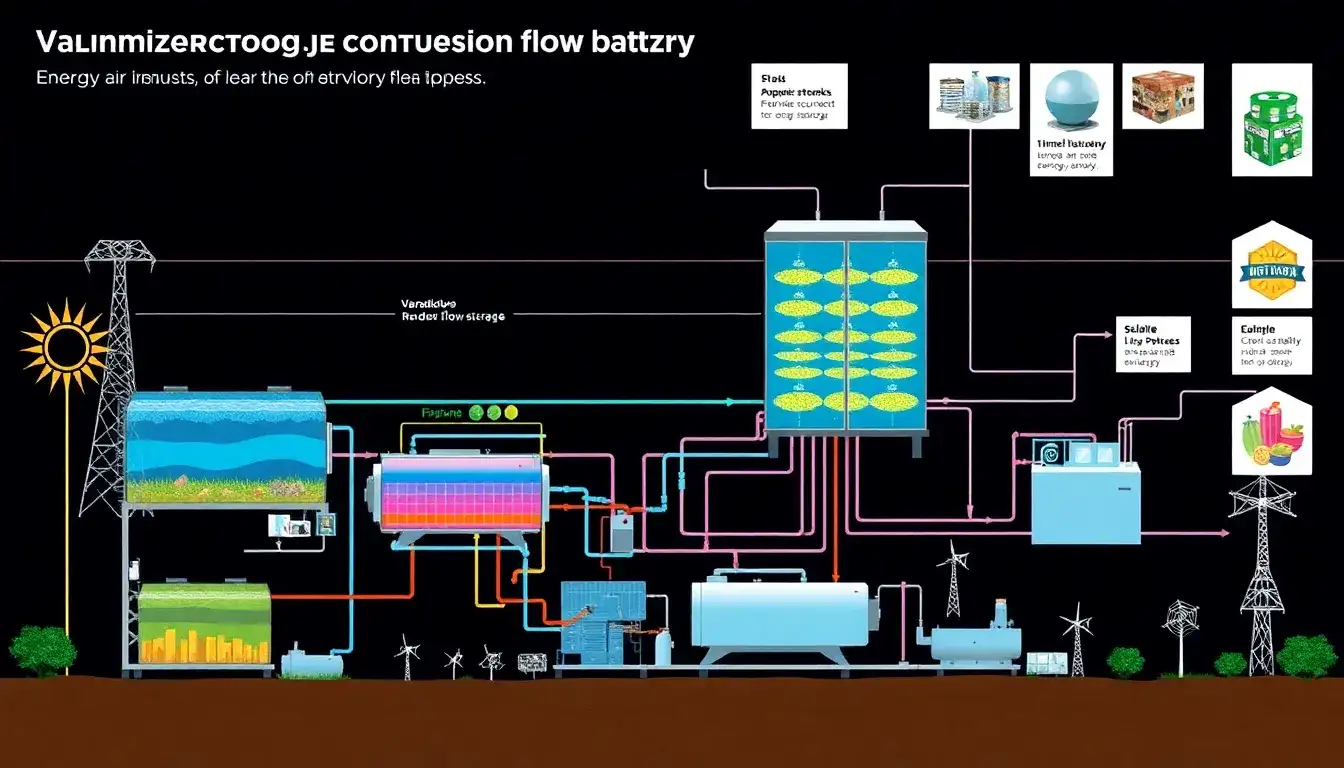
Vanadium redox flow batteries (VRFBs) stand out among long-duration energy storage (LDES) technologies for grid integration due to several distinctive advantages:
Comparison of VRFBs to Other LDES Technologies in Grid Integration
1. Safety and Environmental Impact
- VRFBs use a non-flammable electrolyte, eliminating risks of thermal runaway typical in lithium-ion batteries.
- Their manufacturing results in significantly lower CO2 emissions (78% less than lithium-ion).
- The vanadium electrolyte is fully recyclable, enabling sustainability and reduced environmental impact at end of life.
2. Lifespan and Durability
- VRFBs have an effectively unlimited cycle life with proper maintenance, maintaining stable capacity over 20+ years.
- They tolerate deep discharges (up to 100%) without degradation, unlike solid-state batteries whose performance declines over time due to heat and cycling stresses.
3. Scalability and Flexibility
- The liquid electrolyte allows easy scaling by increasing electrolyte volume or adding modules, providing virtually unlimited capacity.
- VRFBs are well suited for medium- to long-duration storage needs (4 to 12 hours), outlasting typical lithium-ion battery durations of 2-4 hours.
- Rapid response times in the millisecond range aid in providing grid ancillary services and stability.
4. Applications in Grid Integration
- VRFBs support renewable energy integration by storing excess generation and supplying power when renewable sources (e.g., solar, wind) are unavailable, mitigating curtailment.
- They enable microgrid and virtual power plant (VPP) setups where local generation can be matched with demand or feed excess power back to the main grid.
- Their suitability for peak shaving, long-term energy shifting, and critical load support makes them ideal for utility-scale and distributed grid applications.
Summary Table
| Feature | Vanadium Redox Flow Battery (VRFB) | Other LDES (e.g., Lithium-ion, Solid-state) |
|---|---|---|
| Safety | Non-flammable, no thermal runaway risk | Flammable, risk of thermal runaway |
| Environmental Impact | Low manufacturing emissions, recyclable electrolyte | Higher emissions, limited recycling |
| Cycle Life | >20 years, stable capacity, unloads deeply | Degrades with cycles and heat |
| Scalability | Modular, electrolyte volume defines capacity | Limited by solid electrode size |
| Storage Duration | 4-12 hours | Typically 2-4 hours |
| Response Time | Milliseconds | Similar, but cycle durability limits use |
| Grid Integration Benefits | Renewable integration, microgrids, VPPs | Good for short duration, less ideal for long duration |
In conclusion, VRFBs offer superior long-duration storage capabilities with high safety, longevity, and sustainability that are particularly advantageous for grid integration of renewable energy and for applications requiring scalable, reliable, long-term storage solutions. This distinguishes them from many other LDES technologies that typically face trade-offs in cycle life, scalability, and safety.
Original article by NenPower, If reposted, please credit the source: https://nenpower.com/blog/how-do-vanadium-redox-flow-batteries-compare-to-other-ldes-technologies-in-terms-of-grid-integration/

