

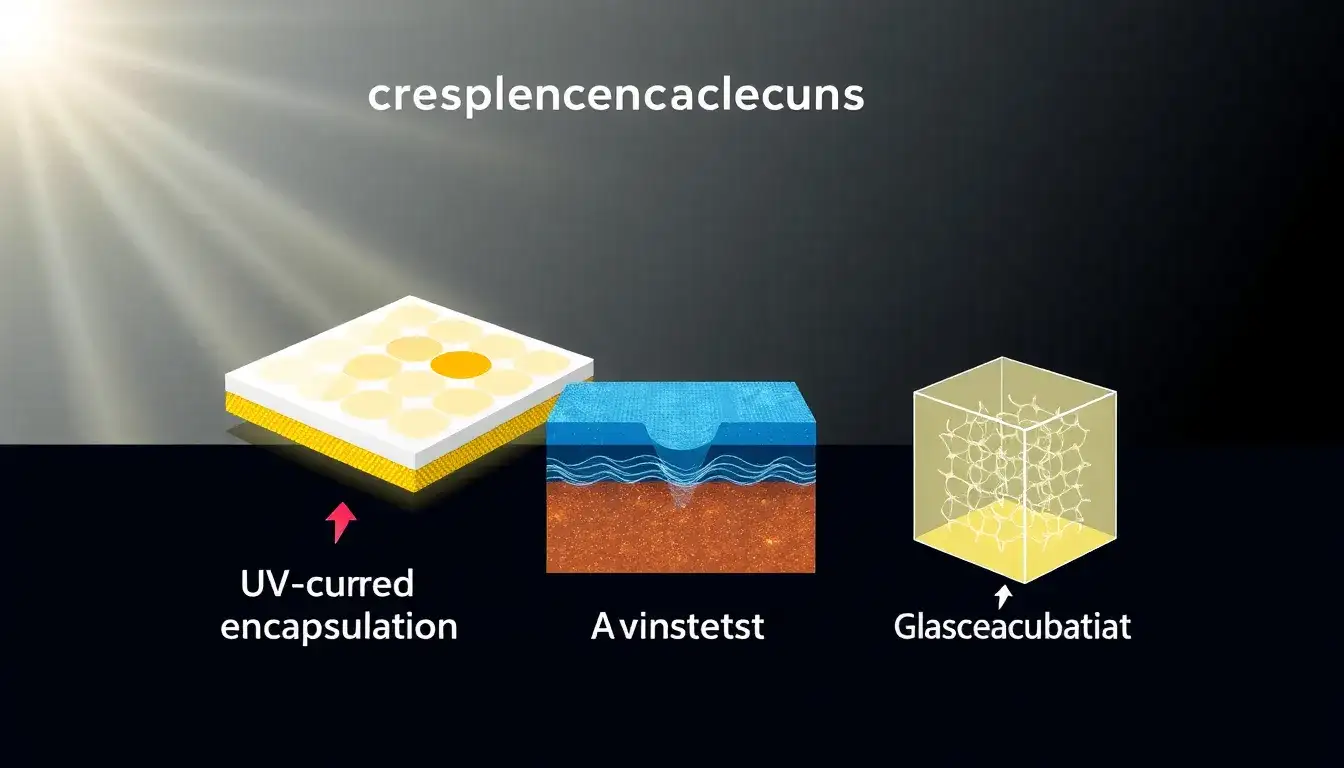
UV-cured encapsulations for perovskite solar cells (PSCs) offer a distinct set of advantages and limitations when compared to other encapsulation methods such as lamination-based glass–glass encapsulation, glue-based interim encapsulation, and flexible encapsulants like polydimethylsiloxane (PDMS).
Comparison of UV-Cured Encapsulation with Other Methods
UV-Cured Encapsulation:
- UV epoxy-based encapsulation can provide stable device performance, especially for carbon-based electrodes, by curing rapidly upon UV exposure to form a protective layer.
- It typically does not require high-temperature processing, which is beneficial since PSCs are sensitive to heat and air exposure.
- However, simple UV epoxy encapsulation may not meet stringent durability standards such as the IEC 61215 damp heat test, which assesses long-term stability under humidity and heat.
Lamination-Based Glass–Glass Encapsulation:
- This method involves vacuum lamination of two glass layers, often with an interlayer adhesive, creating an excellent barrier against moisture and oxygen.
- It has been demonstrated to enable PSCs to retain over 95% of their initial efficiency after 1566 hours in damp heat conditions and more than 10 months of outdoor testing, passing rigorous international standards (IEC 61215).
- It requires the device to withstand short air exposure and elevated temperatures (~150 °C) during processing, which may limit applicability for some device architectures.
Glue-Based Interim Encapsulation:
- This simpler strategy uses adhesive glues and is suitable for short-term protection and transport rather than long-term outdoor stability.
- While it allows PSCs to retain more than 93% of their efficiency after significant ambient storage, it fails the damp heat test and thus has a higher likelihood of fast degradation under real outdoor conditions.
PDMS Flexible Encapsulation:
- Polydimethylsiloxane encapsulation offers flexibility and can be applied via simple methods like dipping.
- Besides providing moisture and oxygen shielding, PDMS encapsulation can be patterned using soft lithography to reduce optical losses, improving power conversion efficiency by about 8% relative to control devices.
- This encapsulation does not require UV curing or high-temperature processing, making it versatile for flexible and rigid PSCs.
- PDMS encapsulation targets both stability enhancement and optical improvement but may not yet match the long-term barrier performance of glass–glass lamination.
Summary Table of Encapsulation Methods for PSCs
| Encapsulation Method | Processing Requirements | Moisture Barrier & Stability | Optical Properties | Suitability | Notes |
|---|---|---|---|---|---|
| UV-Cured Epoxy | UV light curing, room temperature | Moderate stability; may fail damp heat test | Neutral | Good for electrodes sensitive to heat/air | Rapid curing, useful for short-to-medium term |
| Glass–Glass Lamination | Vacuum lamination, elevated heat (∼150°C) | Excellent; passes IEC 61215 damp heat test | Good (glass transparency) | Long-term outdoor, commercialization | Requires heat tolerance, complex processing |
| Glue-Based Interim | Simple glue, ambient | Moderate; fails damp heat test | Neutral | Short-term protection, transport | Not suitable for long-term outdoor use |
| PDMS Flexible Coating | Dip coating, room temperature | Good barrier; flexible | Improves light management & efficiency | Flexible & rigid devices; optical improvement | No UV curing or high temp needed; emerging tech |
Conclusion
UV-cured encapsulation for PSCs is a convenient and effective option providing stable performance with relatively simple processing and rapid curing. However, it generally does not surpass more robust encapsulation methods like glass–glass lamination when it comes to moisture barrier performance and long-term stability under harsh environmental conditions. PDMS encapsulation emerges as a flexible alternative that can enhance both stability and optical efficiency without requiring UV curing or high temperatures but may still be developing to match the durability of lamination methods. Thus, the choice of encapsulation depends on the intended application, balancing ease of processing, stability requirements, and optical performance.
Original article by NenPower, If reposted, please credit the source: https://nenpower.com/blog/how-do-uv-cured-encapsulations-compare-to-other-encapsulation-methods-for-perovskite-solar-cells/

