

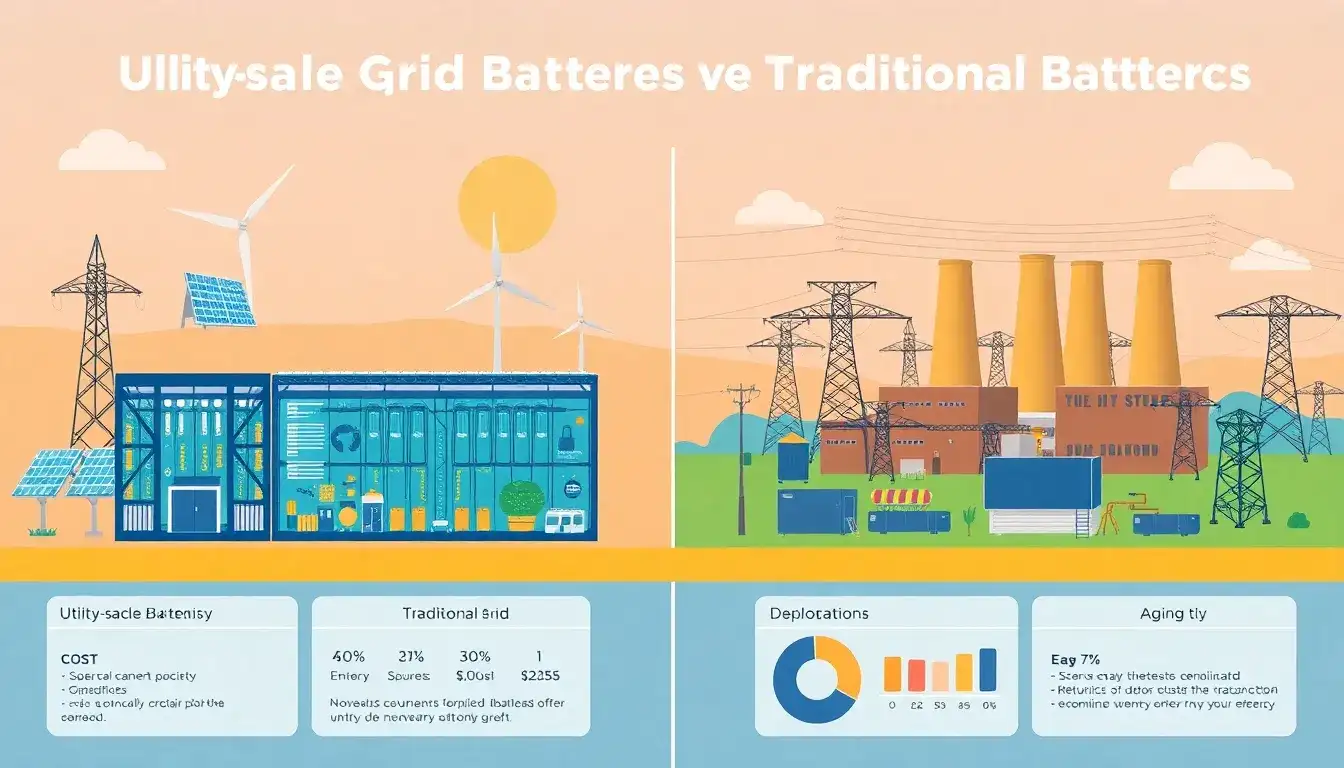
Utility-scale batteries, primarily lithium-ion, have seen significant cost reductions in recent years, making them increasingly competitive but still generally more expensive upfront compared to traditional grid infrastructure.
Cost Comparison of Utility-Scale Batteries vs. Traditional Grid Infrastructure
Utility-Scale Battery Costs
- Installed costs for utility-scale lithium-ion battery systems typically range around $300/kWh (€300-400/kWh in Europe) as of recent data, reflecting a roughly 70% cost decrease over the past decade.
- Total installed costs include the battery cells plus balance-of-system expenses such as power electronics, controls, integration, and installation, roughly doubling the raw battery pack price. For example, a lithium-ion battery cell cost might be ~$150/kWh, but the full grid-scale system installed cost is about $300/kWh.
- Battery storage systems are often designed with specific discharge durations (e.g., 4 hours), affecting costs since longer duration storage tends to be cheaper per kWh but more expensive per kW power capacity.
- Projected cost reductions of around 40% by 2030 are anticipated due to technological improvements and economies of scale, further enhancing competitiveness.
Traditional Grid Infrastructure Costs
- Traditional grid infrastructure components (e.g., transmission lines, transformers, substations) typically have lower upfront capital costs per unit of energy delivered, but they do not provide the same energy storage flexibility or grid services like peak shaving, frequency regulation, and integration of renewables that batteries do.
- Grid upgrades to accommodate increasing renewable penetration or to improve grid resilience can be expensive and complex but are generally cheaper on a pure capital cost basis compared to adding utility-scale battery systems when measured per kWh delivered or stored.
Economic Value Considerations Beyond Capital Cost
- Utility-scale batteries add value by enabling renewable energy integration, providing grid flexibility, peak demand management, and frequency regulation services that traditional grid infrastructure alone cannot efficiently provide.
- Batteries can store excess renewable generation for release during periods when solar or wind are unavailable, helping to stabilize the grid and reduce reliance on fossil fuel peaking plants.
- While batteries currently have higher capital costs than traditional grid assets, their operational flexibility and declining costs are reshaping grid investment strategies towards hybrid approaches combining storage and conventional infrastructure.
Summary
| Aspect | Utility-Scale Batteries | Traditional Grid Infrastructure |
|---|---|---|
| Installed Cost (approximate) | ~$300/kWh (full system) | Generally lower cost per energy delivered |
| Cost Trend | Rapidly decreasing (~70% past decade, 40% projected next decade) | Stable or slowly increasing, depending on upgrades needed |
| Functional Benefit | Energy storage, grid flexibility, renewables integration | Energy transmission and distribution |
| Economic Role | Enables peak shaving, frequency regulation, renewable smoothing | Provides fundamental transmission/distribution |
Utility-scale battery storage currently costs more upfront than traditional grid infrastructure but offers unique grid services and operational flexibility critical for modern grids increasingly reliant on variable renewable energy. Continued cost reductions and performance improvements are bridging the economic gap and enabling broader deployment of battery storage at scale.
Original article by NenPower, If reposted, please credit the source: https://nenpower.com/blog/how-do-utility-scale-batteries-compare-to-traditional-grid-infrastructure-in-terms-of-cost/

