

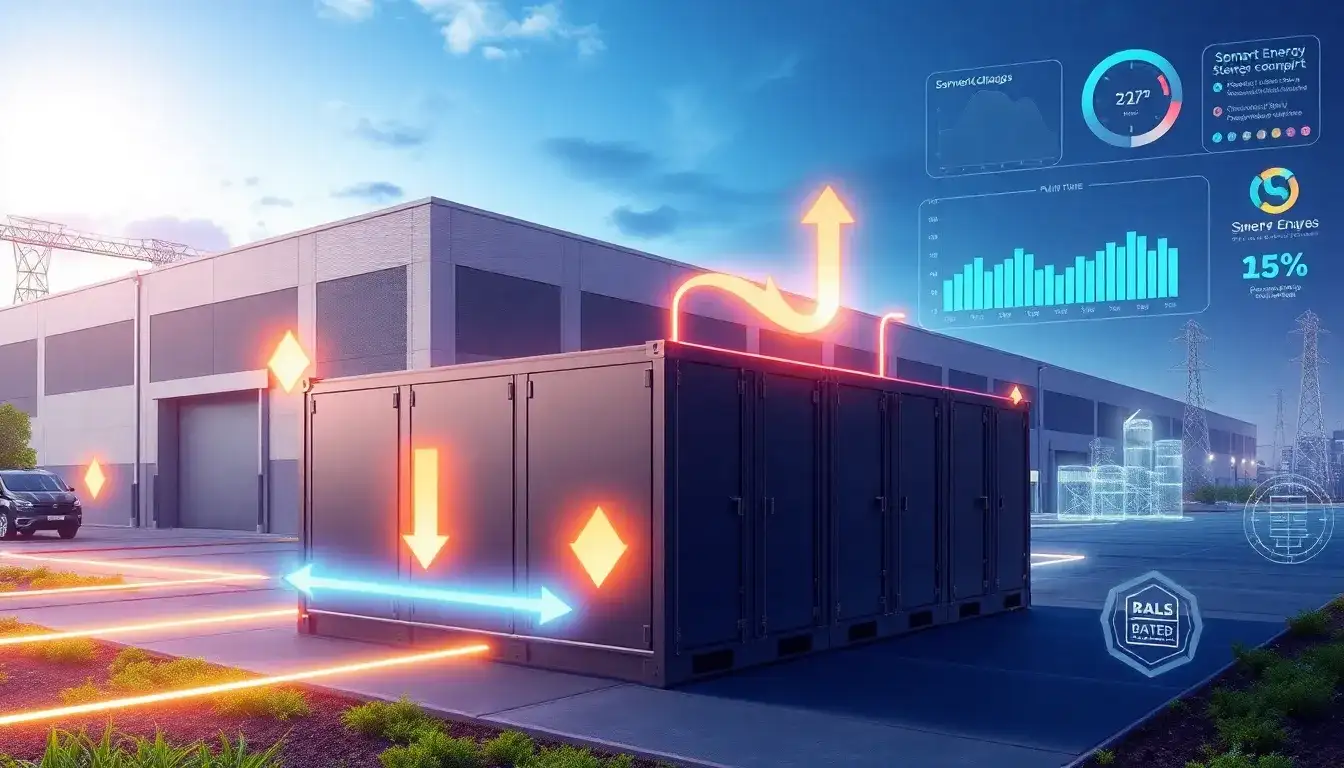
Utility-scale batteries and Demand Charge Reduction
Utility-scale batteries can significantly assist in reducing demand charges for commercial customers by efficiently managing peak electricity usage. Here’s how they help:
Mechanism of Demand Charge Reduction
- Peak Shaving: Batteries charge during off-peak hours when electricity prices are lower, typically using alternating current (AC) from the grid converted to direct current (DC) via an inverter. This stored energy is then used during peak hours to reduce the load on the grid, effectively flattening the demand curve.
- Demand Charge Mitigation: By discharging batteries to meet peak demand, businesses can avoid exceeding their allocated power consumption levels. This prevents them from incurring high demand charges, which are often the largest component of commercial electricity bills.
- Energy Arbitrage: Although not the primary method of reducing demand charges, energy arbitrage involves buying energy at low prices and selling it back to the grid at higher prices. However, for demand charge reduction, the focus is more on smoothing peak demand rather than solely on arbitrage.
Benefits for Commercial Customers
- Cost Savings: Reducing peak demand significantly lowers demand charges, which can be substantial. For many commercial customers in the U.S., these charges exceed $15 per kilowatt.
- Return on Investment: By reducing demand charges, businesses can lower their total cost of ownership for operations like electric vehicle charging stations, making such investments more viable.
- Flatter Load Profile: Utility-scale batteries help maintain a more consistent load profile throughout the day, which can lead to more stable and predictable energy costs.
Overall, utility-scale batteries are a valuable tool for commercial customers looking to manage their energy expenses effectively by reducing the impact of demand charges.
Original article by NenPower, If reposted, please credit the source: https://nenpower.com/blog/how-do-utility-scale-batteries-assist-in-reducing-demand-charges-for-commercial-customers/

