

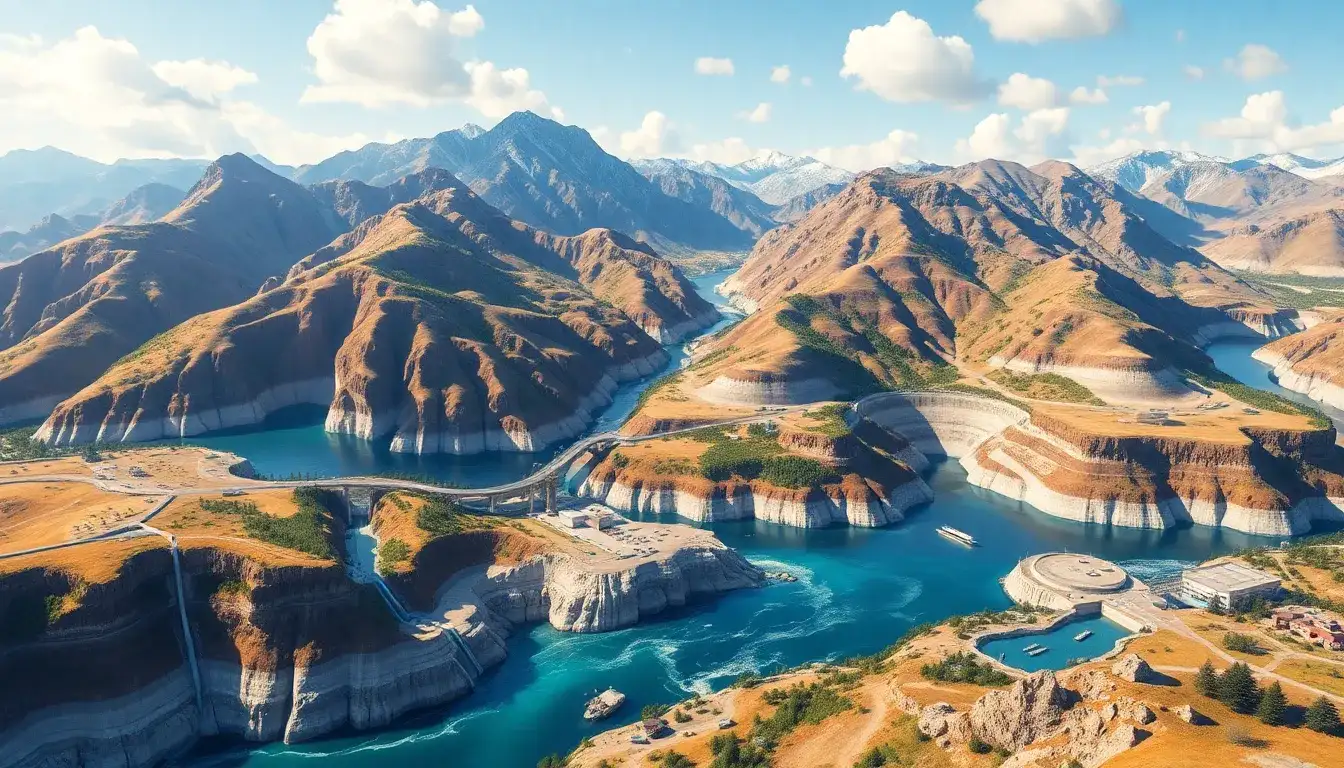
Topographical features critically influence the feasibility of pumped hydro storage (PHS) projects primarily by determining the potential energy storage capacity and the cost-effectiveness of construction. The key impacts of topography on PHS feasibility include:
Importance of Elevation Difference (Head)
- PHS projects rely on storing water at a higher elevation in an upper reservoir and releasing it to a lower reservoir to generate electricity. Hence, a significant elevation difference (head) between these reservoirs is essential to maximize energy storage potential. Regions with higher elevation changes such as the Rocky Mountains, the Cascade Range, and the Alaska Range have a higher density of technically viable PHS sites due to their natural topography.
Suitability of Landforms
- Suitable topographical features include natural depressions or dry gullies that can be utilized to form reservoirs with minimal excavation or earthworks. Using existing land contours reduces civil works and construction costs, which typically represent about two-thirds of the total capital costs for PHS projects.
Closed-loop Systems and Topography
- Closed-loop PHS systems, which are isolated from natural river systems, can be sited where topography allows for reservoirs without impacting aquatic ecosystems. The right topographical setting can enable such closed-loop systems to be located strategically to support grid needs rather than being constrained by proximity to existing water bodies.
Impact on Project Size and Complexity
- Flat or gently sloped terrain presents challenges such as low hydraulic head and the need for large reservoirs with high water volumes, which increases land and water requirements and costs. Conversely, steep terrain allows for more compact reservoirs and higher heads but may increase construction complexity and risk.
Influence on Water Requirements and Environmental Impact
- Topography affects the water volume needed and the availability of natural catchments. High-head sites in mountainous areas generally require less water volume for the same energy storage due to greater potential energy per unit volume, reducing water resource stress and environmental impact.
Summary Table of Topographical Influence on PHS Feasibility
| Factor | Influence on Feasibility |
|---|---|
| Elevation difference (head) | Higher head = higher energy density and efficiency |
| Natural depressions/gullies | Reduce construction costs by using existing reservoirs |
| Terrain steepness | Steep terrain increases head but may complicate build |
| Site isolation from rivers | Enables closed-loop systems minimizing ecological impact |
| Land availability | Flat areas need large reservoirs, increasing costs |
| Regional topography examples | Mountainous Western US has high PHS potential |
In conclusion, topographical features are a primary determinant of pumped hydro storage project feasibility because they affect energy storage capacity, capital and operational costs, environmental impacts, and site location flexibility. Optimal sites generally combine significant elevation difference and suitable landforms to minimize construction and maximize energy storage efficiency.
Original article by NenPower, If reposted, please credit the source: https://nenpower.com/blog/how-do-topographical-features-influence-the-feasibility-of-pumped-hydro-storage-projects/

