

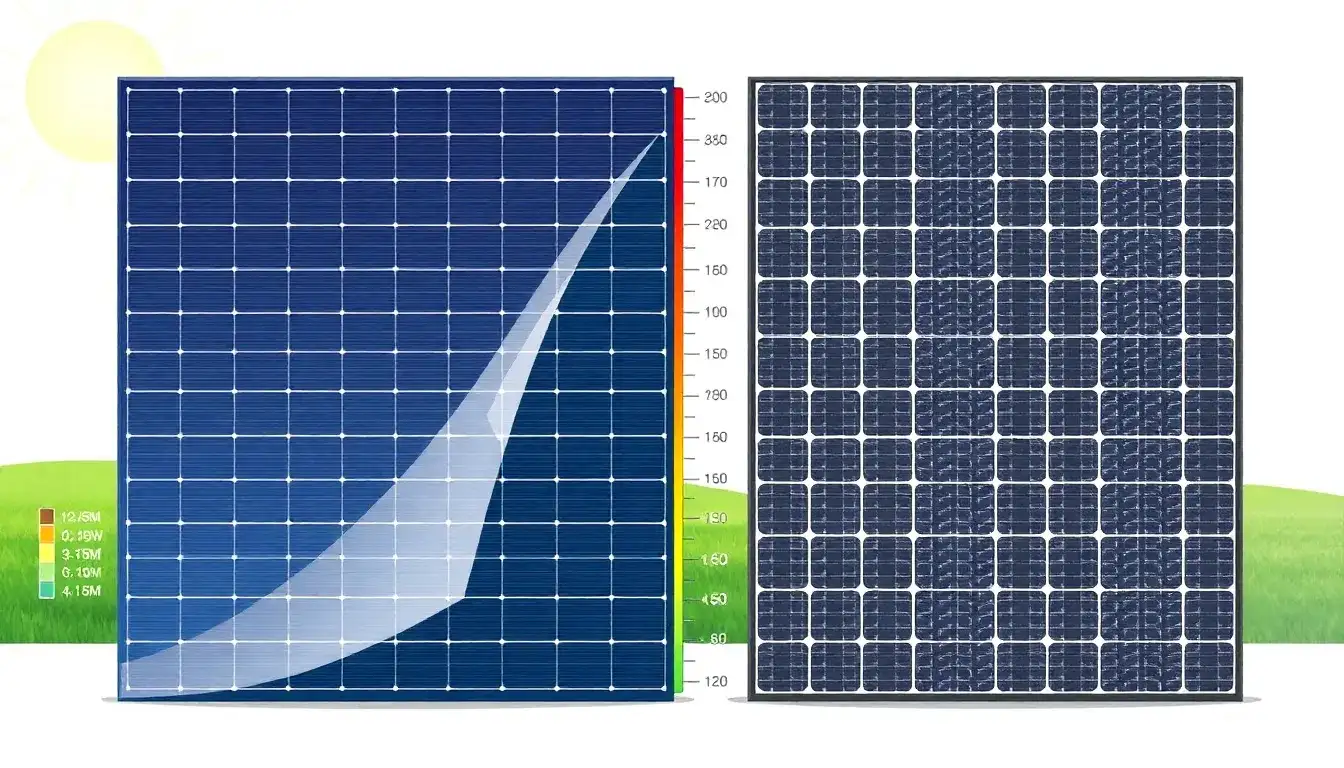
Thin-film solar panels have a notably better temperature coefficient compared to traditional monocrystalline and polycrystalline solar panels. The temperature coefficient measures how much a solar panel’s efficiency decreases with every 1°C rise above the standard test temperature of 25°C. This is important because solar panels get hotter under sunlight, and higher temperatures typically reduce their power output.
Comparison of Temperature Coefficients:
- Thin-film solar panels generally have a temperature coefficient around -0.2% per °C. This means their efficiency drops by about 0.2% for every 1°C increase in temperature above 25°C.
- Traditional monocrystalline and polycrystalline panels typically have temperature coefficients ranging from -0.3% to -0.5% per °C. For example, many popular brands fall between -0.29% and -0.45% per °C. This indicates a greater efficiency loss in hotter conditions compared to thin film panels.
Implications:
- Because thin-film panels lose less efficiency at higher temperatures, they perform better than traditional panels in hot environments where panel temperatures can reach 60°C or higher.
- The thinner construction of thin-film cells allows for faster heat dissipation, which helps maintain performance in high-temperature conditions.
- However, thin-film panels generally have lower overall efficiency (typically 10-13%) than crystalline silicon panels (monocrystalline can have efficiencies from 17% to 22%), so they require more surface area to produce the same power.
Summary Table:
| Panel Type | Typical Temperature Coefficient (% per °C) | Efficiency Range (%) | Notes |
|---|---|---|---|
| Thin-film (CdTe, CIGS) | Around -0.2% | 10–13% commercially available | Best high-temp performance, lower efficiency |
| Monocrystalline silicon | -0.29% to -0.38% | 17–22% | Higher efficiency, more loss at high temp |
| Polycrystalline silicon | -0.37% to -0.5% | 15–17% | Moderate efficiency, higher temp sensitivity |
In conclusion, thin-film solar panels exhibit a significantly lower temperature coefficient compared to traditional monocrystalline and polycrystalline panels, making them more efficient in hotter conditions though at the trade-off of lower overall efficiency and power density.
Original article by NenPower, If reposted, please credit the source: https://nenpower.com/blog/how-do-thin-film-solar-panels-compare-to-traditional-ones-in-terms-of-temperature-coefficient/

