

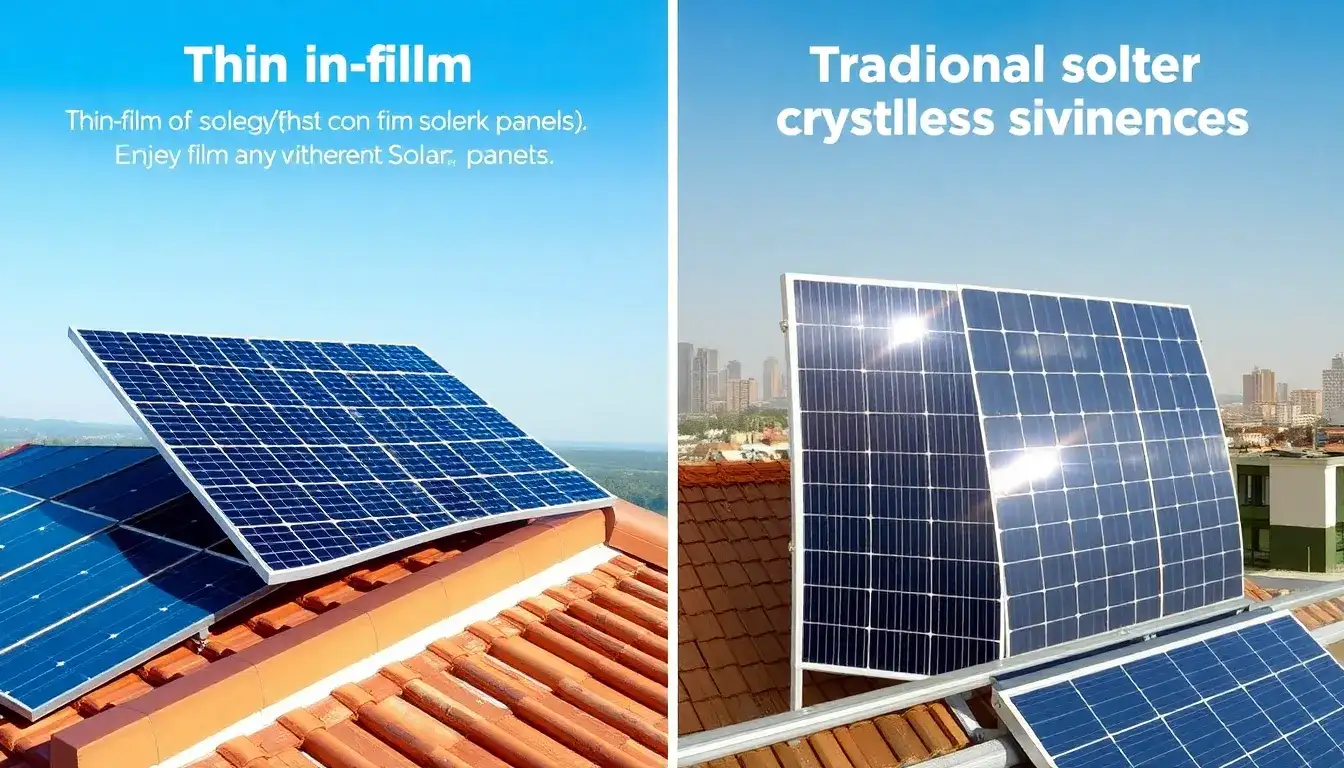
Thin-film solar panels differ significantly from traditional crystalline silicon (c-Si) panels in terms of efficiency, as well as other characteristics:
Efficiency Comparison
- Thin-film solar panels generally have lower efficiency ratings compared to traditional crystalline silicon panels. Their efficiency typically ranges between 7% and 18%, depending on the specific thin-film technology used:
- Amorphous silicon (a-Si) panels: about 6% to 8% efficiency.
- Cadmium telluride (CdTe) panels: typically 9% to 11%, with some laboratory records up to nearly 19%.
- Copper indium gallium selenide (CIGS) panels: can reach efficiencies up to 18-23% in some cases.
- Gallium arsenide (GaAs) panels: have achieved efficiencies near 30%, but are prohibitively expensive and primarily used in space applications.
- Traditional crystalline silicon panels (monocrystalline or polycrystalline) typically have efficiencies in the range of about 15% to 22%:
- Monocrystalline panels often achieve higher efficiencies around 15-20%.
- Polycrystalline panels are slightly less efficient, about 13-15% on average.
Thus, most thin-film technologies are less efficient than the mainstream crystalline silicon panels, except GaAs which is not commercially widespread due to cost.
Other Relevant Differences Influencing Efficiency
- Temperature performance: Thin-film panels tend to have a better temperature coefficient, meaning they lose less efficiency at higher temperatures compared to crystalline silicon panels. This characteristic makes thin-film panels advantageous in hot climates.
- Material and construction: Thin-film panels are made by depositing very thin layers of photovoltaic materials onto substrates, often flexible, which can reduce material cost but typically sacrifices efficiency. Crystalline silicon panels use thicker, rigid wafers with well-established high-efficiency technology.
- Space requirement: Because of their lower efficiency, thin-film panels require more surface area to produce the same amount of power as crystalline silicon panels, which can be a disadvantage in space-limited installations.
Summary Table
| Feature | Thin-Film Solar Panels | Crystalline Silicon Panels |
|---|---|---|
| Efficiency Range | 7% to 18% (typical), up to ~30% (GaAs lab cells) | ~15% to 22% (commercial) |
| Best Commercial Efficiency | CIGS ~18-23%, CdTe ~11-19% | Monocrystalline: 15-20%, Polycrystalline: 13-15% |
| Temperature Coefficient | Better (less efficiency loss in heat) | worse (more efficiency loss at high temps) |
| Flexibility | Thin, lightweight, flexible | Rigid, bulky |
| Installation Space Needed | More (due to lower efficiency) | Less (higher efficiency) |
| Typical Applications | Specialized, commercial, portable, building-integrated photovoltaics | Residential, commercial, industrial |
Conclusion
Thin-film solar panels are less efficient than traditional crystalline silicon panels in most commercial applications, typically converting between 7% to 18% of sunlight versus 15% to 22% for c-Si panels. However, thin-film technology offers advantages in flexibility, lighter weight, better performance at high temperatures, and potentially lower production costs. High-efficiency thin-film types like GaAs exist but are costly and not widely used outside aerospace. Traditional crystalline silicon panels remain the dominant, most efficient and cost-effective choice for residential and commercial solar power.
Original article by NenPower, If reposted, please credit the source: https://nenpower.com/blog/how-do-thin-film-solar-panels-compare-to-traditional-crystalline-silicon-panels-in-terms-of-efficiency/

