

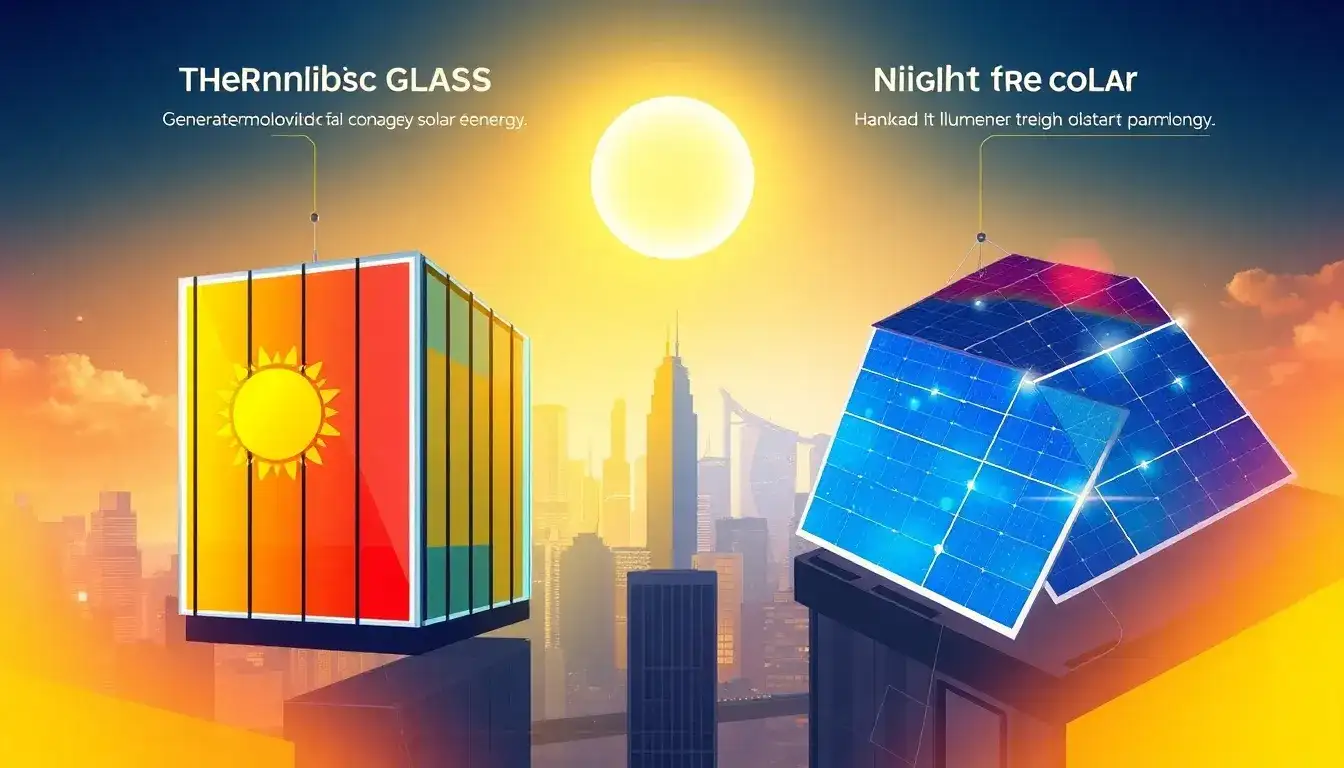
Thermochromic Photovoltaic Glass and Night Solar Technologies
Both thermochromic photovoltaic glass and night solar technologies represent innovative approaches in the field of renewable energy, focusing on enhancing the efficiency and versatility of solar energy systems.
Thermochromic Photovoltaic Glass
While the specific details of thermochromic photovoltaic glass are not provided, thermochromic materials generally change color in response to temperature changes. In the context of photovoltaic (PV) systems, such materials could potentially be used to manage heat, maintain optimal temperatures, or even provide visual indicators of system health. However, the exact mechanism or applications of thermochromic photovoltaic glass in enhancing solar panel performance are not discussed.
Night Solar Technologies
Night solar technologies, often referred to as “night solar panels” or “anti-solar cells,” have been developed to generate electricity during nighttime. These panels work by leveraging the principle of radiative cooling, where heat from the Earth is radiated into space on clear nights, creating a temperature difference that can be converted into electricity. Here’s a breakdown of how they work:
- Radiative Cooling: This process involves the Earth’s surface radiating infrared energy into space, particularly on clear nights. As objects on Earth lose heat, they can become cooler than the ambient air.
- Thermoelectric Generators (TEGs): These devices are used to convert the temperature difference created by radiative cooling into electricity. By attaching TEGs to modified solar panels, researchers can harness the energy dissipated during the cooling process.
- Nighttime Power Generation: Although the power output is significantly lower than conventional solar panels (around 50 milliwatts per square meter), it can still support low-power applications like powering small devices or lighting in off-grid areas.
- Applications: These panels are promising for regions with inconsistent sunlight or off-grid communities, offering a reliable nighttime power source without the need for battery storage.
Future Potential
- Hybrid Systems: Combining conventional solar panels with night solar technologies could enable 24-hour energy generation, enhancing the reliability of solar energy systems.
- Improvement and Development: While current prototypes have limitations, ongoing research aims to improve efficiency and make these technologies more viable for widespread use.
- Sustainability: Night solar panels can contribute to reducing dependency on batteries and fossil fuels in remote or underserved regions, potentially lowering greenhouse gas emissions.
Original article by NenPower, If reposted, please credit the source: https://nenpower.com/blog/how-do-thermochromic-photovoltaic-glass-and-night-solar-technologies-work/

